What Is Meta Muse AI? Features, Shopping, WhatsApp & Safety Explained
What Is Meta Muse AI? Complete 2026 Guide
Meta Muse AI is one of the newest AI agents attracting attention in 2026.
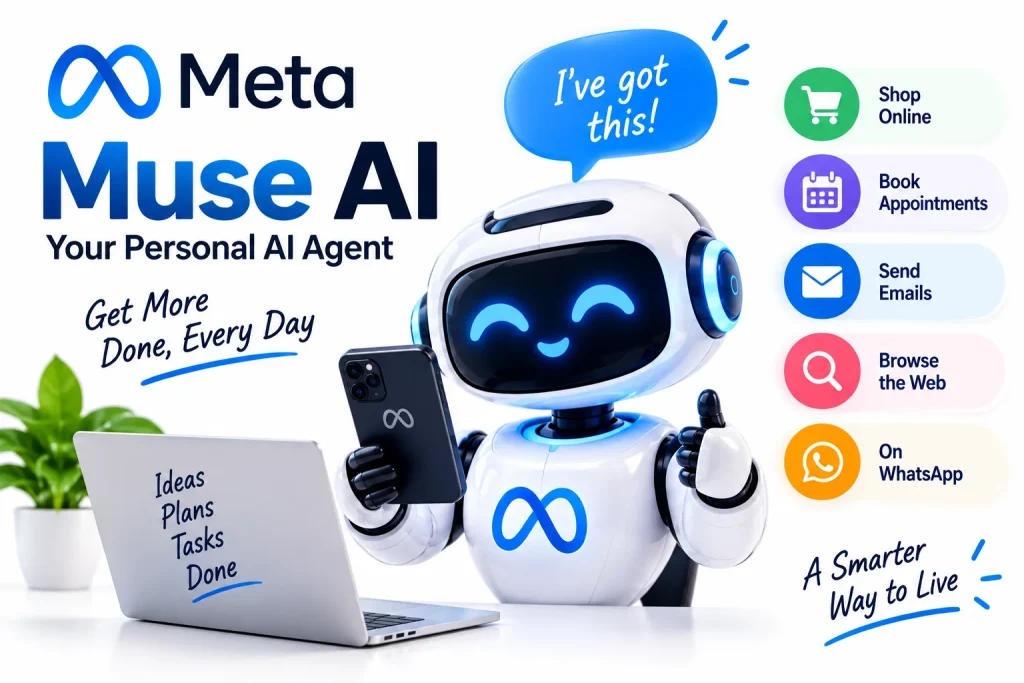
Launched by Meta on September 8, 2026, Muse is designed to do more than answer questions. Meta describes it as a personal AI agent that can perform tasks on a user’s behalf, including browsing the web, filling out forms, sending emails, booking travel, making purchases and working with connected applications.
That distinction is important.
Traditional AI assistants usually wait for a question and provide an answer.
Muse is designed to take a goal and complete multiple steps toward achieving it.
For example, rather than simply asking an AI:
“Which hotel should I book?”
a personal AI agent could potentially research hotels, compare options, navigate booking websites and help complete a reservation after receiving the required approval.
Muse can also communicate through WhatsApp, work through its own browser and continue longer tasks after a user closes the app.
But the rapid arrival of AI agents also raises questions about privacy, payments, website access and how much control people should give autonomous software.
Here is what Meta Muse AI does, how it works and what you should know before using it.
What Is Meta Muse AI?
Muse is a personal AI agent developed by Meta.
Meta introduced Muse publicly on September 8, 2026, describing it as an AI system that can move beyond conversations and actually perform work for users.
Muse is powered by Meta’s Muse Spark technology and runs inside what Meta calls a Muse Secure VM.
A VM, or virtual machine, functions like a separate computer running in the cloud.
Muse receives its own browser and computing environment so it can interact with websites and connected services on behalf of the user.
According to Meta, users can communicate with Muse through the dedicated Muse application or directly through WhatsApp.
The concept is part of a much broader move toward agentic AI—AI systems that can take actions rather than only generate answers.
INTERNAL LINK: Link the phrase “AI agents for small business” here to your existing AI Agents for Small Business guide.
What Can Meta Muse Do?
Muse’s capabilities extend well beyond basic question answering.
According to Meta’s official Muse product information, the agent can perform tasks including:
- Answering questions
- Browsing the web
- Completing online tasks
- Filling out forms
- Booking appointments
- Booking travel
- Sending emails
- Making purchases
- Generating images
- Creating documents
- Setting reminders
- Tracking goals
- Monitoring things a user cares about
- Working with connected applications and services
Meta also says Muse can continue working on longer tasks after the user closes the app.
That makes Muse considerably different from an AI system designed only for chat.
How Does Meta Muse AI Work?
Muse combines several technologies.
1. You Give Muse a Goal
You begin by describing what you want done.
For example:
“Find me a hotel in San Diego for next weekend.”
Or:
“Help me find a cheaper internet plan.”
Or:
“Organize a dinner party for eight people.”
Muse can then break that objective into smaller tasks.
2. Muse Uses Its Own Browser
One of Muse’s most important features is its browser.
Meta says Muse runs inside a persistent virtual machine equipped with its own browser, allowing it to navigate websites and complete web-based tasks.
This is fundamentally different from an AI model merely describing what you should do.
The agent can potentially perform the steps itself.
3. Muse Can Connect to Other Apps
Meta says users can connect services such as:
- Calendar
- Other supported applications
Users determine what level of access Muse receives.
For example, someone might allow Muse to read calendar availability but not modify certain other information.
4. Muse Works Through the Task
The agent may browse websites, gather information, compare options and complete routine steps.
For longer tasks, Meta says Muse can continue working after the app has been closed.
5. Muse Requests Approval for Sensitive Actions
Meta says Muse requires user approval before sensitive actions such as sending an email or completing a purchase.
That means the intended model is not unlimited autonomous control.
Users are supposed to remain involved when consequential actions occur.
Is Meta Muse the Same as Meta AI?
No.
Meta AI is Meta’s broader AI assistant experience across its applications and services.
Muse is specifically positioned as a personal AI agent designed to complete tasks and pursue goals.
The distinction can be simplified like this:
Meta AI
Primarily helps you:
- Ask questions
- Generate content
- Analyze information
- Create images
- Search and discover information
Muse
Designed to additionally:
- Browse websites
- Perform multi-step tasks
- Use connected applications
- Fill forms
- Book things
- Make purchases
- Continue working on longer tasks
- Take approved actions
Both are part of Meta’s larger artificial-intelligence ecosystem.
Muse Spark technology also plays an important role in Meta’s current generation of AI products.
Can You Use Meta Muse in WhatsApp?
Yes.
Meta says Muse is designed to work both through its own application and directly inside WhatsApp.
This could significantly reduce the learning curve.
Instead of opening specialized AI software, users can interact with their personal agent in an interface that works similarly to sending normal messages.
You might write something such as:
“Find three dinner options near me for Friday night.”
Or:
“Help me plan next week’s schedule.”
The important difference is that Muse may be able to move beyond simply giving suggestions and perform permitted actions as part of the task.
Is the Meta Muse App Available Now?
Meta announced the U.S. rollout of Muse on September 8, 2026.
According to Meta, Muse is rolling out in the United States on:
- iOS
- Android
- The web
Meta has also said Muse is coming to AI glasses.
Availability may change quickly as Meta expands the product, so users should verify current support through Meta’s official Muse information.
Is Meta Muse AI Free?
Meta says Muse is free for most common usage, while subscription plans are available for people who want to do more.
Because AI-agent plans, usage allowances and subscription features can change, users should check Meta’s current pricing before choosing a paid option.
Can Meta Muse Shop Online for You?
Yes.
Shopping is one of Muse’s most important capabilities.
Meta says Muse can browse websites, compare products and help users complete purchases.
Its official product information lists making purchases among Muse’s supported capabilities.
Meta’s launch announcement also described payment support involving Link by Stripe, including one-time-use card functionality designed to avoid exposing a user’s actual card details during eligible agent transactions.
Shop Pay support has also been expanding as AI-assisted commerce develops.
This emerging category is often called agentic commerce.
Instead of:
User → search engine → retailer → checkout
the process can become:
User → AI agent → product research → retailer → purchase approval
That shift could significantly affect how consumers discover and buy products online.
Can Muse Buy Products From Amazon?
Currently, there is an important limitation.
Amazon has blocked Meta’s Muse agent from shopping on Amazon.com.
Amazon said Meta had not received authorization for Muse to access the marketplace as an AI shopping agent and raised concerns about transparency, customer experience and data access.
As a result, someone using Muse may be able to research products elsewhere but cannot currently rely on Muse to complete shopping tasks through Amazon.
This situation may change as AI agents and retailers develop new agreements and technical standards.
Why Did Amazon Block Meta Muse?
The disagreement highlights a larger issue facing AI shopping agents.
When an AI agent browses a retailer’s website, several questions arise:
- Who controls the customer experience?
- Who owns the shopping data?
- Who is responsible if the agent makes a mistake?
- Should retailers be able to block autonomous agents?
- How should agents identify themselves?
- Who handles refunds or incorrect purchases?
Amazon said Muse had not been authorized to shop on its marketplace and argued that third-party shopping agents should operate transparently and respect whether a service provider chooses to participate.
This conflict extends beyond Muse.
As AI agents become more capable, websites may increasingly have to decide whether they want human customers, AI agents—or both—interacting with their services.
What Is Agentic Shopping?
Agentic shopping uses an AI agent to perform some or most of the shopping process for a user.
For example, instead of manually visiting ten websites to find running shoes, someone could tell an agent:
“Find me waterproof trail-running shoes under $150 with good grip and delivery before Friday.”
The agent could potentially:
- Search multiple stores.
- Compare products.
- Check prices.
- Review specifications.
- Check delivery estimates.
- Present suitable choices.
- Complete checkout after approval.
Muse is one example of this rapidly developing model.
The emergence of agentic shopping also creates new opportunities for businesses that want their products to be discoverable by AI systems.
Can Businesses Sell Products Through Muse?
This area is evolving quickly.
Muse’s shopping capabilities mean businesses may increasingly need to think about a new kind of customer:
AI agents acting on behalf of humans.
Historically, online stores optimized their websites for:
- Human visitors
- Google Search
- Social media
- Shopping platforms
Increasingly, businesses may also need to ensure their information can be correctly understood by AI agents.
Clear product information becomes especially important.
Useful information includes:
- Accurate product names
- Pricing
- Inventory
- Shipping information
- Product specifications
- Return policies
- Structured product data
Businesses should not change their entire strategy based on one new AI product, but agentic commerce is a trend worth monitoring.
Meta Muse for Small Business
Although Muse is positioned primarily as a personal AI agent, many of the technologies behind it illustrate where business AI is heading.
Small-business owners could use increasingly capable agents for tasks such as:
- Research
- Travel planning
- Scheduling
- Vendor research
- Product sourcing
- Document preparation
- Routine administrative work
- Monitoring information
- Online purchasing
However, businesses should be cautious about allowing agents to independently perform high-impact actions involving customer data, payments or contractual decisions.
For a broader business-focused explanation, INTERNAL LINK: link “AI agents for small business” to your existing pillar article.
Can Muse Handle Customer Service?
Meta’s official Muse product page says its browser can complete tasks that include customer-service interactions.
For example, a user might ask the agent to contact a company regarding:
- A delayed order
- Subscription cancellation
- A billing question
- A return
- An appointment
The agent may be able to navigate the relevant website and work through the process.
This is the opposite side of customer-service automation.
Businesses are increasingly deploying AI agents to answer customers, while customers themselves can increasingly deploy AI agents to interact with businesses.
INTERNAL LINK: Link “AI customer service agents for small business” here to your existing customer-service AI guide.
Could Muse Make Phone Calls?
Muse’s current capabilities should not be confused with every possible type of AI agent.
Businesses specifically interested in automated incoming telephone calls should look at AI receptionists and voice agents rather than assuming a general personal agent provides the same workflow.
INTERNAL LINK: Link “AI receptionist for small business” here to your existing AI receptionist article.
What Is Muse Secure VM?
One of Meta’s most heavily emphasized Muse features is the Muse Secure VM.
A virtual machine is essentially an isolated software-based computer.
Meta says each Muse operates inside a dedicated cloud VM containing the agent and information required for its tasks.
This environment gives Muse its own browser.
According to Meta, connected credentials are stored separately so Muse can use them without directly seeing passwords or payment information.
Meta also says another system called Sentinel operates separately from Muse and reviews actions before they reach the internet.
These are Meta’s descriptions of its security architecture; users should still evaluate what information and access they are comfortable giving any AI agent.