AI Agents for Small Business: 15 Practical Uses in 2026
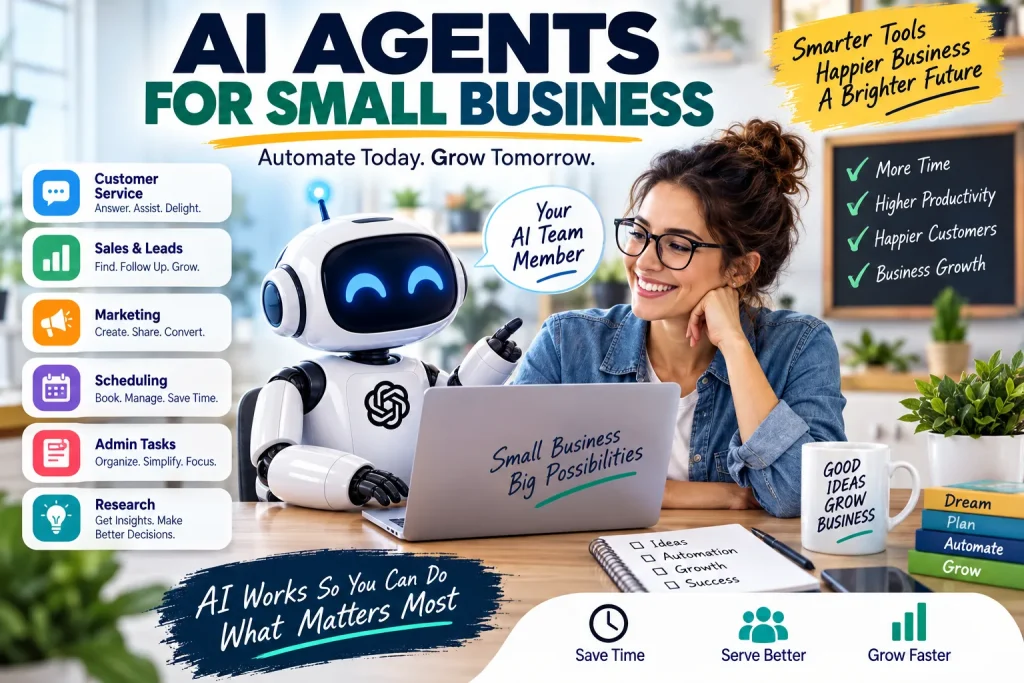
AI Agents for Small Business: 15 Uses in 2026
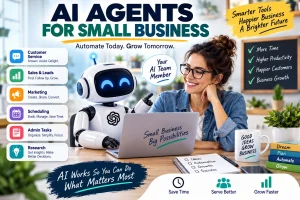
AI agents for small business are becoming one of the most important artificial intelligence trends of 2026.
Unlike traditional AI tools that simply respond to a prompt, AI agents can often complete multi-step tasks, interact with connected tools, retrieve information, follow workflows and take permitted actions on behalf of a user.
That makes them especially interesting for small businesses.
A business owner might use an AI assistant to write an email. An AI agent, by contrast, could potentially gather information about a customer, prepare the email, update a customer record and schedule a follow-up as part of the same workflow.
The shift is already visible.
Google Cloud describes 2026 as a move beyond basic AI assistants toward agents capable of orchestrating more complex business processes. Its 2026 AI Agent Trends report is based on insights from more than 3,400 global executives and Google AI experts.
Small businesses are also increasingly experimenting with AI. OpenAI reported in May 2026 that at least four million people in the United States used ChatGPT during March 2026 to help plan, start, run or grow a business.
So what exactly can AI agents do for a small business?
Here are 15 practical applications, along with the benefits, risks and steps businesses should understand before automating important work.
What Are AI Agents for Small Business?
An AI agent is an AI-powered system designed to pursue a goal by performing one or more tasks, often with access to tools, information or software needed to complete the job.
For a small business, that could mean an AI agent that:
- Responds to customer questions
- Qualifies sales leads
- Schedules appointments
- Researches potential customers
- Prepares reports
- Updates business records
- Drafts follow-up messages
- Monitors routine workflows
- Routes customer requests
- Organizes internal information
The key difference is that an agent is generally designed to do more than generate an answer.
Google Cloud characterizes the current shift as moving from one-off prompts toward systems capable of coordinating end-to-end workflows.
AI Agent vs. AI Assistant: What Is the Difference?
The terms are sometimes used interchangeably, but they describe different levels of automation.
An AI assistant typically waits for a person to ask a question or provide an instruction.
For example:
You: Write a follow-up email for this customer.
AI assistant: Produces the email.
An AI agent may be designed to handle several connected steps.
For example:
Goal: Follow up with qualified leads.
An agent could potentially:
- Review new leads.
- Identify leads matching specified criteria.
- Retrieve relevant information.
- Draft personalized messages.
- send or queue approved messages.
- Update the CRM.
- Schedule a future follow-up.
Exactly what an agent can do depends on the system, permissions, integrations and safeguards configured by the business.
Why AI Agents Matter for Small Businesses in 2026
Small companies often have fewer employees responsible for a wider range of tasks.
A business owner may simultaneously handle marketing, customer service, sales, scheduling, administration and operations.
That makes automation particularly relevant.
The U.S. Small Business Administration’s February 2026 small-business FAQ reported that 7.6% of businesses used AI between September 2024 and August 2025. Among businesses with fewer than five employees, the figure was 8.2%.
The SBA and its resource partners are continuing to offer programs in 2026 focused on practical AI applications for entrepreneurs, including automation, business operations and productivity.
AI agents potentially push that trend further by shifting AI from something a business consults occasionally into something integrated with everyday workflows.
15 Ways Small Businesses Can Use AI Agents
1. AI Customer Service Agents
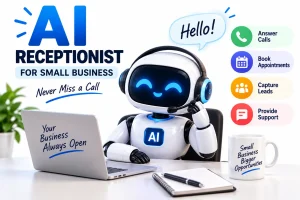
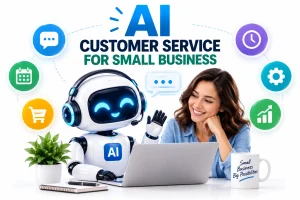
Customer service is one of the clearest uses for small business AI agents.
An AI customer service agent may be able to handle common questions about:
- Business hours
- Shipping
- Returns
- Products
- Services
- Pricing
- Appointment availability
- Order status
- Basic troubleshooting
More advanced systems can route complicated conversations to a human employee.
Meta, for example, expanded its business AI agent on WhatsApp globally in 2026. According to Meta’s announcement reported by TechCrunch, the system can answer questions, recommend products, book appointments, qualify leads and transfer queries to people when necessary.
For small businesses, the goal does not have to be eliminating human customer service.
A more practical use is letting automation handle repetitive questions while employees manage unusual or sensitive issues.
2. AI Lead Qualification
Not every inquiry is equally likely to become a customer.
An AI sales agent can help organize incoming leads based on information such as:
- Requested service
- Location
- Budget
- Company size
- Timeline
- Product interest
- Previous interactions
The agent might then direct high-priority inquiries to a salesperson while placing other prospects into an appropriate follow-up workflow.
Human-defined qualification rules are important because an AI system should not independently decide important customer outcomes without appropriate oversight.
3. Automated Sales Follow-Ups
Following up consistently is difficult when a small team is busy.
An AI agent can help track when a prospect last interacted with the business and prepare or trigger the next appropriate step.
A workflow could look like this:
New inquiry → qualification → personalized response → reminder → follow-up → CRM update
This type of connected workflow is one reason agentic AI differs from simply asking a chatbot to write sales copy.
4. Appointment Scheduling
Service businesses can use AI-powered systems to help manage appointments.
An agent connected to an approved scheduling system could potentially:
- Find available times
- Suggest appointments
- Confirm bookings
- Send reminders
- Reschedule appointments
- Answer basic appointment questions
Businesses such as salons, consultants, repair companies, fitness professionals and home-service providers may benefit from reducing repetitive scheduling conversations.
Human review should remain available for unusual scheduling situations.
5. Email Management
Email can consume a significant portion of a business owner’s day.
An AI agent can help with tasks such as:
- Categorizing messages
- Summarizing long threads
- Identifying messages requiring attention
- Drafting responses
- Extracting action items
- Preparing follow-up reminders
The safest approach is generally to distinguish between low-risk automation and messages requiring human approval.
For example, automatically summarizing an email is much lower risk than independently agreeing to a contract or changing a customer’s account.
6. AI Marketing Agents
Marketing involves dozens of repetitive tasks that can potentially be assisted by AI.
An AI marketing workflow might help:
- Generate campaign ideas
- Research topics
- Draft social posts
- Repurpose articles
- Prepare newsletters
- Analyze campaign performance
- Organize content calendars
- Identify potential content gaps
Businesses should still review AI-generated marketing material for accuracy, originality, brand consistency and compliance before publication.
7. Content Repurposing
A single piece of content can often become multiple marketing assets.
For example, an AI workflow could transform a long-form article into:
- Social media posts
- Newsletter summaries
- Short video scripts
- FAQ content
- Product snippets
- Internal sales notes
- Promotional captions
This can reduce repetitive content-production work without requiring the business to create every asset from scratch.
Human editing remains important, particularly for factual claims and brand-sensitive content.
8. AI Research Agents
Research is another useful application of AI agents.
Businesses may use AI-assisted research to examine:
- Competitors
- Industries
- Market developments
- Customer questions
- Product categories
- Suppliers
- Regulations
- Public company information
An agent can potentially collect information from multiple permitted sources and organize it into a report.
However, AI-generated research can contain errors. Important facts should be checked against authoritative primary sources before business decisions are made.
9. Internal Knowledge Agents
As businesses grow, employees repeatedly ask the same internal questions:
Where is this form?
What is the refund procedure?
How do we onboard a new customer?
Which template should I use?
An internal AI knowledge agent connected to approved company documentation can help employees retrieve information more quickly.
This is particularly useful when the system uses the company’s own verified sources rather than relying solely on general model knowledge.
10. AI Agents for Administrative Work
Administrative tasks are often ideal candidates for carefully supervised automation.
Examples include:
- Organizing notes
- Preparing meeting summaries
- Converting conversations into task lists
- Formatting documents
- Updating records
- Creating routine reports
- Sorting incoming requests
Google Cloud’s August 2026 guidance for lean teams emphasizes moving AI beyond isolated experiments and into repeatable workflows tied to actual business processes.
The key is to start with repetitive, well-defined work rather than immediately automating high-risk decisions.
11. AI Agents for E-Commerce
Online stores can potentially use agents throughout the customer journey.
Examples include:
- Product discovery
- Product recommendations
- Customer questions
- Order assistance
- Inventory notifications
- Post-purchase communication
- Customer feedback organization
AI commerce agents are developing rapidly, although businesses should verify exactly what information and actions third-party systems are permitted to access.
12. AI Social Media Management
An AI agent can help monitor and prepare social media workflows.
Potential tasks include:
- Drafting posts
- Generating content variations
- Categorizing comments
- Identifying frequently asked questions
- Summarizing engagement
- Suggesting responses
- Building content calendars
Businesses should be cautious about fully autonomous public posting.
A poorly generated post can become public immediately, so approval workflows are valuable for brand-sensitive communications.
13. AI Agents for Recruiting Support
AI can also help with administrative portions of recruiting, such as:
- Drafting job descriptions
- Scheduling interviews
- Summarizing candidate-provided information
- Preparing interview questions
- Organizing recruiting communications
Employment decisions require additional care.
Businesses should not assume an AI model is unbiased or appropriate for automatically making consequential hiring decisions. Employment laws and requirements may also apply depending on the jurisdiction and use case.
14. AI Reporting and Business Intelligence
A business may have valuable data spread across several systems.
An AI agent connected to approved data sources could help answer questions such as:
- Which products sold best this month?
- Which customer questions appear most frequently?
- What changed compared with last month?
- Which marketing campaigns produced the most inquiries?
- Which invoices remain outstanding?
Instead of manually building every report, a business could potentially ask questions in natural language.
Numbers should still be validated against the underlying records before financial or operational decisions are made.
15. Multi-Step Workflow Automation
The biggest opportunity may eventually come from combining several tasks.
Imagine a local service business receiving a new website inquiry.
An approved AI workflow could potentially:
Step 1: Read the inquiry.
Step 2: Identify the requested service.
Step 3: Collect relevant business information.
Step 4: Prepare an appropriate response.
Step 5: Suggest available appointment times.
Step 6: Update the customer record.
Step 7: Create a reminder if the prospect does not respond.
This is the broader concept behind agentic AI: instead of helping with only one isolated task, the system coordinates several steps toward a defined objective.
Benefits of AI Agents for Small Business
AI agents can offer several potential advantages when implemented appropriately.
Save Time
Automating repetitive administrative work can give owners and employees more time for work requiring judgment, expertise or customer interaction.
Improve Response Speed
An automated system may be able to answer routine inquiries outside normal business hours.
Create More Consistent Processes
A defined workflow can help ensure that routine steps are not accidentally forgotten.
Scale Repetitive Work
Software can process routine tasks at a volume that would otherwise require significant manual effort.
Connect Existing Tools
The most useful AI agent may not be a completely separate product.
Instead, it may act as a layer connecting tools a business already uses, such as email, calendars, customer records and internal documents.
Risks of AI Agents Small Businesses Should Understand
AI agents can be useful, but giving software the ability to take actions creates additional risks.
Incorrect Information
AI systems can produce inaccurate information.
The risk becomes more significant when the output automatically triggers another action.
Excessive Permissions
An agent should not automatically receive access to every business system.
Access should be limited to what is necessary for its assigned workflow.
Customer Data and Privacy
Businesses should understand what information is sent to an AI provider, how it is stored and what permissions connected systems receive.
Security
Agent systems increasingly depend on external tools, integrations and add-ons.
Security researchers and companies are developing new safeguards specifically because agents can interact with a growing number of external systems.
Automation Errors at Scale
A human employee might make one mistake.
An automated workflow can potentially repeat the same mistake many times before someone notices.
This is why monitoring and human approval are especially important for consequential actions.
How to Start Using AI Agents in a Small Business
Small businesses do not need to automate everything at once.
A better approach is to begin with a single repetitive workflow.
Step 1: Find a Repetitive Task
Look for work that happens frequently and follows predictable steps.
Examples include:
- Answering common inquiries
- Scheduling appointments
- Summarizing meetings
- Organizing leads
- Preparing follow-ups
Step 2: Map the Current Process
Write down exactly what a person currently does.
For example:
Inquiry received → check service → check location → send response → create lead → schedule follow-up
If the process cannot be clearly explained, it may be difficult to automate safely.
Step 3: Decide What AI Can Do
Separate tasks into three categories:
AI can do automatically
Low-risk, repetitive actions.
AI can prepare for approval
Tasks where a person should check the result before anything happens.
Human only
High-impact decisions requiring judgment, accountability or specialist expertise.
Step 4: Limit Access
Give an AI agent only the permissions required for its job.
A scheduling agent, for example, may need calendar access but not access to unrelated financial documents.
Step 5: Test With Low-Risk Tasks
Start with a controlled use case.
Monitor the results before expanding access or autonomy.
Step 6: Measure the Outcome
Track whether the agent actually improves the business.
Useful measurements could include:
- Time saved
- Response times
- Error rates
- Leads processed
- Appointments booked
- Customer satisfaction
- Human corrections required
AI automation is valuable only when it produces a measurable improvement.
AI Agents vs. Traditional Automation
Traditional automation usually follows predetermined rules:
If X happens, do Y.
AI agents can potentially handle situations with more variation by interpreting information and selecting among permitted actions.
That flexibility is useful, but it also makes monitoring more important.
Traditional automation may be preferable when the workflow is completely predictable.
Agentic AI may make more sense when a task requires interpreting text, gathering context or choosing between several possible next steps.
In many businesses, the strongest solution may combine both approaches.
Will AI Agents Replace Small Business Employees?
AI agents are increasingly being used for work that was previously performed manually, but that does not mean every role can or should be replaced.
A September 2026 TechCrunch discussion about AI-native startups highlighted agents taking on functions involving engineering, research, customer support and operations while also raising questions about who verifies the work and who remains responsible when an agent makes a mistake.
For many small businesses, a practical model is likely to involve humans working with AI systems.
AI handles repetitive or computational work.
People remain responsible for areas requiring judgment, accountability, relationships, creativity and complex decision-making.
How Much Do AI Agents Cost for a Small Business?
There is no universal price for an AI agent.
Costs depend on factors including:
- AI provider
- Number of users
- Model usage
- Integrations
- Automation volume
- Data storage
- Custom development
- API usage
- Security requirements
Some AI functionality is included inside existing software subscriptions, while advanced custom agents may require separate development and infrastructure.
Businesses should calculate the total cost against the time or revenue impact of the workflow being automated rather than choosing a system simply because it is labeled “AI.”
Are AI Agents Safe for Small Businesses?
They can be used safely when appropriate safeguards are in place, but no AI agent should automatically be assumed to be accurate or secure.
Useful controls include:
- Limited permissions
- Human approval for sensitive actions
- Activity logs
- Access controls
- Verified data sources
- Regular testing
- Error monitoring
- Clear escalation paths
The greater the potential consequence of an action, the stronger the oversight should generally be.
Frequently Asked Questions About AI Agents for Small Business
What is an AI agent for small business?
An AI agent for small business is an AI-powered system designed to perform one or more business tasks toward a defined goal. Depending on its permissions, it may retrieve information, use connected software, complete workflow steps and take approved actions.
What can an AI agent do for a small business?
AI agents can potentially assist with customer service, lead qualification, sales follow-ups, scheduling, research, marketing, email management, reporting, internal knowledge retrieval and administrative workflows.
What is the difference between an AI agent and ChatGPT?
ChatGPT can perform assistant and agent-like tasks depending on the product, tools and permissions being used. More generally, an AI chatbot primarily responds to user requests, while an agentic system may be configured to complete multiple steps and interact with external tools toward a goal.
Are AI agents good for small businesses?
They can be useful for repetitive and well-defined workflows, particularly where automation saves meaningful time. Their value depends on accuracy, cost, integrations, security and how effectively the workflow is supervised.
Can an AI agent answer customer questions?
Yes. Customer support is already a significant AI-agent use case. Some systems can answer common questions, recommend products, assist with bookings and transfer conversations to human employees.
Can AI agents book appointments?
An agent connected to an appropriate scheduling system may be able to check availability, suggest times and create appointments within the permissions it has been given.
Can AI agents send emails?
Some AI agents can draft or send emails when connected to authorized email systems. Businesses should consider requiring human approval for important, sensitive or contractual communications.
Can AI agents make sales calls?
AI systems can support sales workflows, but capabilities, legal requirements and disclosure obligations vary by communication method and jurisdiction. Businesses should verify applicable laws before deploying automated outreach.
Are AI agents the same as automation?
Not exactly. Traditional automation normally follows predefined rules. AI agents can potentially interpret changing information and determine which permitted action should happen next.
Do I need coding skills to use AI agents?
Not always. Many AI platforms increasingly provide no-code or low-code interfaces. More customized agents and integrations may still require technical expertise.
What is agentic AI?
Agentic AI generally refers to AI systems designed to work toward goals by planning or coordinating actions rather than simply producing one response to one prompt.
Are AI agents accurate?
Not all the time. AI systems can misunderstand information or generate incorrect outputs, which is why important results should be verified and consequential actions should have appropriate safeguards.
Should a small business use one AI agent or several?
It depends on the workflows involved. A business may begin with one narrow agent and expand only after the first workflow is reliable. Multiple specialized agents may eventually handle different functions, but greater complexity also creates additional management and security requirements.
The Future of AI Agents for Small Business
The direction of AI in 2026 is increasingly moving from generation to execution.
Early generative AI adoption centered heavily on asking a model to write, summarize or brainstorm.
Agentic systems extend that idea.
Instead of:
“Write a customer follow-up.”
The request becomes:
“Handle the follow-up process according to these rules.”
Google Cloud’s 2026 research describes this broader movement as a transition toward agents running interconnected workflows, while OpenAI has documented increasing use of AI by entrepreneurs and small-business operators.
That does not mean every small business needs autonomous AI.
For many businesses, the best starting point is much simpler:
Find one repetitive task.
Define the process.
Automate the safest portions.
Keep a person in control where the consequences matter.
Measure whether the automation actually works.
The Bottom Line
AI agents for small business are one of the most important practical AI trends to watch in 2026.
They move beyond the traditional chatbot model by potentially helping businesses complete multi-step workflows involving customer service, sales, scheduling, research, marketing, administration and internal operations.
Recent developments show that the shift is already underway. Google Cloud is emphasizing agentic workflows across business operations, while OpenAI reported that at least four million U.S. users used ChatGPT in March 2026 to help plan, start, run or grow businesses.
Small businesses do not need to automate every process to benefit.
The most practical strategy is to identify one repetitive, measurable workflow, introduce AI with limited permissions, maintain human oversight and expand only when the system consistently produces reliable results.
The businesses that benefit most from AI agents may not be those that automate the most.
They may be the ones that identify exactly which work should be automated—and which work still needs a person.