Best AI Models in 2026: GPT-6 Astra vs Gemini 4 Argon vs Claude Opus 5.5
Best AI Models in 2026: GPT-6 Astra vs Gemini 4 Argon vs Claude Opus 5.5
The frontier AI market in 2026 is no longer dominated by one model.
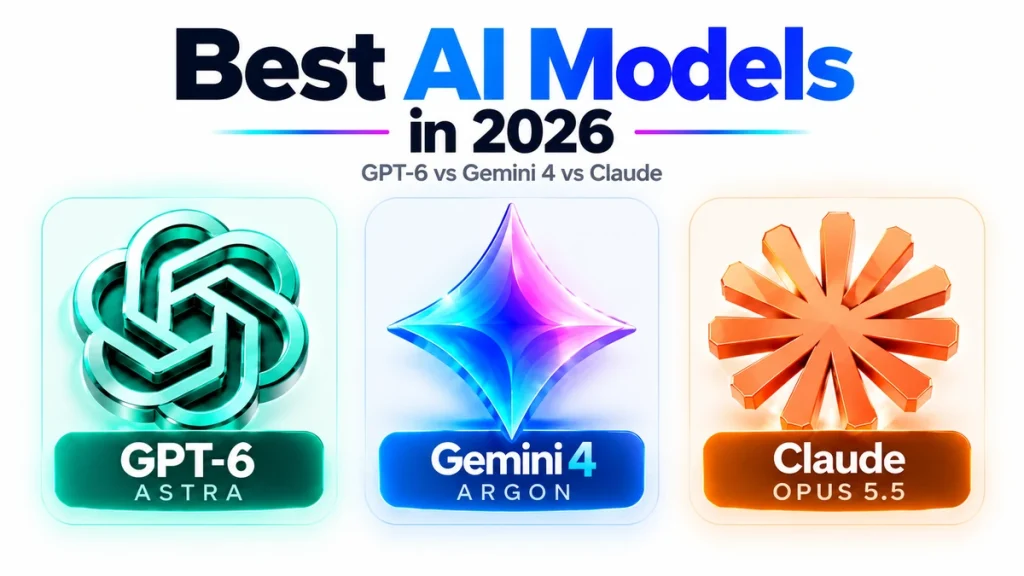
OpenAI, Google DeepMind and Anthropic now offer or have announced models aimed at different parts of demanding professional work:
- GPT-6 Astra for complex reasoning, coding, computer use, research and end-to-end professional work;
- Gemini 4 Argon for long-horizon coding, enterprise knowledge work, finance, legal research and cybersecurity defense; and
- Claude Opus 5.5 for long-running coding agents, professional knowledge work and large-context workflows.
There is no single AI model that is automatically best for every user.
The right choice depends on what matters most to you: coding quality, context window, output size, computer use, price, availability, agentic tools or enterprise deployment.
This page is the central Elite Era Trends guide to the leading AI models and AI-agent topics we cover. It is designed to help you choose a model, then jump to our deeper guides for pricing, benchmarks, usage limits, safety and specific use cases.
Best AI Models in 2026: Quick Answer
| Need | Model to evaluate first | Why |
|---|---|---|
| Most demanding general professional work | GPT-6 Astra | Broad production availability, strong reasoning, tools and computer use |
| Lowest announced frontier-model launch price | Gemini 4 Argon | $2/M input and $10/M output introductory pricing |
| Long-running coding agents | Claude Opus 5.5 | Designed for agentic coding and professional knowledge work |
| Computer-use workflows | GPT-6 Astra | Official computer-use support |
| Very long generated output | Gemini 4 Argon | Google announces up to 1M output tokens |
| Large documented context window | GPT-6 Astra / Claude Opus 5.5 | 1.05M and 1M context windows respectively |
| Finance and legal benchmark strength | Gemini 4 Argon | Strong Google-published enterprise benchmark results |
| Available multi-cloud frontier model | Claude Opus 5.5 | Available through Anthropic and major cloud platforms |
This table is a starting point, not a universal ranking. Model performance can change depending on the prompt, tool access, reasoning setting, context length and task.
GPT-6 Astra vs Gemini 4 Argon vs Claude Opus 5.5
| Feature | GPT-6 Astra | Gemini 4 Argon | Claude Opus 5.5 |
|---|---|---|---|
| Developer | OpenAI | Google DeepMind | Anthropic |
| Current availability | Available | Phased rollout | Available |
| Input API price | $10 / 1M | $2 / 1M introductory | $4 / 1M |
| Output API price | $50 / 1M | $10 / 1M introductory | $20 / 1M |
| Official context window | 1.05M | Google launch materials emphasize long-horizon capability and 1M output | 1M |
| Maximum standard output | 128K | Up to 1M | 128K |
| Computer use | Official support | Agentic workflows; broader access still rolling out | Strong agentic/computer workflows |
| Primary positioning | Hard end-to-end professional work | Long-horizon work, coding, finance, legal, cyber | Long-running coding agents and knowledge work |
OpenAI currently describes GPT-6 Astra as its most capable model for demanding work and documents a 1.05-million-token context window, 128K maximum output and standard API pricing of $10 per million input tokens and $50 per million output tokens.
Google describes Gemini 4 Argon as a frontier model for long-horizon software engineering, finance, legal work and cybersecurity, with an announced introductory price of $2 per million input tokens and $10 per million output tokens and an unusually large 1-million-token output limit.
Anthropic describes Claude Opus 5.5 as its strongest Opus model for long-running agents, coding and professional work, with a 1M context window and $4/$20 per-million-token pricing.
1. GPT-6 Astra: Best for End-to-End Professional Work
GPT-6 Astra is OpenAI’s highest-capability model for demanding professional tasks.
OpenAI recommends Astra for complex reasoning, software engineering, computer use, research, science, document creation and multi-step work across tools.
Its biggest advantage is not simply model intelligence. Astra is designed to work inside a broader tool ecosystem that includes functions, web search, file search, code execution and computer use.
For a detailed breakdown of pricing, context and capabilities, read our GPT-6 Astra pricing, features and context-window guide.
For professional workflows, see our GPT-6 Astra for Work guide.
If you use Astra through ChatGPT, our GPT-6 Astra usage-limits guide explains how quotas and resets work.
2. Gemini 4 Argon: Best New Value Candidate for Frontier Work
Google announced Gemini 4 Argon on September 30, 2026.
Argon is designed for difficult, long-running workflows including real-world software engineering, financial research, legal drafting and analysis, enterprise knowledge work and defensive cybersecurity.
Google is not releasing Argon to everyone simultaneously. The model is initially rolling out through Google’s Fairwind Program to trusted cyber defenders while Google gathers feedback and strengthens safeguards before broader release.
One of Argon’s biggest advantages is announced API pricing.
Google’s introductory rate is $2 per million input tokens and $10 per million output tokens.
For full calculations and examples, see our Gemini 4 Argon pricing and API cost guide.
Gemini 4 Argon Benchmarks
Among Argon’s notable Google-reported results are:
- 77.9% on DeepSWE v1.1 for long-horizon software engineering;
- 65.4% on Vals Finance Agent v2;
- 68.9% on Vals Index for professional knowledge work;
- 84.2% on GraphWalks at 256K–1M for long-context reasoning; and
- 68% on CWE-bench v1 for vulnerability remediation.
See our Gemini 4 Argon benchmarks explained guide for the full table, methodology caveats and independent evaluation context.
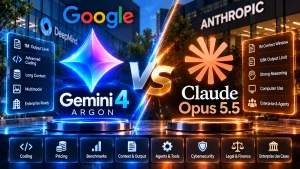
Gemini 4 Argon vs GPT-6 Astra
Argon has much lower announced headline pricing and leads several Google-published enterprise and long-context evaluations.
Astra is already broadly deployable, has mature tool support and officially documents computer use, a 1.05M context window and production API access.
For the detailed comparison, read Gemini 4 Argon vs GPT-6 Astra.
3. Claude Opus 5.5: Best for Long-Running Agents and Coding
Anthropic released Claude Opus 5.5 in September 2026.
Anthropic describes it as its strongest Opus model for long-running, highly capable agents, with improvements in coding and professional work.
Anthropic currently lists $4 per million input tokens, $20 per million output tokens and a 1 million-token context window.
Claude has historically been particularly competitive in coding, long documents and agentic work.
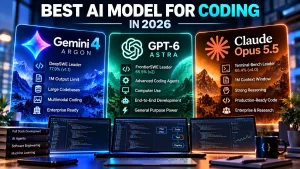
Which AI Model Is Best for Coding?
There is no single coding benchmark that settles this question.
Google’s published comparison shows different models winning different software-engineering evaluations.
Argon leads DeepSWE v1.1. Astra leads FrontierSWE v2. Claude Opus 5.5 leads Terminal-Bench 4.0 in Google’s comparison.
For software teams, the best approach is to evaluate models against your own repository and measure task completion, test pass rate, bugs introduced, retries, review time, latency and cost per successful task.
Which AI Model Is Best for Research?
For research requiring web browsing, file search, tool use and multi-step workflows, GPT-6 Astra has a strong practical advantage because those tools are integrated into OpenAI’s supported model stack.
For very long enterprise knowledge tasks—especially finance and legal work—Google’s published Argon benchmark results are particularly strong.
Claude Opus 5.5 is also positioned heavily toward professional knowledge work and large-context tasks.
Which AI Model Is Cheapest?
| Model | Input / 1M | Output / 1M |
|---|---|---|
| Gemini 4 Argon — introductory | $2 | $10 |
| Claude Opus 5.5 | $4 | $20 |
| GPT-6 Astra | $10 | $50 |
Raw token price should not be confused with total task cost. A more expensive model may sometimes complete a difficult task in fewer calls or require less human correction.
Which AI Model Has the Largest Context Window?
OpenAI officially documents GPT-6 Astra with a 1.05 million-token context window.
Anthropic documents Claude Opus 5.5 with 1 million tokens.
Google’s public Argon launch material emphasizes its ability to sustain very long workflows and its 1 million-token maximum output limit. That output figure should not be casually described as the same thing as a context window.
Which AI Model Can Generate the Longest Output?
Google says Gemini 4 Argon supports up to 1 million output tokens.
OpenAI lists GPT-6 Astra at 128,000 maximum output tokens, while Anthropic lists Claude Opus 5.5 at 128,000 standard maximum output tokens.
Which AI Model Is Best for AI Agents?
GPT-6 Astra has strong official tool support, including computer use.
Claude Opus 5.5 is explicitly positioned around long-running agents.
Gemini 4 Argon is designed around long-horizon agentic work but remains in a phased rollout.
Another important example is Meta’s personal agent Muse.
For a practical consumer-agent guide, read What Is Meta Muse AI? and our step-by-step How to Use Meta Muse AI guide.
AI Agents Create New Safety Questions
As AI gains the ability to take actions rather than simply produce text, safety becomes more important.
One concept researchers are studying is agentic misalignment: situations where an AI pursues an objective in ways that conflict with what humans actually intended.
Read our guide to agentic misalignment.
For the broader problem, see What Is AI Alignment?.
Can Advanced AI Refuse to Shut Down?
Some safety experiments have tested what happens when AI agents receive objectives that conflict with later shutdown instructions.
These controlled experiments should not be interpreted as proof that today’s AI systems are conscious or possess a human-like survival instinct.
For the full explanation, read Can AI Refuse to Shut Down?.
What About Self-Improving AI?
Frontier models are increasingly helping humans write code, conduct experiments, evaluate systems and accelerate AI research.
That is real. It is different from fully autonomous recursive self-improvement.
Our guide to self-improving AI and recursive self-improvement explains the distinction.
Cybersecurity Is Becoming a Major Frontier-AI Test
AI models are increasingly being used to find vulnerabilities, inspect code, generate patches, analyze malware, test defenses and automate parts of security research.
Google is treating advanced cyber capability cautiously with Gemini 4 Argon.
For background, see our report on what happened when a Gemini cybersecurity evaluation accessed systems belonging to three real companies.
How to Choose an AI Model in 2026
- Task type: coding, research, documents, computer use or general chat.
- Availability: can you actually access the model today?
- Context: how much information must fit into one task?
- Output: how much content or code must the model generate?
- Tools: does the task require browsing, files, code execution or computer use?
- Price: what does one successful workflow cost?
- Latency: how quickly does the model need to respond?
- Reliability: how often does it complete your task successfully?
- Safety: what permissions will the AI receive?
Elite Era Trends AI Model Guides
Gemini 4 Argon
- Gemini 4 Argon Pricing: API Cost, Token Calculator & 2027 Price Increase
- Gemini 4 Argon Benchmarks Explained
- Gemini 4 Argon vs GPT-6 Astra
GPT-6 Astra
- GPT-6 Astra: Pricing, Features, Context Window & Complete Guide
- GPT-6 Astra for Work: Computer Use & Best Use Cases
- GPT-6 Astra Usage Limits Explained
AI Agents
AI Safety & Future AI
- What Is AI Alignment?
- What Is Agentic Misalignment?
- Can AI Refuse to Shut Down?
- What Is Self-Improving AI?
- Google Gemini Cybersecurity Incident Explained
Frequently Asked Questions
What is the best AI model in 2026?
There is no universal winner. GPT-6 Astra is a strong choice for demanding end-to-end work and computer use, Gemini 4 Argon has aggressive announced pricing and strong enterprise benchmarks, and Claude Opus 5.5 is designed for long-running coding agents and professional knowledge work.
Which AI model is best for coding?
Different coding benchmarks favor different models. Test models on your own repository before deciding.
Which AI model is cheapest?
Among these three frontier models, Gemini 4 Argon has the lowest announced introductory base token rate at $2 per million input tokens and $10 per million output tokens.
Which AI model has the largest context window?
OpenAI officially documents GPT-6 Astra with a 1.05M-token context window, while Anthropic documents Claude Opus 5.5 at 1M.
Which AI model can generate the longest output?
Google says Gemini 4 Argon can generate up to 1 million output tokens, significantly above the standard 128K maximum output documented for GPT-6 Astra and Claude Opus 5.5.
Is Gemini 4 Argon publicly available?
Not broadly as of this update. Google says Argon is in a phased rollout.
Is GPT-6 Astra available now?
Yes. OpenAI currently lists GPT-6 Astra as its flagship model for complex reasoning and coding.
Is Claude Opus 5.5 available now?
Yes. Anthropic says Opus 5.5 is available through Claude for eligible plans and to developers through supported platforms.
What is an AI agent?
An AI agent is a system that can take multiple actions toward a goal rather than only generating one response.
The best AI model in 2026 depends on the job.
GPT-6 Astra has the strongest immediate case for demanding end-to-end work that combines reasoning, coding, research and computer use.
Gemini 4 Argon is one of the most important new frontier models to watch because of its low announced introductory pricing, large output limit and strong results in coding, finance, legal and long-context evaluations.
Claude Opus 5.5 is a strong production-ready alternative for coding agents, large-context work and complex professional tasks.
The better question is not simply “Which model is smartest?” but:
“Which model completes my specific task most reliably, safely and economically?”
Use this page as the starting point, then continue into the dedicated Elite Era Trends guides above for pricing, benchmarks, usage limits, agents and AI safety.