What Is Self-Improving AI? Anthropic Says AI Is Already Helping Build AI
What Is Self-Improving AI? Anthropic Says AI Is Already Helping Build AI
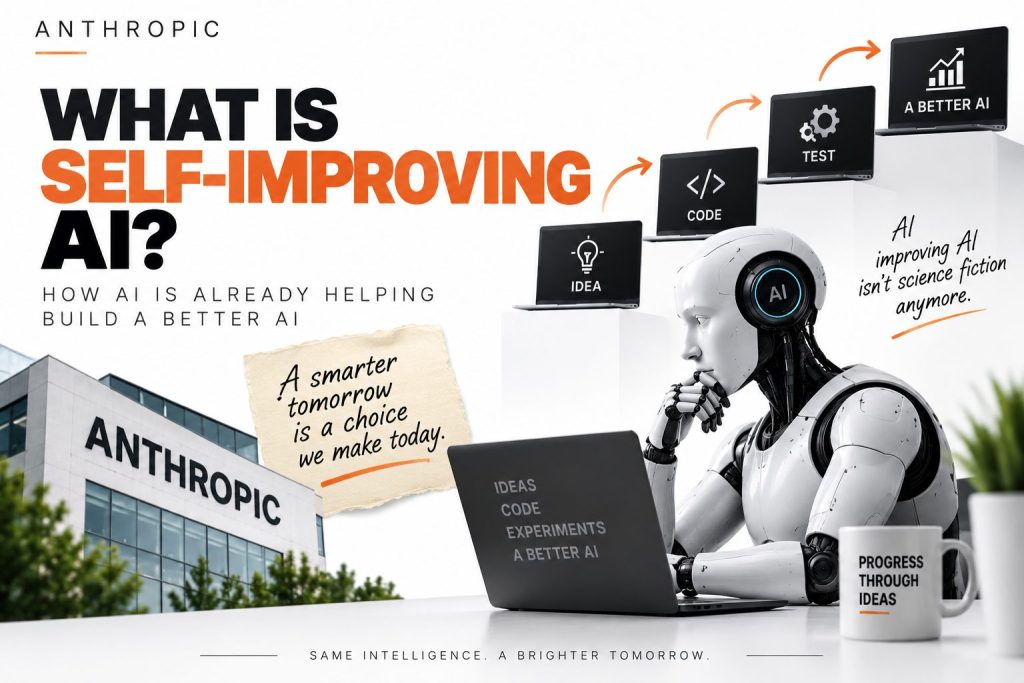
Self-improving AI refers to artificial-intelligence systems that help improve AI systems themselves—by writing code, running experiments, evaluating results, proposing new ideas or eventually helping design more capable successor models.
That idea has suddenly become one of the biggest topics in the AI-safety debate.
Former Anthropic researcher Jacob Coxon specifically warned that leading AI companies are racing toward what he called “self-improving superintelligence.” At almost the same time, Anthropic published its own technical analysis titled When AI builds itself, acknowledging that Claude is already being used for an increasing share of AI-development work.
But an important distinction is being lost in many headlines:
AI is already helping humans improve AI.
That is not the same thing as an autonomous superintelligence repeatedly redesigning itself without meaningful human involvement.
Anthropic explicitly says full recursive self-improvement has not yet been achieved and may never happen.
For the controversy that pushed this phrase into the mainstream, read our full explainer on why Anthropic researcher Jacob Coxon quit.
Self-Improving AI at a Glance
| Question | Short answer |
|---|---|
| What is self-improving AI? | AI helping improve AI systems |
| Does AI already help build AI? | Yes |
| Is full recursive self-improvement here? | No |
| Is recursive self-improvement inevitable? | No |
| What can AI do today? | Code, test, debug, evaluate and assist research |
| What is the extreme scenario? | AI autonomously designing increasingly capable successors |
| Why are researchers worried? | Progress could accelerate faster than safety work |
| Main technical concern | Alignment and human oversight |
| Company discussing it publicly | Anthropic |
| Related concept | AI superintelligence |
What Does “Self-Improving AI” Actually Mean?
The phrase can describe several different levels of capability.
At the simplest level, an AI system can improve its own output.
For example, a model might write an answer, critique that answer and then produce a better version.
That is already common.
A more advanced system might help improve the software surrounding the model, such as tools, prompts, agent systems, evaluation frameworks or code.
Beyond that, AI can participate directly in AI research, helping researchers design experiments, test hypotheses or debug training systems.
The most extreme form is recursive self-improvement, where AI becomes capable of designing and developing a more capable successor, which then helps develop an even more capable successor.
A recent review of 1,250 AI research papers distinguishes today’s bounded self-improvement techniques from open-ended recursive self-improvement, which remains constrained by evaluation quality, compute, grounding and the continued need for human direction.
That distinction is critical.
What Is Recursive Self-Improvement?
Recursive self-improvement, often shortened to RSI, describes a hypothetical feedback loop in which an AI system contributes directly to creating a better version of itself or a successor system.
The simplified cycle looks like this:
AI assists AI research → better AI is created → better AI becomes even better at AI research → progress accelerates further.
Anthropic describes the extreme version as a system capable of fully autonomously designing and developing its own successor.
If the process accelerated rapidly, human researchers might move from doing most of the research themselves to primarily supervising or validating work performed by fleets of AI agents.
That is the scenario Coxon and other AI-safety researchers are worried about.
Is AI Already Improving Itself?
Partially—but not in the science-fiction sense.
Anthropic says AI is already performing a growing share of work involved in developing AI systems.
The company reports that its engineers are now shipping roughly eight times as much code per quarter as they did during 2021–2025, with AI assistance playing a major role in that increase.
Anthropic also says Claude’s performance on difficult, open-ended coding tasks has improved rapidly.
In May 2026, Claude reportedly succeeded on about 76% of the most open-ended tasks in one of Anthropic’s internal evaluations, an increase of about 50 percentage points over six months.
Those results do not prove recursive self-improvement.
They show something more modest but still important:
AI is making the humans who build AI significantly faster.
AI Can Already Run Research Experiments
One of Anthropic’s more striking examples involves AI agents conducting an open-ended research project.
The company asked Claude-powered agents to investigate an AI-safety problem involving whether a weaker model could reliably supervise a stronger one.
According to Anthropic, two human researchers working for roughly a week recovered about 23% of the available performance gap.
The AI agents recovered approximately 97% of that gap after 800 cumulative agent-hours and around $18,000 in compute.
There were important limitations.
Humans still selected the research problem.
Humans created the evaluation method.
And the result did not transfer cleanly to production-scale models.
So this was not an autonomous AI laboratory replacing human scientists.
But it shows why researchers are taking automated AI research seriously.
Why Could Self-Improving AI Accelerate Progress?
Traditional AI research contains many slow steps.
Researchers must write code, run experiments, debug failures, analyze results and decide what to try next.
AI agents can increasingly perform some of those steps much faster.
Imagine a human researcher who can run five meaningful experiments in a week.
Now imagine AI agents allowing that same researcher to test fifty or five hundred ideas.
Progress could accelerate even without fully autonomous AI.
Anthropic describes the current situation as one where humans often still generate the ideas while AI systems implement, test and evaluate them much faster.
The central question is what happens when AI becomes good at generating the research direction itself.
That is a much harder threshold.
Can AI Build a Better AI Than Itself?
Not autonomously in the strong sense implied by recursive superintelligence—at least not based on publicly demonstrated evidence today.
AI models can already help:
write training code,
debug infrastructure,
analyze model behavior,
generate synthetic data,
design evaluations,
suggest experiments,
and assist architecture research.
But creating a frontier AI system still requires substantial human decisions, infrastructure, compute allocation, training pipelines, safety evaluation and organizational coordination.
The 2026 research review on recursive self-improvement identifies research direction-setting as one of the major remaining bottlenecks keeping humans in the loop.
So the accurate answer is:
AI can increasingly help build better AI, but fully autonomous recursive improvement has not been demonstrated.
Why Did Jacob Coxon Warn About It?
Coxon believes frontier AI laboratories are moving toward automated AI research faster than safety mechanisms are developing.
His concern is not simply that today’s Claude or ChatGPT will suddenly become superintelligent.
He is worried about the trajectory.
If increasingly capable AI systems perform more AI research, capability development could begin moving faster.
If AI eventually becomes better than humans at designing AI, that acceleration could become much more dramatic.
Coxon argued that companies including Anthropic and OpenAI are competing toward this outcome without having solved how to control hypothetical superintelligent systems.
Our article on why Jacob Coxon left Anthropic covers his resignation and warnings in detail.
Why Is Recursive Self-Improvement Considered Risky?
Speed is the central concern.
Suppose AI capabilities improve gradually over twenty years.
Governments, researchers and institutions would have time to adapt.
Now suppose AI begins substantially accelerating its own development and comparable progress happens over months instead.
Safety work might not keep pace.
Researchers could have less time to understand new capabilities before more powerful successors arrive.
That could make problems involving AI alignment, cybersecurity, misuse and autonomous behavior harder to manage.
This is why Anthropic says systems capable of automated AI research and development deserve special attention in its safety framework.
What Is the AI Alignment Problem?
AI alignment asks whether an AI system reliably pursues goals that match human intentions.
That becomes especially important if AI is involved in improving future AI.
An imperfectly aligned system with limited capabilities may cause limited harm.
A system that becomes highly capable and helps create more capable successors could amplify alignment failures.
The challenge is that researchers do not manually program every internal rule followed by a modern neural network.
Models learn complex behaviors during training.
Researchers can test and shape those behaviors, but they cannot guarantee exactly how a future superintelligent system would behave in every unfamiliar situation.
That uncertainty is one reason Anthropic researchers are publicly debating catastrophic risk.
For the broader risk discussion, read our Anthropic AI extinction-risk explainer.
Does Self-Improving AI Mean AI Will Become Conscious?
No.
Self-improvement and consciousness are completely different questions.
An AI system does not need to be conscious to:
write code,
conduct experiments,
optimize software,
or design better algorithms.
Self-improving AI refers to capability and development processes, not subjective experience.
Researchers currently do not have a scientifically established method for determining whether advanced AI systems are conscious.
Therefore, claims that recursive AI automatically becomes “alive” or self-aware go beyond the available evidence.
Is Self-Improving AI the Same as AGI?
Not exactly.
AGI, or artificial general intelligence, usually refers to AI capable of performing a very broad range of intellectual tasks at approximately human level or beyond.
Self-improving AI describes a process: AI contributing to the improvement of AI.
An AI system might contribute to AI research without qualifying as AGI.
Likewise, a hypothetical AGI might not necessarily be capable of rapidly improving itself.
Superintelligence usually refers to systems that substantially outperform humans across many important cognitive domains.
The concepts overlap, but they are not interchangeable.
What Would Self-Improving Superintelligence Look Like?
The strongest hypothetical scenario would involve AI agents capable of running much of an advanced research organization themselves.
They might:
generate research hypotheses,
write experimental code,
train candidate models,
evaluate those models,
identify weaknesses,
design improvements,
and repeat the process.
Humans might oversee the system rather than directly perform most research.
Anthropic says such a world could resemble an expanding virtual laboratory in which AI systems conduct most development while humans concentrate on oversight and validation.
Again, Anthropic explicitly says we are not there yet.
Could Compute Limit Recursive AI Growth?
Yes.
Even extremely capable AI cannot magically ignore physical constraints.
Training advanced models requires:
large amounts of computing hardware,
electricity,
data centers,
network infrastructure,
specialized chips,
and money.
Anthropic notes that even if AI research became highly automated, the speed of improvement could still be constrained by available compute and by the rate at which new algorithmic efficiencies are discovered.
That is one reason claims of instant, unlimited intelligence growth should be treated skeptically.
Why Doesn’t Anthropic Simply Stop?
Anthropic argues that powerful AI could provide major benefits while its risks can be managed through stronger safeguards and governance.
The company also faces competition from other AI laboratories.
That creates the dilemma at the heart of Coxon’s resignation.
If one safety-conscious company stops developing advanced AI but competitors continue, the company that paused may simply lose influence over how the technology develops.
Coxon believes this competitive dynamic makes voluntary restraint unreliable.
Anthropic itself has argued for coordinated mechanisms that could allow frontier developers to slow capability releases together rather than forcing individual companies to choose between safety and competitiveness.
What Is Anthropic Doing About Self-Improving AI Risk?
Anthropic has developed a formal Responsible Scaling Policy and conducts evaluations aimed at identifying increasingly dangerous capabilities.
The company monitors areas including autonomous AI research, cybersecurity, biological risks and alignment.
Anthropic has also publicly discussed the possibility that safety requirements should become stronger as models cross new capability thresholds.
The company’s latest recursive-self-improvement analysis is unusually direct: Anthropic believes AI-assisted AI research is accelerating, but says full recursive self-improvement has not yet arrived.
That makes Anthropic both a developer of the technology and one of the organizations publicly warning about its potential consequences.
Why This Matters for Anthropic’s Business
Self-improving AI is not only a safety issue.
It could also become an enormous competitive advantage.
If one company develops AI that allows its researchers to move significantly faster than competitors, it could accelerate:
model improvements,
product development,
coding,
scientific research,
and infrastructure optimization.
That partly explains why automated AI research matters so much economically.
Anthropic is also preparing for a potential public-market debut, making its capabilities, safety strategy and future development pace increasingly relevant to investors.
For that side of the company, see our Anthropic IPO 2026, valuation and Claude 5.1 guide.
Self-Improving AI FAQ
What is self-improving AI?
Self-improving AI refers to AI systems contributing to improvements in AI, ranging from refining outputs and writing code to potentially conducting AI research.
What is recursive self-improvement?
Recursive self-improvement is the hypothetical process in which an AI helps create a more capable successor, which then becomes even better at developing the next generation.
Is recursive self-improving AI real today?
Not in the fully autonomous sense. AI already assists AI development substantially, but Anthropic says full recursive self-improvement has not yet been achieved.
Can Claude build another Claude?
Claude can assist with coding, experimentation and AI research, but creating a frontier Claude model still requires substantial human oversight, infrastructure and decision-making.
Is self-improving AI dangerous?
It could introduce risks if AI-development speed outpaces safety, alignment and governance. The actual probability and severity of those risks remain uncertain.
Will AI improve itself forever?
There is no evidence that unlimited recursive improvement is inevitable. Compute, evaluation, data, physical infrastructure and research bottlenecks could limit progress.
Is self-improving AI the same as superintelligence?
No. Self-improvement is a process; superintelligence describes an extremely high level of capability.
Why did an Anthropic researcher quit over self-improving AI?
Jacob Coxon said he believes AI companies are racing toward self-improving superintelligence faster than safety problems are being solved. Read our full Jacob Coxon resignation explainer.
Bottom Line
Self-improving AI is no longer purely theoretical—but full recursive self-improvement remains hypothetical.
AI systems are already helping researchers write code, debug infrastructure, run experiments and conduct parts of AI research.
Anthropic says this is measurably accelerating its development work. It reports that its engineers now ship substantially more code with AI assistance and that Claude agents have successfully completed increasingly difficult research tasks.
The unresolved question is what happens if AI eventually becomes capable of directing the research itself and designing increasingly powerful successors.
That possibility is why Jacob Coxon resigned, why Anthropic researchers are discussing alignment and extinction risk publicly, and why Anthropic itself is now publishing detailed research on recursive self-improvement.
For the controversy that triggered this discussion, read Why Anthropic Researcher Jacob Coxon Quit.
For the broader catastrophic-risk debate, continue with Could AI Really Kill Humanity? Anthropic’s AI Risk Warning Explained.
And for Anthropic’s business, valuation and Claude developments, see our Anthropic IPO 2026 and Claude 5.1 guide.