Medicare ACCESS Program 2027: Who Qualifies for $0–$7 At-Home Chronic Care?
Medicare ACCESS Program 2027
Medicare has introduced a new way for people with chronic health conditions to receive ongoing support from home—and the program is expanding again in 2027.
It is called:
Medicare ACCESS.
ACCESS stands for:
Advancing Chronic Care with Effective, Scalable Solutions.
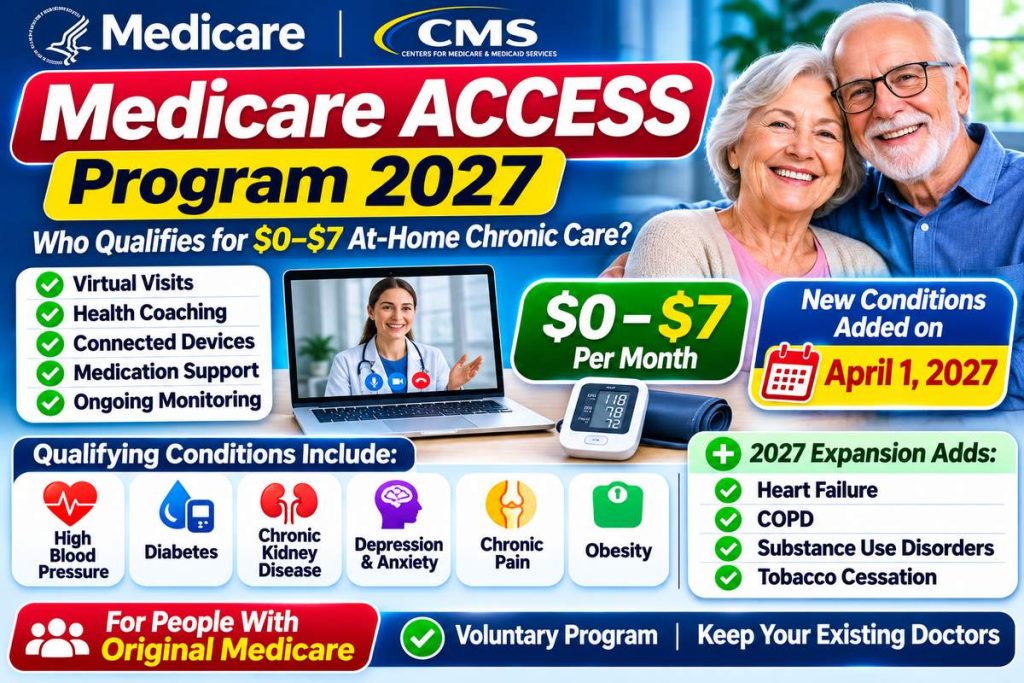
The program is designed for people with Original Medicare who have qualifying chronic conditions such as:
- high blood pressure;
- high cholesterol;
- obesity;
- prediabetes;
- diabetes;
- chronic kidney disease;
- heart disease;
- depression;
- anxiety;
- chronic muscle or joint pain.
Depending on the participating organization, support can include:
- virtual visits;
- health coaching;
- connected health devices;
- wearable devices;
- medication support;
- behavioral-health care;
- remote monitoring.
And the cost can be surprisingly low.
According to Medicare.gov’s official ACCESS information, most participating organizations charge between:
$0 and $7 per month.
If one organization is helping you manage several qualifying conditions, Medicare says it generally cannot charge more than:
$13 per month total.
Beginning April 1, 2027, Medicare ACCESS will expand to additional conditions including:
- heart failure;
- chronic obstructive pulmonary disease, or COPD;
- substance use disorders;
- tobacco cessation.
Here is how Medicare ACCESS works, who qualifies, what it costs and how to sign up.
What Is the Medicare ACCESS Program?
Medicare ACCESS is a voluntary chronic-care program operated through the Centers for Medicare & Medicaid Services.
The program began in:
July 2026
and CMS plans to test the model for approximately:
10 years.
Its goal is to make technology-supported chronic care easier to access under Original Medicare.
Traditional Medicare generally pays providers for individual medical services.
ACCESS uses a different approach.
CMS pays participating organizations based partly on whether patients achieve measurable improvements in their health.
In other words, ACCESS is designed to reward:
better health outcomes
rather than simply:
more appointments or procedures.
CMS explains the full program on its official ACCESS Model page.
Who Can Use Medicare ACCESS?
The program is currently available to people who:
have Original Medicare
and:
have at least one qualifying chronic condition.
You do not necessarily need several conditions.
One qualifying condition can be enough.
Medicare currently lists conditions including:
- high blood pressure;
- high cholesterol;
- obesity;
- prediabetes;
- diabetes;
- chronic kidney disease;
- atherosclerotic cardiovascular disease;
- depression;
- anxiety;
- chronic muscle or joint pain.
Medicare says people with more than one qualifying condition may be able to participate in:
more than one ACCESS track.
Is Medicare ACCESS Available With Medicare Advantage?
No.
This is one of the most important eligibility rules.
Medicare.gov states that people enrolled in:
Medicare Advantage, also called Part C
cannot use the Medicare ACCESS care option.
ACCESS is currently designed for:
Original Medicare.
However, Medicare Advantage plans may offer their own chronic-care programs, remote monitoring or disease-management services.
If you have Medicare Advantage, contact your plan and ask what chronic-condition programs are available.
If your Medicare Advantage coverage is changing or ending for 2027, see our guide to what to do if your Medicare Advantage plan is ending.
What Conditions Does Medicare ACCESS Cover?
CMS organizes ACCESS into several clinical tracks.
Early Cardio-Kidney-Metabolic Track
This track can include qualifying people with conditions such as:
- high blood pressure;
- high cholesterol;
- obesity;
- overweight with certain risk factors;
- prediabetes.
The goal is to intervene earlier before these conditions progress into more serious disease.
Cardio-Kidney-Metabolic Track
This track includes qualifying conditions such as:
- diabetes;
- chronic kidney disease;
- atherosclerotic cardiovascular disease.
The program may help beneficiaries monitor their health and manage treatment between regular doctor appointments.
Musculoskeletal Track
This track supports people with:
chronic muscle, bone or joint pain.
Depending on the participating provider, support might include:
- virtual physical therapy;
- exercise programs;
- pain-management coaching;
- mobility monitoring.
Behavioral Health Track
This track can support people with:
- depression;
- anxiety.
Services can include virtual behavioral-health support and technology-assisted care.
What Changes in Medicare ACCESS in 2027?
ACCESS expands substantially beginning:
April 1, 2027.
CMS says new tracks will include:
Heart Failure
Eligible patients may receive ongoing monitoring focused on:
- symptoms;
- daily functioning;
- quality of life;
- health changes between appointments.
COPD
People with qualifying chronic obstructive pulmonary disease may receive support designed to:
- improve symptom control;
- monitor lung health;
- support daily activity.
Substance Use Disorders
The program will expand to support qualifying people with conditions involving:
- opioids;
- alcohol;
- other substances.
CMS says care may also incorporate support for co-occurring:
- depression;
- anxiety.
Tobacco Cessation
ACCESS will also offer services designed to help eligible beneficiaries stop using tobacco.
Expanded Musculoskeletal Care
CMS is also adding extended support for certain chronic musculoskeletal conditions beyond the initial period of care.
The official CMS announcement is available in its September 2026 ACCESS expansion release.
How Much Does Medicare ACCESS Cost?
Medicare.gov says most participating organizations charge between:
$0 and $7 per month.
That is the beneficiary’s cost for ACCESS support.
If one organization helps you with multiple qualifying conditions, Medicare says the organization generally cannot charge more than:
$13 per month total.
Example:
Suppose you have:
high blood pressure
and:
diabetes.
If one participating organization supports both conditions, your total ACCESS cost through that organization cannot simply be $7 + $7 + additional fees indefinitely.
Medicare places limits on what organizations can charge.
Is Medicare ACCESS Completely Free?
Sometimes.
Some ACCESS organizations charge:
$0.
Others may charge a small monthly amount.
Medicare currently says:
most charge $0–$7 per month.
The exact cost depends on:
- the organization;
- the clinical track;
- the services provided.
Always confirm the price before enrolling.
Can ACCESS Give You Free Health Devices?
Potentially, yes.
Medicare says participating organizations may provide or loan equipment related to your condition.
Examples can include devices such as:
- blood pressure monitors;
- connected health devices;
- continuous glucose monitors where appropriate;
- other monitoring equipment.
Medicare says you generally will not have to pay to use equipment supplied as part of the ACCESS care arrangement.
However, the organization may require you to:
return the equipment later.
Does ACCESS Replace Your Doctor?
No.
ACCESS is designed to:
add to your existing health care.
It does not replace your:
- primary-care doctor;
- specialists;
- other Medicare providers.
You can continue seeing providers who accept Medicare.
Medicare says ACCESS organizations should coordinate with your existing doctors when possible.
That distinction matters.
ACCESS is meant to provide:
additional support between appointments
rather than create an entirely separate health-care system.
What Kind of Services Can ACCESS Provide?
Services vary by organization.
Medicare lists examples including:
Lifestyle coaching
You might receive help with:
- nutrition;
- exercise;
- weight management;
- daily health habits.
Connected devices
Organizations may use:
- blood pressure monitors;
- glucose-monitoring technology;
- other connected devices.
Wearable technology
Wearables may help track health information between medical appointments.
Mobile apps
Some organizations provide apps for:
- tracking symptoms;
- communicating with care teams;
- completing exercises;
- monitoring progress.
Medication management
Participating organizations may help patients understand and follow their medication plans.
Behavioral-health support
Some ACCESS providers offer technology-supported care for:
- depression;
- anxiety.
Virtual visits
Patients may be able to receive part of their ongoing support remotely.
Does Medicare ACCESS Include AI?
Some participating ACCESS services may use:
- artificial intelligence;
- remote monitoring;
- connected devices;
- digital-health platforms.
CMS specifically describes ACCESS as a way to expand access to:
technology-supported care.
But that does not mean every ACCESS organization uses AI.
The specific tools depend on the provider you choose.
How Do You Sign Up for Medicare ACCESS?
One advantage of ACCESS is that Medicare says you can generally enroll:
directly.
You do not necessarily need a physician referral.
The process looks like this:
Step 1: Confirm You Have Original Medicare
If you have Medicare Advantage, ACCESS is not currently available to you.
Step 2: Identify Your Qualifying Condition
Examples include:
- high blood pressure;
- diabetes;
- depression;
- anxiety;
- chronic pain.
Step 3: Find a Participating ACCESS Organization
Medicare maintains a directory at:
The directory allows you to look for organizations offering services for your condition.
Step 4: Contact the Organization
Medicare says beneficiaries can contact participating organizations directly.
You can also ask your:
- doctor;
- pharmacist;
- other health professional
to help you find an appropriate provider.
Step 5: The Organization Confirms Eligibility
The ACCESS provider reviews whether you qualify for its services.
Step 6: Begin Your Care Plan
The organization develops a support plan based on your condition.
When possible, it coordinates that plan with your existing health-care team.
Do You Need a Doctor Referral?
Not necessarily.
Medicare.gov says beneficiaries can:
sign up directly with a participating care organization.
A referral from your doctor can still be useful.
Your primary-care provider may know:
- which program fits your condition;
- whether remote monitoring would help;
- which organization integrates well with your current care.
But a referral is not always required.
Can You Leave the ACCESS Program?
Yes.
Participation is voluntary.
Medicare says you are not required to remain with an ACCESS organization permanently.
After your first:
90 days
you can generally:
- cancel;
- switch organizations.
This gives beneficiaries flexibility if they decide the service is not useful or another provider better fits their needs.
Does ACCESS Change Your Medicare Coverage?
No.
Enrolling in ACCESS does not cancel your existing Original Medicare coverage.
Medicare says participation does not negatively change:
- Medicare eligibility;
- covered benefits;
- provider choice.
You continue having access to covered Original Medicare services.
Can You Still See Any Doctor Who Accepts Medicare?
Yes.
ACCESS does not create a closed provider network like many Medicare Advantage plans.
You can continue seeing providers who accept Original Medicare.
The ACCESS organization is meant to provide:
additional chronic-care support.
How Many Organizations Participate?
CMS reported in October 2026 that:
more than 160 health-care organizations
were participating in ACCESS.
The list is expected to evolve.
Organizations include different types of technology-enabled health-care providers and chronic-care companies.
You should use the current Medicare directory rather than relying on an older list because:
- new organizations can join;
- available conditions can change;
- geographic availability can change.
Is ACCESS Available Everywhere?
Availability depends on participating organizations.
The program is federal, but not every provider serves every condition or geographic area.
Medicare’s ACCESS directory is the best place to check:
what is available where you live.
Why Did Medicare Create ACCESS?
Chronic conditions affect a large portion of the Medicare population.
CMS says roughly:
three out of four people with Medicare
qualify for at least one ACCESS clinical track.
Traditional health care often revolves around:
periodic doctor appointments.
But chronic diseases require daily management.
For example:
Someone with high blood pressure may need to monitor readings several times each week.
Someone with diabetes may need ongoing help with:
- medication;
- diet;
- glucose levels.
Someone with depression may benefit from support between office visits.
ACCESS attempts to fill that gap with more continuous technology-supported care.
ACCESS Pays for Results Instead of Only Visits
This is one of the most unusual parts of the model.
Traditional Medicare payments often compensate providers for performing specific services.
ACCESS uses what CMS calls an:
outcome-aligned payment approach.
Providers can be rewarded based on whether participating patients achieve measurable health improvements.
Examples could involve improvements in areas such as:
- blood pressure;
- functional ability;
- symptoms;
- behavioral-health outcomes.
The goal is to create an incentive for:
successful chronic-condition management
rather than simply increasing the number of billed services.
Example: ACCESS for High Blood Pressure
Imagine a beneficiary with:
hypertension.
Instead of waiting several months between doctor visits, an ACCESS organization might provide:
- a connected blood pressure monitor;
- regular health coaching;
- medication reminders;
- virtual check-ins;
- alerts when readings change.
The person’s existing physician remains involved.
The ACCESS service adds ongoing support between appointments.
Example: ACCESS for Diabetes
Someone with qualifying diabetes could potentially receive support such as:
- glucose monitoring;
- nutrition coaching;
- medication management;
- virtual support;
- health tracking.
ACCESS does not replace normal Medicare diabetes benefits.
It is an additional chronic-care option.
People using GLP-1 medications should also understand that ACCESS is separate from Medicare’s prescription drug rules.
For weight-loss drug coverage, see our guide to the Medicare GLP-1 Bridge in 2027, which explains the separate $50 monthly program for qualifying Wegovy, Zepbound and other covered GLP-1 products.
ACCESS vs. Medicare Advantage
These programs work very differently.
| Feature | Medicare ACCESS | Medicare Advantage |
|---|---|---|
| Available with Original Medicare | Yes | No |
| Private health plan | No | Yes |
| Replaces Original Medicare administration | No | Yes |
| Chronic-care support | Yes | Often |
| Provider network restrictions | ACCESS does not replace Original Medicare provider choice | Often applies |
| Monthly ACCESS cost | Usually $0–$7 | Plan-specific |
| Voluntary additional service | Yes | Full Medicare coverage arrangement |
If you have Medicare Advantage, ask your plan about similar:
- remote monitoring;
- chronic-condition programs;
- Special Needs Plans.
ACCESS vs. Medicare Part D
ACCESS does not replace prescription drug coverage.
If you use medications, you still need applicable Medicare drug coverage.
Part D operates separately.
That distinction is especially important in 2027 because stand-alone Part D premiums can change significantly.
See our current analysis of why Medicare Part D premiums could jump for people who keep the same plan in 2027.
ACCESS vs. Medicare GLP-1 Bridge
These are two separate Medicare initiatives.
ACCESS
Focuses on:
technology-supported chronic care.
Possible cost:
usually $0–$7/month.
GLP-1 Bridge
Focuses on:
certain weight-loss medications.
Eligible beneficiaries pay:
$50 per monthly supply
for qualifying covered drugs.
Someone could potentially interact with both programs if they independently meet the eligibility requirements.
Will ACCESS Pay for Wegovy or Zepbound?
ACCESS itself is not the Medicare GLP-1 drug-coverage program.
The separate:
Medicare GLP-1 Bridge
handles certain qualifying weight-loss medications.
If you are looking specifically for:
- Wegovy;
- Zepbound;
- Foundayo;
use Medicare’s GLP-1 Bridge eligibility process rather than assuming ACCESS automatically covers the drug.
What Happens If You Have Several Chronic Conditions?
You may be able to receive support for more than one condition.
Medicare says beneficiaries can potentially work with:
- one organization across multiple conditions;
- more than one organization.
If a single organization helps you with several conditions, Medicare says it generally cannot charge more than:
$13 per month total.
Is ACCESS Worth It?
That depends on your health needs and the organization available to you.
ACCESS may be particularly useful if you:
- have difficulty managing a chronic condition between doctor visits;
- want more frequent monitoring;
- are comfortable using virtual care;
- would benefit from coaching;
- want connected devices;
- need help following a treatment plan.
Someone whose condition is already stable and who does not want additional monitoring may find less value.
Participation is voluntary.
Questions to Ask Before Joining ACCESS
Before signing up, ask:
What will I pay each month?
Confirm the exact cost.
What services do I receive?
Ask whether the program includes:
- coaching;
- virtual visits;
- devices;
- medication support.
Who monitors my health information?
Understand who reviews your readings and messages.
How will my doctor be involved?
Ask how the ACCESS provider communicates with your existing medical team.
What technology do I need?
Find out whether you need:
- a smartphone;
- internet access;
- an app.
What happens to my data?
Ask about privacy and information sharing.
Do I have to return equipment?
Some equipment may be loaned rather than permanently provided.
How do I leave the program?
Confirm cancellation and switching procedures.
What Changes on April 1, 2027?
Starting April 1, CMS says ACCESS expands with new condition tracks covering:
- heart failure;
- COPD;
- substance use disorders;
- tobacco cessation.
CMS is also expanding support for chronic musculoskeletal conditions.
This makes 2027 an important expansion year for ACCESS.
People who do not currently qualify may become eligible after the new tracks begin.
Medicare ACCESS 2027 at a Glance
| ACCESS rule | 2027 details |
|---|---|
| Medicare type required | Original Medicare |
| Medicare Advantage eligible? | No |
| Typical monthly cost | $0–$7 |
| Same organization helping multiple conditions | Up to $13/month total |
| Doctor referral required? | Usually no |
| Can keep existing doctors? | Yes |
| Can leave program? | Yes |
| Switch/cancel after initial period | Generally after 90 days |
| New 2027 tracks start | April 1, 2027 |
| Participating organizations | 160+ reported by CMS |
| Program voluntary? | Yes |
How ACCESS Fits Into the Bigger 2027 Medicare Picture
ACCESS is only one of several important Medicare changes heading into 2027.
Beneficiaries are also dealing with:
- changing Part D premiums;
- a $700 defined-standard Part D deductible;
- a $2,400 Part D out-of-pocket threshold;
- Medicare Advantage plan changes;
- Social Security’s 3.6% COLA;
- Part B premium changes.
Our 2027 Social Security and Medicare Retirement Guide brings the major changes together in one place.
Beneficiaries concerned about how Medicare premiums affect their Social Security increase should also read our guide to the 2027 Medicare hold-harmless rule.
Frequently Asked Questions
What is Medicare ACCESS?
Medicare ACCESS is a CMS chronic-care program that provides qualifying Original Medicare beneficiaries with technology-supported care through approved organizations.
How much does Medicare ACCESS cost?
Medicare.gov says most participating organizations charge:
$0–$7 per month.
Is Medicare ACCESS free?
Some participating organizations charge $0.
Others charge a small monthly amount.
Who qualifies for ACCESS?
You generally need:
Original Medicare
and:
at least one qualifying chronic condition.
What conditions qualify?
Current examples include:
- hypertension;
- high cholesterol;
- obesity;
- prediabetes;
- diabetes;
- chronic kidney disease;
- heart disease;
- depression;
- anxiety;
- chronic musculoskeletal pain.
Does ACCESS cover heart failure?
Heart-failure support is scheduled to become part of ACCESS beginning:
April 1, 2027.
Does ACCESS cover COPD?
COPD is also being added beginning:
April 1, 2027.
Does ACCESS cover substance use disorders?
Yes, new substance-use-disorder support is scheduled for the 2027 expansion.
Does ACCESS help people stop smoking?
Tobacco-cessation support is part of the new April 2027 expansion.
Can Medicare Advantage members use ACCESS?
No.
Medicare.gov says the program currently applies to:
Original Medicare beneficiaries.
Do I need a referral?
Medicare says you can generally contact participating ACCESS organizations directly.
Can ACCESS give me a blood pressure monitor?
Participating organizations may provide or loan condition-related equipment such as blood pressure monitors.
Do I have to pay for the equipment?
Medicare says beneficiaries generally don’t pay to use equipment supplied through ACCESS, although it may need to be returned.
Can I still see my normal doctor?
Yes.
ACCESS does not replace your existing doctors or Original Medicare coverage.
Can I leave ACCESS?
Yes.
Participation is voluntary.
Medicare says you can generally cancel or switch organizations after the first 90 days.
Is ACCESS the same as Medicare Advantage?
No.
ACCESS is an additional care option for people with Original Medicare.
Is ACCESS the same as the Medicare GLP-1 Bridge?
No.
ACCESS focuses on chronic-care support.
The GLP-1 Bridge is a separate Medicare program covering certain weight-loss drugs for qualifying beneficiaries.
Bottom Line
The Medicare ACCESS Program is one of the most important new chronic-care options for people with Original Medicare heading into 2027.
Qualifying beneficiaries can receive ongoing support for conditions including:
- high blood pressure;
- diabetes;
- chronic kidney disease;
- depression;
- anxiety;
- chronic pain.
Participating organizations may provide:
- virtual visits;
- coaching;
- apps;
- wearables;
- remote monitoring;
- connected medical devices;
- medication support.
And Medicare says most organizations charge only:
$0–$7 per month.
Beginning:
April 1, 2027
the program expands to include:
- heart failure;
- COPD;
- substance use disorders;
- tobacco cessation.
The biggest eligibility restriction is:
ACCESS is currently for Original Medicare—not Medicare Advantage.
Participation is voluntary, it does not replace your doctors, and you keep your existing Medicare coverage.
For people managing chronic disease between medical appointments, ACCESS could provide an inexpensive new layer of support.
The best first step is to visit Medicare’s official ACCESS directory and see whether a participating organization offers services for your condition in your area.