Medicare Part D Premiums Could Jump 50% in 2027 If You Keep the Same Plan: Check Before December 7
Medicare Part D Premiums Could Jump 50% in 2027
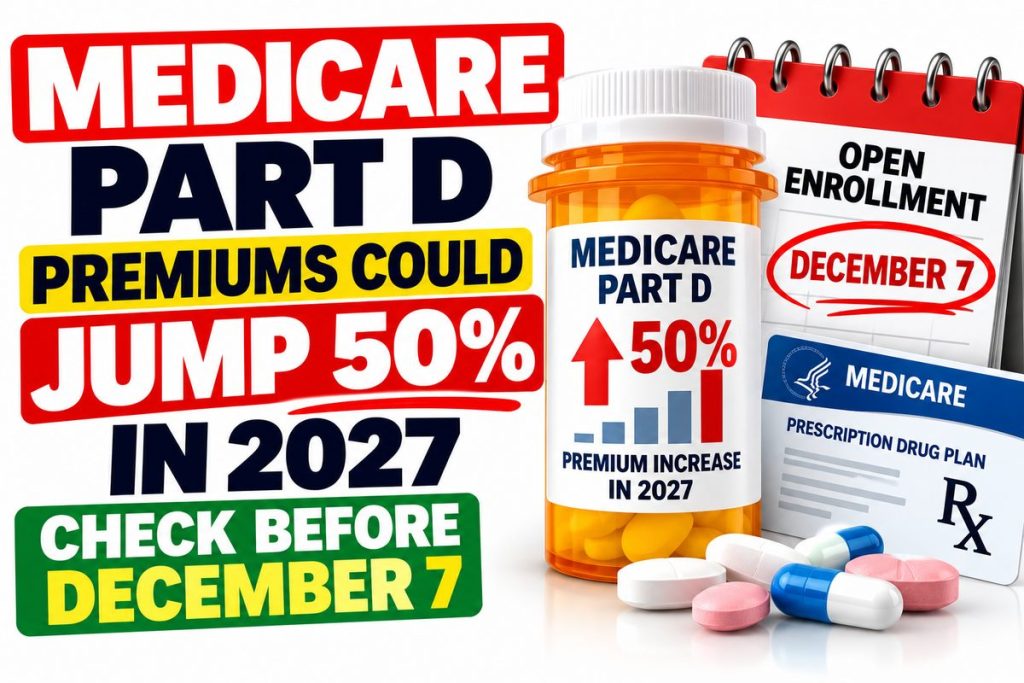
Medicare beneficiaries with stand-alone prescription drug coverage have a new reason to review their plan before the December 7, 2026 Open Enrollment deadline.
A new KFF analysis estimates that if current Medicare Part D stand-alone drug plan enrollees simply remain in the same plans for 2027, the enrollment-weighted average monthly premium could rise from approximately:
$34 in 2026
to:
$51 in 2027.
That is an increase of about:
50%.
Even more striking, KFF estimates that approximately 10.4 million people, or 76% of stand-alone Part D enrollees without the Low-Income Subsidy, could pay a higher premium next year if they make no change during Medicare Open Enrollment.
And about:
2.4 million beneficiaries
could see their monthly premium rise by:
more than $50.
But there is an important complication.
The Centers for Medicare & Medicaid Services previously projected that the national average stand-alone Part D premium would rise by less than $1—from $35.09 in 2026 to approximately:
$36 in 2027.
So why is one estimate $36 while another is $51?
The answer comes down largely to:
which plans people actually choose.
CMS’s projection represents a broader national average.
KFF’s $51 estimate asks a different question:
What could happen if today’s beneficiaries stay in their current plans instead of switching during Open Enrollment?
That distinction makes this year’s Medicare plan review particularly important.
Here is what the new numbers mean, why some premiums are rising sharply, and exactly what beneficiaries should check before the December 7 deadline.
Medicare Part D Premiums in 2027: The Key Numbers
| Medicare Part D figure | 2026 | 2027 |
|---|---|---|
| CMS projected national average stand-alone premium | $35.09 | About $36 |
| KFF same-plan enrollment-weighted estimate | About $34 | About $51 |
| Estimated KFF increase | — | About 50% |
| Defined-standard Part D deductible | $615 | $700 |
| Part D out-of-pocket threshold | $2,100 | $2,400 |
| Medicare Open Enrollment deadline | — | December 7, 2026 |
The most important point is that:
neither $36 nor $51 is the premium everyone will pay.
Your actual premium depends on:
- the plan available where you live;
- whether you stay in your current plan;
- whether you switch;
- whether you receive Extra Help;
- the specific plan premium;
- your prescriptions;
- your pharmacies;
- your income and possible Part D IRMAA.
Why Is KFF Saying Part D Premiums Could Rise 50%?
KFF analyzed Medicare’s 2027 plan landscape and benefit data.
Its analysis estimates that if current stand-alone Part D enrollees remain in the plans they have today, the average enrollment-weighted monthly premium would increase from approximately:
$34
to:
$51.
Calculation:
$51 − $34 = $17 monthly increase
$17 ÷ $34 × 100 ≈ 50%
That could mean approximately:
$204 more per year
for someone experiencing the average $17 monthly increase.
But averages hide enormous differences among plans.
Some beneficiaries could see little change.
Others could face increases of:
$50 or more per month.
Why Does CMS Say the Average Will Be Only $36?
CMS published a different national projection.
The agency says the average monthly premium for stand-alone Part D prescription drug plans is projected to increase from:
$35.09 in 2026
to:
approximately $36 in 2027.
That’s an increase of only:
$0.91 per month.
KFF notes that CMS did not publicly explain enough of the methodology behind that specific average for KFF to fully reconcile the difference.
One possible explanation is that CMS’s calculation assumes beneficiaries will move toward lower-premium plans during Open Enrollment.
KFF’s analysis instead asks what happens if today’s enrollees largely stay in place.
That means the two figures are not necessarily describing exactly the same scenario.
$36 vs. $51: Which Number Should You Believe?
Both figures can be useful if you understand what they represent.
CMS: About $36
This is a projected national average across stand-alone Part D coverage.
It does not mean your current plan will cost approximately $36.
KFF: About $51
This is an estimate of the average premium current enrollees could face if they stay in their existing plans, based on 2026 enrollment patterns and 2027 plan premiums.
It also does not mean everyone will pay $51.
The number that matters most is:
your specific 2027 plan premium.
Check the Annual Notice of Change from your insurer and compare it against the options available through Medicare Plan Finder.
76% of Stand-Alone Part D Enrollees Could Pay More If They Stay Put
KFF estimates that approximately:
10.4 million
stand-alone Part D enrollees without the Low-Income Subsidy could see higher premiums in 2027 if they make no plan change.
That represents:
76%
of the affected group in its analysis.
By comparison, KFF says about 56% faced increases in their existing plans for 2026.
This is one reason Medicare beneficiaries should not automatically assume:
“My plan worked last year, so I’ll just keep it.”
The plan may have the same name but very different costs.
2.4 Million People Could Face Increases Above $50 Per Month
The most concerning part of the KFF analysis involves beneficiaries facing very large premium increases.
KFF estimates that approximately:
2.4 million
people could experience increases exceeding:
$50 per month
if they remain in their current plans.
A $50 monthly increase equals:
$50 × 12 = $600 per year.
And some plan changes are substantially larger.
That makes the December 7 deadline particularly important.
Nearly 4 Million People Could Pay at Least $100 Per Month
KFF also estimates that if current beneficiaries stay in the same plans, approximately:
3.9 million
stand-alone Part D enrollees without the Low-Income Subsidy could pay monthly premiums of at least:
$100.
At the same time, more than half of stand-alone plan enrollees in the analysis would still have premiums below:
$20 per month.
That enormous spread shows why national averages can be misleading.
One beneficiary might pay:
$10
while another pays:
$100+
for stand-alone prescription coverage.
Zero-Premium Stand-Alone Part D Plans Disappear in 2027
Another important change affects people currently enrolled in:
$0-premium stand-alone Part D plans.
KFF estimates that approximately:
4.1 million people
without the Low-Income Subsidy are currently enrolled in zero-premium stand-alone drug plans.
According to KFF’s analysis:
no zero-premium stand-alone PDPs are available for 2027.
That means these beneficiaries will experience at least some premium increase unless their eligibility or coverage arrangement changes.
This does not mean zero-premium drug coverage disappears from Medicare entirely.
Many Medicare Advantage plans continue to include prescription drug coverage with little or no separate drug premium.
Why Are Stand-Alone Part D Premiums Rising?
Several factors are affecting the 2027 market.
One important change is the end of the temporary:
Part D Premium Stabilization Demonstration.
CMS used the program during 2025 and 2026 to provide additional premium subsidies to stand-alone Part D plans and limit premium increases during the major redesign of Medicare’s prescription drug benefit.
The demonstration ends after:
2026.
That removes one temporary source of premium support.
At the same time, insurers are pricing plans based on:
- expected prescription drug spending;
- enrollee health risks;
- plan design;
- manufacturer discounts;
- Medicare payment rules;
- market competition;
- the redesigned Part D benefit.
The result is that individual premiums can move significantly even when a national average looks relatively stable.
Medicare Part D Deductible Rises to $700 in 2027
Premiums are not the only Part D cost changing.
The defined-standard Medicare Part D deductible rises from:
$615 in 2026
to:
$700 in 2027.
Increase:
$85.
Some plans can charge a lower deductible.
Some drugs may also be exempt from a plan’s deductible depending on the plan design.
But $700 is the maximum defined-standard deductible for 2027.
Our complete Medicare Part D 2027 guide explains the new deductible and out-of-pocket rules in detail.
The Part D Out-of-Pocket Threshold Rises to $2,400
The annual Part D out-of-pocket threshold also increases.
2026:
$2,100
2027:
$2,400
Difference:
$300.
Once a beneficiary reaches the applicable threshold in covered Part D spending under the program’s rules, catastrophic coverage begins and the beneficiary generally pays:
$0 for covered Part D medications for the rest of the year.
The $2,400 threshold therefore functions as an important annual protection against unlimited Part D drug spending.
Higher Premium Doesn’t Always Mean a Worse Plan
Do not switch based solely on the monthly premium.
A plan costing:
$15 per month
could potentially cost you more overall than a plan costing:
$40 per month
if your prescriptions are more expensive under the cheaper plan.
You need to compare:
total expected annual cost.
That includes:
- premiums;
- deductible;
- prescription copays;
- coinsurance;
- drug tiers;
- pharmacy pricing;
- formulary restrictions.
Medicare Plan Finder can estimate yearly costs after you enter your medications and pharmacies.
Example: Cheap Premium but Expensive Medication
Suppose Plan A costs:
$10/month
Premium for the year:
$10 × 12 = $120
Plan B costs:
$40/month
Annual premium:
$40 × 12 = $480
At first glance, Plan A looks $360 cheaper.
But suppose one of your regular medications costs:
$80 more per month
under Plan A.
Additional annual drug cost:
$80 × 12 = $960
Plan A could therefore end up costing significantly more overall despite its lower premium.
This is why Medicare specifically recommends entering your medications when comparing plans.
Check Every Prescription You Take
Before changing plans, create a complete medication list.
For each drug, check:
- whether it is covered;
- formulary tier;
- copayment;
- coinsurance;
- deductible treatment;
- quantity limits;
- prior authorization;
- step therapy.
Do not assume a drug covered in 2026 will remain covered the same way in 2027.
Formularies can change every year.
Your Pharmacy Can Change What You Pay
The same drug can cost different amounts depending on the pharmacy used.
Many Part D plans distinguish between:
preferred network pharmacies
and:
standard network pharmacies.
A preferred pharmacy may offer substantially lower cost sharing.
When using Medicare Plan Finder, compare at least:
- your current pharmacy;
- another nearby pharmacy;
- mail order if appropriate.
A plan that looks expensive at one pharmacy may look very different at another.
Check Your Annual Notice of Change
Medicare drug plans send members an:
Annual Notice of Change
before the next plan year.
This document explains how the plan will change.
Look carefully for changes to:
- monthly premium;
- deductible;
- formulary;
- drug tiers;
- copays;
- coinsurance;
- pharmacy network;
- prior authorization;
- coverage rules.
Do not simply file the notice away.
For 2027, it may contain changes worth hundreds of dollars per year.
Medicare Open Enrollment Ends December 7
The annual Medicare Open Enrollment Period runs:
October 15 through December 7, 2026.
During this period, Medicare beneficiaries can generally make changes that take effect:
January 1, 2027.
If you have Original Medicare with a stand-alone drug plan, you can:
- switch to another Part D plan;
- drop the existing drug plan;
- join another eligible plan;
- make other permitted Medicare coverage changes.
Medicare says your enrollment request must generally be received by:
December 7.
Do not wait until late December to compare Part D plans.
How to Switch Medicare Part D Plans
You generally do not need to cancel your old prescription drug plan first.
When you join a new Part D plan during an eligible enrollment period, Medicare says your old drug coverage generally ends when the new coverage begins.
You can enroll through:
Medicare.gov Plan Finder
or:
1-800-MEDICARE
or directly through the new plan.
For 2027 Open Enrollment changes, new coverage generally begins:
January 1, 2027.
Use Medicare Plan Finder Before Switching
The official Medicare Plan Finder allows beneficiaries to compare:
- premiums;
- deductible;
- estimated drug costs;
- covered medications;
- pharmacies;
- total yearly cost.
You can also sign in to your Medicare account and use saved prescriptions and pharmacies.
That can produce a much more personalized comparison than looking at plan advertisements or national averages.
Should You Switch Just Because Your Premium Increased?
Not automatically.
A premium increase is a reason to:
compare.
It is not automatically a reason to:
switch.
Your existing plan may still be the best overall option if:
- your prescriptions are covered favorably;
- your pharmacy remains preferred;
- other plans charge higher drug copays;
- another plan requires more prior authorization;
- total annual cost remains competitive.
The correct question is:
Which plan gives me the lowest total cost and appropriate coverage for the medications I actually take?
Example: $60 Premium Increase
Suppose your current Part D plan rises from:
$30/month
to:
$90/month.
Monthly increase:
$60
Annual increase:
$60 × 12 = $720
If another plan with comparable medication coverage costs:
$25 per month,
the premium difference alone could be:
($90 − $25) × 12 = $780 per year.
But you would still need to compare your medication costs before switching.
Medicare Advantage Drug Coverage Looks Different
The premium story is very different for people receiving prescription drug coverage through Medicare Advantage plans.
KFF estimates the average drug premium component in Medicare Advantage prescription drug plans at approximately:
$9 per month in 2027.
CMS separately projects the average Part D premium component in Medicare Advantage plans at approximately:
$7.
Both estimates are dramatically below the KFF $51 same-plan estimate for stand-alone drug plans.
One reason is that Medicare Advantage organizations can use Medicare rebate dollars to help reduce the drug premium.
Stand-alone Part D plans do not have access to those Medicare Advantage rebate dollars.
Does This Mean You Should Switch to Medicare Advantage?
Not necessarily.
You should not choose Medicare Advantage solely because average drug premiums are lower.
Medicare Advantage changes much more than prescription coverage.
It can affect:
- doctor networks;
- hospital networks;
- prior authorization;
- specialist access;
- maximum out-of-pocket costs;
- travel coverage;
- supplemental benefits.
Someone currently using Original Medicare plus Medigap and Part D should therefore think carefully before replacing that arrangement with Medicare Advantage.
The Medicare drug premium is only one part of the decision.
Can You Switch From One Stand-Alone Part D Plan to Another?
Yes.
During Medicare Open Enrollment, people with Original Medicare can switch from one stand-alone Medicare drug plan to another.
You generally do not need to separately cancel the old plan.
Joining the new plan causes the old coverage to end when the new coverage becomes effective.
What Happens If You Do Nothing?
If your existing Medicare drug plan continues to operate in your area and you take no action, your coverage generally rolls over automatically into the plan’s:
2027 version.
But the costs and benefits can change.
You could therefore enter January with:
- a higher premium;
- a higher deductible;
- different drug tiers;
- different pharmacy prices;
- different coverage restrictions.
Doing nothing is effectively a decision to accept your plan’s 2027 terms.
What If Your Current Plan Is Ending?
If a plan leaves Medicare or stops serving your area, different rules can apply.
You may receive a notice explaining your options and potential Special Enrollment Period rights.
This is particularly relevant for people whose Medicare Advantage or drug plans are terminating.
Do not ignore a termination notice.
Our guide to What to Do If Your Medicare Advantage Plan Is Ending in 2027 explains plan termination options in more detail.
Can Extra Help Eliminate the Part D Premium?
People with limited income and resources may qualify for Medicare’s:
Extra Help
program.
Medicare says people receiving Extra Help in 2027 can pay:
$0 plan premium
and:
$0 plan deductible
for qualifying coverage under the program.
Prescription copays can also be substantially reduced.
For 2027, Medicare lists maximum Extra Help prescription copays of:
$5.80 for generic drugs
and:
$14.40 for brand-name drugs
at participating pharmacies for qualifying beneficiaries.
Once applicable total drug costs reach the $2,400 threshold, covered drugs cost:
$0
for the rest of the year.
Who Automatically Gets Extra Help?
Some Medicare beneficiaries automatically qualify for Extra Help because they also receive certain other assistance.
For example, eligibility can be connected with:
- Medicaid;
- Medicare Savings Programs;
- Supplemental Security Income in qualifying circumstances.
Other people can apply separately.
If your financial situation changes, Medicare says you can apply for Extra Help at any time.
Does Part D IRMAA Affect the Premium?
Yes.
Higher-income Medicare beneficiaries can pay an additional amount called:
Part D IRMAA.
The Income-Related Monthly Adjustment Amount is separate from the plan’s advertised premium.
That means someone might pay:
the plan premium
plus:
the Part D IRMAA surcharge.
SSA generally determines IRMAA using tax information from two years earlier.
For 2027, income from the relevant earlier tax year can therefore affect the Medicare surcharge.
The final 2027 Medicare IRMAA amounts are announced separately.
Why Your Current Part D Article Is Still Useful
The broader 2027 Part D rules remain important.
Your existing Elite Era Trends guide covers:
$700 deductible
$2,400 out-of-pocket threshold
negotiated Medicare drug prices
and:
the Medicare Prescription Payment Plan.
This new premium article serves a different search intent:
Should I keep my current drug plan?
and:
Why did my Medicare Part D premium increase so much for 2027?
For SEO, the two articles should link to each other rather than compete.
Read: Medicare Part D 2027: $700 Deductible, $2,400 Out-of-Pocket Cap and Premium Changes
What Beneficiaries Should Check Before December 7
Use this quick checklist.
1. Find Your 2027 Premium
Do not assume your 2026 premium continues.
2. Check the Deductible
The defined-standard maximum is:
$700
but individual plans may differ.
3. Enter Every Prescription
Use Medicare Plan Finder with your current medications.
4. Compare Pharmacies
Check preferred and standard network pricing.
5. Review the Formulary
Confirm all important prescriptions remain covered.
6. Look at Drug Tiers
A medication moving to a higher tier can increase your costs dramatically.
7. Check Prior Authorization
Coverage may exist but require additional approval.
8. Compare Total Annual Cost
Do not select based only on premium.
9. Check Extra Help Eligibility
You may qualify for assistance with premiums and prescriptions.
10. Complete Any Switch by December 7
Changes made during Open Enrollment generally begin:
January 1, 2027.
Why You Should Not Trust the National Average Alone
The Part D situation illustrates an important limitation of national Medicare averages.
CMS can correctly report a projected national average around:
$36
while an individual beneficiary receives a renewal notice showing:
$80, $100 or even more per month.
That does not necessarily mean one of the figures is false.
A national average combines many plans and enrollment assumptions.
Your personal premium is determined by:
your specific plan.
This is why the Annual Notice of Change and Medicare Plan Finder matter more for an individual decision than a headline national average.
Frequently Asked Questions
Are Medicare Part D premiums increasing 50% in 2027?
Not for everyone.
KFF estimates that the enrollment-weighted average premium for current stand-alone Part D enrollees could increase from about $34 to $51 if beneficiaries keep their existing plans.
Your individual increase may be higher, lower, or zero.
Why does CMS say the average Part D premium is only $36?
CMS projects a national average of approximately $36 for stand-alone Part D coverage.
KFF’s $51 estimate uses a different approach focused on what current enrollees could pay if they remain in the same plans.
What is the average 2027 Medicare Part D premium?
CMS projects approximately:
$36 per month
for stand-alone prescription drug plans nationally.
KFF estimates an enrollment-weighted average of approximately:
$51
for current enrollees if they remain in their existing plans.
Does everyone have to pay $51?
No.
$51 is an average estimate under a particular scenario.
Individual premiums vary widely.
How many people could see higher premiums?
KFF estimates approximately:
10.4 million
non-LIS stand-alone drug plan enrollees could face higher premiums if they remain in their current plans.
How many could see increases above $50?
KFF estimates approximately:
2.4 million beneficiaries
could face monthly premium increases greater than $50 if they stay in the same plan.
Are there $0 stand-alone Part D plans in 2027?
KFF’s analysis found no zero-premium stand-alone PDPs available in 2027.
What is the Medicare Part D deductible for 2027?
The defined-standard deductible is:
$700.
What is the 2027 Part D out-of-pocket cap?
The annual out-of-pocket threshold is:
$2,400.
After applicable spending reaches that threshold under Part D rules, beneficiaries generally pay $0 for covered Part D drugs for the rest of the calendar year.
When does Medicare Open Enrollment end?
Medicare Open Enrollment ends:
December 7, 2026.
When does the new plan start?
Coverage selected during the annual Open Enrollment Period generally begins:
January 1, 2027.
Can I switch from one Medicare drug plan to another?
Yes.
People with Original Medicare can generally switch stand-alone Part D plans during annual Open Enrollment.
Do I have to cancel my old plan?
Normally, joining the new Part D plan causes the old coverage to end when the new coverage begins.
Should I choose the plan with the lowest premium?
Not necessarily.
Compare total estimated yearly cost after entering your medications and preferred pharmacies.
What if I can’t afford my Part D plan?
Check whether you qualify for Medicare Extra Help or a Medicare Savings Program.
Bottom Line
Medicare beneficiaries with stand-alone prescription drug plans should pay particularly close attention during:
2027 Open Enrollment.
CMS projects that the national average stand-alone Part D premium will rise only slightly to approximately:
$36 per month.
But a fresh KFF analysis shows a very different picture for people who simply stay in their existing plans.
KFF estimates that the average enrollment-weighted premium could rise from roughly:
$34
to:
$51 per month
if current beneficiaries keep the same plan.
That’s an increase of approximately:
50%.
KFF also estimates:
10.4 million people
could face higher premiums;
2.4 million
could see increases exceeding $50 per month;
and:
3.9 million
could pay at least $100 per month if they remain in their existing stand-alone plans.
The takeaway is not that every Medicare beneficiary needs to switch.
The takeaway is:
everyone with stand-alone Part D coverage should compare.
Check:
- your premium;
- your deductible;
- every prescription;
- your pharmacy;
- formulary changes;
- total estimated annual cost.
And do it before:
December 7, 2026.
A few minutes spent comparing 2027 plans could potentially save some beneficiaries hundreds—or even more than $1,000—over the course of the year.