Best Cheap AI Models in 2026: Claude Haiku 5.5 vs GPT-6 Luna vs Gemini 3.1 Flash-Lite
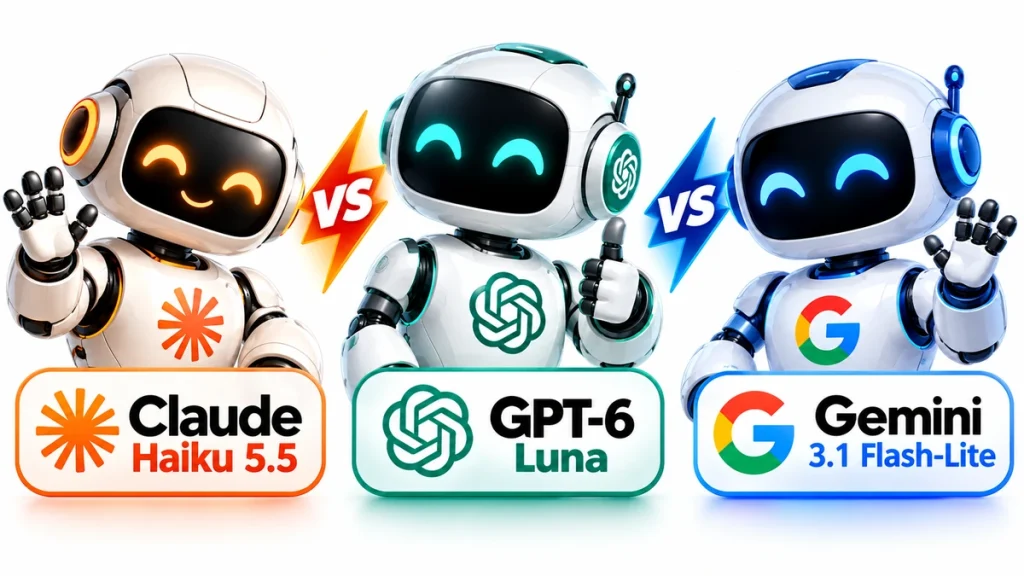
Best Cheap AI Models in 2026: Claude Haiku 5.5 vs GPT-6 Luna vs Gemini 3.1 Flash-Lite
Running advanced AI no longer has to cost several dollars per million tokens.
Three of the most interesting efficiency-focused AI models available in 2026 are:
Claude Haiku 5.5
GPT-6 Luna
and:
Gemini 3.1 Flash-Lite
All three are designed for high-volume workloads where speed and cost matter.
But their pricing structures are surprisingly different.
For shorter prompts, Claude Haiku 5.5 and GPT-6 Luna currently start at exactly:
$0.10 per million input tokens
and:
$0.50 per million output tokens
Google’s Gemini 3.1 Flash-Lite costs:
$0.25 per million text/image/video input tokens
and:
$1.50 per million output tokens
At first glance, that appears to make Haiku and Luna an easy tie for cheapest.
But context length changes the picture.
Claude Haiku 5.5 becomes substantially more expensive when the prompt exceeds:
100,000 tokens
GPT-6 Luna does not receive its long-context price increase until input exceeds:
272,000 tokens
Gemini 3.1 Flash-Lite, meanwhile, provides a 1M-token context window, broad multimodal input support and a free API tier under Google’s applicable usage limits.
So the best cheap AI model depends heavily on what you are actually building.
Best Cheap AI Models in 2026: Quick Answer
| Best for | Model |
|---|---|
| Lowest cost for short prompts | Claude Haiku 5.5 / GPT-6 Luna tie |
| Cheapest 100K–272K prompt range | GPT-6 Luna |
| Cheapest very long prompt among these three | GPT-6 Luna |
| Broadest multimodal input | Gemini 3.1 Flash-Lite |
| Largest context window | GPT-6 Luna — 1.05M |
| Claude ecosystem/subagents | Claude Haiku 5.5 |
| Built-in agent tools | GPT-6 Luna |
| Google Search/Maps integration | Gemini 3.1 Flash-Lite |
| Free prototyping tier | Gemini 3.1 Flash-Lite |
| Maximum standard output | Haiku 5.5 / Luna — 128K |
There is no universal winner.
But for pure token economics, GPT-6 Luna currently has the strongest all-around pricing structure once prompts become larger than 100K tokens.
Claude Haiku 5.5 vs GPT-6 Luna vs Gemini 3.1 Flash-Lite
| Feature | Claude Haiku 5.5 | GPT-6 Luna | Gemini 3.1 Flash-Lite |
|---|---|---|---|
| Developer | Anthropic | OpenAI | |
| Model ID | claude-haiku-5-5 | gpt-6-luna | gemini-3.1-flash-lite |
| Base input price | $0.10/M | $0.10/M | $0.25/M |
| Base output price | $0.50/M | $0.50/M | $1.50/M |
| Context window | 1M | 1.05M | ~1.05M |
| Max output | 128K | 128K | 65,536 |
| Image input | Yes | Yes | Yes |
| Audio input | No | No | Yes |
| Video input | No | No | Yes |
| PDF input | Via document workflows | Via tools/files | Native supported input |
| Reasoning/thinking | Adaptive | Adjustable reasoning | Thinking supported |
| Long-context price increase | Above 100K | Above 272K | Standard listed rate |
| Batch pricing | 50% discount | 50% discount | Discounted Batch API |
| Free developer tier | Platform-dependent | API free tier not supported | Yes, subject to limits |
Official pricing and specifications come from Anthropic, OpenAI and Google’s current developer documentation.
1. Claude Haiku 5.5
Anthropic released Claude Haiku 5.5 on:
October 7, 2026
It is Anthropic’s cheapest and fastest current Claude model.
The model is designed for workloads including:
- summarization;
- extraction;
- classification;
- routing;
- customer support;
- database queries;
- document processing;
- compaction; and
- AI subagents.
For a complete breakdown, see our Claude Haiku 5.5 pricing, features and benchmarks guide.
Claude Haiku 5.5 Pricing
For prompts up to:
100,000 tokens
Anthropic charges:
Input: $0.10/M
Output: $0.50/M
Cache read: $0.01/M
This is extremely inexpensive.
However, once the prompt exceeds 100K tokens, pricing rises to:
Input: $0.50/M
Output: $2.50/M
That is a:
5× price increase
in both base input and output rates.
This pricing breakpoint is one of the most important differences in this comparison.
Claude Haiku 5.5 Context Window
Haiku 5.5 supports:
1 million tokens
of context.
It also supports:
128,000 standard output tokens
and up to:
300,000 output tokens
through Anthropic’s Batch API beta.
That is impressive for an efficiency-class model.
But developers planning to use hundreds of thousands of prompt tokens should calculate cost using the higher pricing tier.
Claude Haiku 5.5 Advantages
Claude Haiku 5.5 is particularly strong when you want:
- very cheap short-context calls;
- fast Claude responses;
- Claude subagents;
- summarization;
- classification;
- retrieval tasks;
- customer support;
- document processing; and
- large-scale repetitive workloads.
Anthropic specifically positions it as a companion to Sonnet and Opus in multi-model agent systems.
Claude Haiku 5.5 Weakness
The biggest weakness is straightforward:
long-context pricing.
The model supports a 1M-token context window, but its cheapest advertised rate applies only while prompts remain at or below 100K tokens.
That means the context window is technically huge without always being economically cheap to fill.
2. GPT-6 Luna
GPT-6 Luna is OpenAI’s current efficiency-focused GPT-6 model.
OpenAI describes it as:
its most efficient model for focused, high-volume tasks.
It combines:
- low token pricing;
- a 1.05M context window;
- 128K maximum output;
- adjustable reasoning;
- image input;
- structured outputs;
- function calling; and
- built-in tool support.
Read our detailed GPT-6 Luna pricing, features and context-window guide.
GPT-6 Luna Pricing
OpenAI currently lists standard pricing at:
Input: $0.10/M
Cached input: $0.01/M
Output: $0.50/M
That exactly matches Haiku 5.5’s base short-prompt pricing.
But Luna has an important advantage:
Its long-context surcharge does not begin until a request contains more than:
272,000 input tokens
For prompts above 272K, OpenAI lists:
2× input pricing
and:
1.5× output pricing
for the entire request.
That makes the effective long-context rates approximately:
Input: $0.20/M
Output: $0.75/M
under standard processing.
That remains significantly below Haiku 5.5’s over-100K rates of:
$0.50/M input
and:
$2.50/M output
GPT-6 Luna Context Window
OpenAI lists:
1,050,000 tokens
of context.
Maximum output:
128,000 tokens
That gives Luna a slightly larger documented context window than Claude Haiku 5.5.
GPT-6 Luna Tool Support
Luna’s strongest differentiator may be its tools.
OpenAI currently lists support for:
- web search;
- file search;
- image generation;
- code interpreter;
- hosted shell;
- computer use;
- function calling;
- structured outputs;
- MCP;
- tool search; and
- other Responses API capabilities.
That makes Luna particularly interesting for inexpensive agentic workflows.
For companies exploring agents, see our AI Agents for Small Business guide.
GPT-6 Luna Advantages
Luna’s strongest advantages are:
- extremely low base price;
- cheaper long context than Haiku;
- 1.05M context;
- 128K output;
- broad tool support;
- adjustable reasoning;
- image understanding;
- computer use; and
- OpenAI Responses API integration.
GPT-6 Luna Weakness
Luna is OpenAI’s efficiency model, not its maximum-capability model.
Very difficult:
- software engineering;
- scientific reasoning;
- professional research;
- autonomous work; and
- complex computer-use tasks
may benefit from GPT-6.1 Sol or GPT-6 Astra.
For the highest-capability end of the market, see our Best AI Models in 2026 comparison.
3. Gemini 3.1 Flash-Lite
Google describes Gemini 3.1 Flash-Lite as a:
low-latency, cost-effective multimodal model optimized for high-frequency, lightweight tasks.
It is designed for:
- translation;
- high-volume agentic workflows;
- simple data processing;
- extraction;
- multimodal analysis; and
- applications where latency and API price matter.
Gemini 3.1 Flash-Lite Pricing
Google currently lists:
Text/image/video input: $0.25/M
Audio input: $0.50/M
Output including thinking tokens: $1.50/M
Context caching for text/image/video costs:
$0.025/M
Google also offers a free API tier subject to applicable rate limits and product terms.
The base paid rates are higher than Luna and Haiku.
But Gemini provides broader native input modalities.
Gemini 3.1 Flash-Lite Context Window
Google lists an input-token limit of:
1,048,576
and an output limit of:
65,536 tokens
That puts its context capacity very close to GPT-6 Luna.
But its maximum output is roughly half the:
128K
available from Luna and Haiku.
Gemini 3.1 Flash-Lite Multimodal Support
This is where Gemini stands out.
Google officially lists input support for:
- text;
- images;
- video;
- audio; and
- PDFs.
Neither Luna nor Haiku offers the same combination of native input modalities in the comparison.
If your workload includes:
video + audio + PDFs + text
Gemini’s higher token price may be worth paying.
Gemini Tools
Google currently lists capabilities including:
- code execution;
- file search;
- function calling;
- structured outputs;
- thinking;
- URL context;
- Google Search grounding;
- Google Maps grounding; and
- context caching.
It does not list computer use for Gemini 3.1 Flash-Lite.
Which Model Is Actually Cheapest?
The answer depends on context length.
For a normal short prompt
Haiku 5.5:
$0.10/M input + $0.50/M output
GPT-6 Luna:
$0.10/M input + $0.50/M output
Gemini Flash-Lite:
$0.25/M input + $1.50/M output
Winner:
Haiku 5.5 and GPT-6 Luna tie
Between 100K and 272K input tokens
Haiku moves to:
$0.50/$2.50
Luna remains:
$0.10/$0.50
Gemini remains:
$0.25/$1.50
Winner:
GPT-6 Luna
Above 272K input tokens
Luna rises to approximately:
$0.20/$0.75
Haiku remains:
$0.50/$2.50
Gemini remains at its standard listed rates:
$0.25/$1.50
Winner on raw token price:
GPT-6 Luna
Real Cost Example: 50K Input + 5K Output
Consider a relatively focused request using:
50,000 input tokens
and:
5,000 output tokens
Claude Haiku 5.5
Input:
0.05 × $0.10 = $0.005
Output:
0.005 × $0.50 = $0.0025
Total:
$0.0075
GPT-6 Luna
Same rates:
$0.0075
Gemini 3.1 Flash-Lite
Input:
0.05 × $0.25 = $0.0125
Output:
0.005 × $1.50 = $0.0075
Total:
$0.02
Result:
Haiku and Luna cost less than one cent for this simplified token-only example.
Gemini costs approximately:
2 cents
Cost Example: 200K Input + 10K Output
Now context length begins to matter.
Claude Haiku 5.5
Because the prompt exceeds 100K:
Input:
0.2 × $0.50 = $0.10
Output:
0.01 × $2.50 = $0.025
Total:
$0.125
GPT-6 Luna
200K remains below Luna’s 272K threshold.
Input:
0.2 × $0.10 = $0.02
Output:
0.01 × $0.50 = $0.005
Total:
$0.025
Gemini Flash-Lite
Input:
0.2 × $0.25 = $0.05
Output:
0.01 × $1.50 = $0.015
Total:
$0.065
Result:
GPT-6 Luna: $0.025
Gemini: $0.065
Haiku: $0.125
In this example, Luna costs only one-fifth as much as Haiku.
Cost Example: 500K Input + 20K Output
Claude Haiku 5.5
Input:
0.5 × $0.50 = $0.25
Output:
0.02 × $2.50 = $0.05
Total:
$0.30
GPT-6 Luna
This exceeds 272K, so use its higher rates:
Input:
0.5 × $0.20 = $0.10
Output:
0.02 × $0.75 = $0.015
Total:
$0.115
Gemini 3.1 Flash-Lite
Input:
0.5 × $0.25 = $0.125
Output:
0.02 × $1.50 = $0.03
Total:
$0.155
Result:
Luna: $0.115
Gemini: $0.155
Haiku: $0.30
This is why developers should never compare cheap models using only their headline price.
Which Is Best for AI Agents?
GPT-6 Luna
Probably the strongest option to test first if your agent needs many built-in tools.
OpenAI supports:
- web search;
- files;
- code interpreter;
- computer use;
- shell;
- function calling; and
- MCP.
Claude Haiku 5.5
Particularly attractive as a:
subagent
inside a Claude system.
Anthropic explicitly recommends Haiku for routine supporting work alongside Sonnet or Opus.
Gemini 3.1 Flash-Lite
Strong when the agent requires:
- Google Search grounding;
- Google Maps;
- URL context;
- code execution;
- multimodal data.
So the winner depends on the surrounding ecosystem.
Which Is Best for Customer Support?
Claude Haiku 5.5 is especially compelling.
Anthropic specifically positions it for:
- live support;
- routing;
- classification;
- summarization; and
- fast real-time interactions.
GPT-6 Luna is also a strong option because it offers the same base token price plus extensive tools.
For text-heavy customer support, I would test:
Haiku and Luna side by side
using your actual support tickets.
Which Is Best for Documents?
If documents are primarily:
text
Haiku and Luna are both extremely inexpensive.
For very large documents over 100K tokens:
Luna has the better pricing structure.
For mixed documents including:
- images;
- audio;
- video; and
- PDFs,
Gemini becomes more attractive.
Which Is Best for Translation?
Google explicitly positions Gemini 3.1 Flash-Lite for high-volume translation.
Its native multimodal support also makes it useful when translation workflows involve:
- screenshots;
- documents;
- audio;
- video; or
- PDFs.
For text-only translation at huge scale, however, Haiku and Luna’s lower token prices deserve testing.
Which Is Best for Coding?
None of these three should automatically be considered the best model for highly complex coding.
They are efficiency-oriented models.
Haiku 5.5 has made a major coding leap relative to Haiku 4.5.
Luna provides powerful coding-related tools and adjustable reasoning.
Gemini Flash-Lite supports code execution and function calling.
But for difficult repository-wide work, stronger models such as:
- Claude Sonnet/Opus;
- GPT-6.1 Sol/Astra; or
- higher-end Gemini models
may produce better task completion rates.
A model that costs five times more per token can still be cheaper per successful task if it solves the problem in one attempt instead of five.
Which Is Best for Multimodal AI?
Gemini 3.1 Flash-Lite wins on breadth.
It supports:
Text
Images
Video
Audio
and:
as native documented input types.
Haiku supports text and images.
Luna supports text and images.
For businesses building workflows around audio or video analysis, Gemini’s extra token cost may be justified.
Which Has the Largest Context Window?
The published limits are:
GPT-6 Luna: 1,050,000
Gemini 3.1 Flash-Lite: 1,048,576
Claude Haiku 5.5: 1,000,000
All three are effectively million-token models.
Luna has the numerical lead.
Which Has the Largest Output?
Claude Haiku 5.5:
128K standard
GPT-6 Luna:
128K
Gemini 3.1 Flash-Lite:
65,536
Haiku also supports up to:
300K
through its Batch API beta.
For very large text-generation jobs, Haiku and Luna have a clear standard-output advantage.
Which Offers the Best Caching?
Base cache-read rates include:
Claude Haiku 5.5
For prompts ≤100K:
$0.01/M
Above 100K:
$0.05/M
GPT-6 Luna
Short context:
$0.01/M
Long context:
approximately:
$0.02/M
Gemini 3.1 Flash-Lite
Text/image/video cache tokens:
$0.025/M
plus applicable storage charges.
The best caching system depends on how frequently the same context is reused and for how long.
Which Has the Best Free Tier?
Google has the clearest advantage for API experimentation.
Google lists a:
free-of-charge Gemini API tier
for Gemini 3.1 Flash-Lite, subject to its rate limits and terms.
OpenAI’s GPT-6 Luna API documentation currently lists:
Free API tier: not supported
Anthropic’s available access depends on Claude products and developer billing arrangements rather than an equivalent universal free API tier.
For students or developers simply experimenting:
Gemini is attractive because of the free tier.
Don’t Choose Only by Token Price
The cheapest token is not necessarily the cheapest AI workflow.
Consider:
Model A
Cost per task:
$0.02
Success rate:
50%
Model B:
Cost per task:
$0.04
Success rate:
95%
Model B may deliver a lower:
cost per successful task
despite costing twice as much per request.
Measure:
- accuracy;
- task completion;
- retries;
- latency;
- human correction;
- token usage;
- tool costs; and
- failure rate.
That is the only reliable way to identify the best model for production.
Best Model by Use Case
| Use case | Model to test first |
|---|---|
| Short text requests | Haiku 5.5 or Luna |
| Long text context | GPT-6 Luna |
| Claude-based subagents | Haiku 5.5 |
| Tool-heavy AI agents | GPT-6 Luna |
| Audio/video/PDF understanding | Gemini 3.1 Flash-Lite |
| Google Search/Maps workflows | Gemini |
| Free API experimentation | Gemini |
| Very large output | Haiku or Luna |
| Customer-support routing | Haiku 5.5 |
| Computer-use agent | GPT-6 Luna |
| High-volume translation | Gemini or Haiku — test both |
When Should You Use Claude Haiku 5.5?
Choose Haiku first when:
- requests usually stay under 100K prompt tokens;
- you are already using Claude;
- you need an inexpensive subagent;
- classification or extraction dominates;
- latency matters;
- customer support is a key workload.
Avoid blindly filling its 1M context window without modeling the higher token price.
When Should You Use GPT-6 Luna?
Choose Luna first when:
- you need long context;
- agent tools matter;
- you need web or computer use;
- prompts frequently exceed 100K;
- OpenAI’s Responses API fits your stack;
- you need a 128K output limit;
- cost at scale is important.
Among the three models compared here, Luna currently has the strongest raw long-context price structure.
When Should You Use Gemini Flash-Lite?
Choose Gemini when:
- you need audio input;
- you need video input;
- native PDF processing matters;
- Google Search grounding matters;
- Maps grounding matters;
- you want a free developer tier;
- you process multimodal information at scale.
Its raw token price is higher, but token price is only part of the product.
Are Cheap AI Models Good Enough for Business?
Often, yes.
Businesses frequently do not need the world’s most powerful AI model for every task.
Many workflows involve:
- sorting;
- extraction;
- classification;
- retrieval;
- summarization;
- routing;
- repetitive transformations.
Using an expensive frontier model for every step can be wasteful.
A common architecture is:
cheap model → routine task
mid-tier model → harder task
frontier model → exceptional case
This routing approach can dramatically reduce total AI cost.
Cheap Models and AI Agents
Agent systems make low-cost models even more important.
One agentic workflow might make:
10
50
or:
hundreds
of model calls before completing one user task.
At that scale, token price matters.
But reliability matters too.
The best system may use Luna or Haiku for routine steps and escalate complex work to a stronger model.
For practical examples, see our AI Agents for Small Business guide.
Frequently Asked Questions
What is the cheapest AI model in 2026?
Among Claude Haiku 5.5, GPT-6 Luna and Gemini 3.1 Flash-Lite, Haiku and Luna tie at the lowest base standard rates for short prompts: $0.10/M input and $0.50/M output.
Is Claude Haiku 5.5 cheaper than GPT-6 Luna?
For prompts up to 100K, their headline input/output rates are the same.
Above 100K prompt tokens, Luna becomes cheaper because Haiku moves to $0.50/$2.50 pricing.
Is GPT-6 Luna cheaper than Gemini 3.1 Flash-Lite?
At current standard text-token rates, yes.
Luna starts at $0.10/M input and $0.50/M output versus Gemini’s $0.25/M input and $1.50/M output.
Which cheap AI model has the largest context window?
GPT-6 Luna has the largest published limit at 1,050,000 tokens, narrowly above Gemini 3.1 Flash-Lite’s 1,048,576 and Haiku’s 1M.
Which supports video?
Gemini 3.1 Flash-Lite supports video input.
Which supports audio?
Gemini 3.1 Flash-Lite supports audio input.
Which supports computer use?
OpenAI lists computer use among GPT-6 Luna’s supported tools.
Which is best for Claude users?
Claude Haiku 5.5 is the natural efficiency model for the Claude ecosystem and is explicitly designed to work as a subagent alongside larger Claude models.
Which has a free API tier?
Google lists a free Gemini 3.1 Flash-Lite API tier subject to applicable limits.
Which is best for 200K-token prompts?
Based purely on standard token pricing, GPT-6 Luna is substantially cheaper than Haiku 5.5 at that prompt size because Haiku’s higher tier starts above 100K.
Which model is best overall?
There is no universal winner. Luna currently offers particularly strong raw price/context economics, Haiku is attractive for Claude subagents and short requests, while Gemini has the broadest native multimodal input support.
The cheap-model market has become extremely competitive.
For short prompts, the headline winner is a tie:
Claude Haiku 5.5: $0.10 input / $0.50 output
GPT-6 Luna: $0.10 input / $0.50 output
Gemini 3.1 Flash-Lite is more expensive at:
$0.25 input / $1.50 output
per million tokens.
But the comparison changes once context gets longer.
Haiku moves to:
$0.50 input / $2.50 output
above 100K prompt tokens.
Luna does not increase its standard pricing until the request exceeds:
272K input tokens
and even then its approximate standard long-context rates are only:
$0.20 input / $0.75 output
Gemini sits between them in our large-context cost examples while providing the broadest multimodal support.
So our practical recommendations are:
Best short-prompt value: Claude Haiku 5.5 or GPT-6 Luna
Best long-context value: GPT-6 Luna
Best broad multimodal model: Gemini 3.1 Flash-Lite
Best Claude subagent: Claude Haiku 5.5
Best built-in tool ecosystem among these three: GPT-6 Luna
Best free API experimentation: Gemini 3.1 Flash-Lite
The most important lesson is not to choose an AI model from its headline token price alone.
Test all serious candidates on your actual workload and calculate:
cost per successfully completed task
That is the number that ultimately matters.
Related Reading on Elite Era Trends
Claude Haiku 5.5: Pricing, Features, Benchmarks & API
What Is GPT-6 Luna? Pricing, Features, Context Window & How to Use It
Best AI Models in 2026: GPT-6 Astra vs Gemini 4 Argon vs Claude