Googlebook 2026: Release Date, Price, Specs and Gemini AI Features Explained
Googlebook 2026: Release Date, Price, Specs and Gemini AI Features Explained
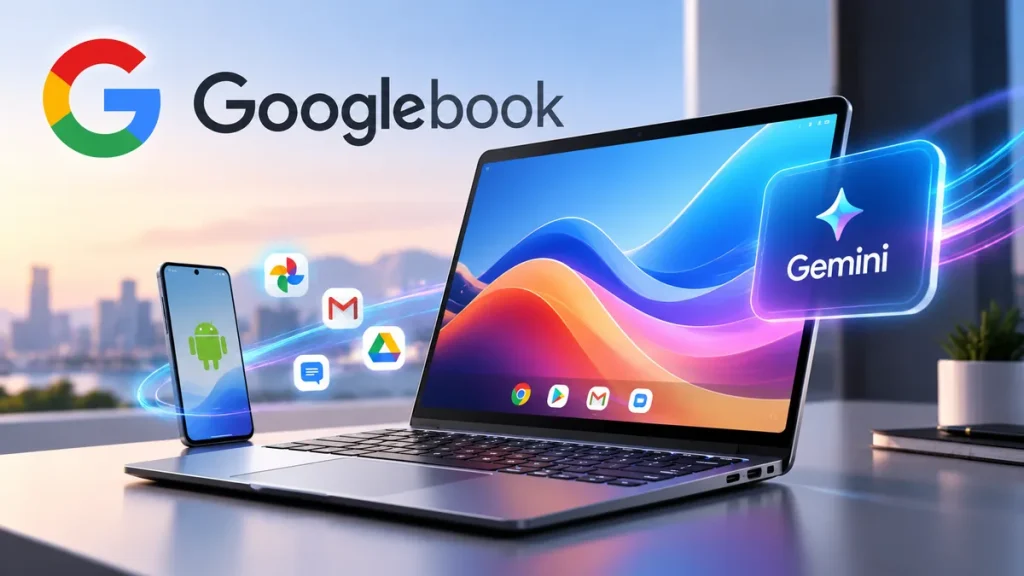
Google is officially entering a new era of laptops with Googlebook, a premium computer platform built around Android, ChromeOS desktop technology and Gemini artificial intelligence.
Googlebook laptops go on sale in the United States on October 4, 2026, following pre-orders that opened September 21.
Prices start at:
$899
and the first generation includes laptops from:
- Acer
- ASUS
- Dell
- HP
- Lenovo
Unlike traditional Chromebooks, which have historically covered everything from inexpensive education laptops to premium devices, Google is positioning Googlebook as a distinct premium AI-focused laptop category.
Every launch model includes at least 16GB of RAM, touchscreen hardware and processors from Intel or Qualcomm, while Google says some configurations offer up to 32GB of memory, 2.8K OLED displays and as much as 14 hours of video playback.
The bigger story, however, is software.
Googlebook is designed around what Google calls Gemini Intelligence, with new features including Magic Pointer, Rambler voice dictation, customizable AI-generated widgets, Android phone integration and Gemini background tasks.
Here is everything you need to know about Googlebook in 2026.
Googlebook 2026 at a Glance
| Feature | Googlebook |
|---|---|
| U.S. release date | October 4, 2026 |
| Pre-orders opened | September 21, 2026 |
| Starting price | $899 |
| Launch manufacturers | Acer, ASUS, Dell, HP, Lenovo |
| Operating platform | Android technology + ChromeOS desktop foundations |
| AI system | Gemini Intelligence |
| Minimum RAM | 16GB |
| Maximum RAM | Up to 32GB on some models |
| Display | Touchscreen, up to 2.8K OLED |
| Processors | Intel Core Ultra / Snapdragon X Elite |
| NPU performance | More than 45 TOPS |
| Video battery life | Up to 14 hours |
| Web browsing | Up to 16 hours on some configurations |
| Android apps | Yes |
| Chrome extensions | Yes |
| Linux environment | Yes |
| AI feature | Magic Pointer |
| Voice feature | Rambler |
| Custom widgets | Create My Widget |
| Included AI plan | 12 months Google AI Pro |
| Software updates | Up to 10 years |
Google says all launch Googlebooks use premium materials such as aluminum, magnesium alloy and carbon fiber, with minimum hardware standards designed to distinguish the new category from entry-level Chromebooks.
When Is the Googlebook Release Date?
The official Googlebook release date in the United States is October 4, 2026.
Googlebook pre-orders began:
September 21, 2026.
The international rollout begins one day after the U.S. launch.
Google says Googlebooks reach stores on October 5 in:
- Canada
- United Kingdom
- Ireland
- France
- Germany
- Australia
Pre-orders are available through Google’s store, Best Buy and selected retailers.
Google first previewed the platform in May 2026 before revealing the full hardware lineup and opening pre-orders in September.
How Much Does Googlebook Cost?
Googlebook pricing starts at:
$899 in the United States.
That is important because Google is deliberately positioning Googlebook above the budget Chromebook market.
Googlebook is meant to compete more directly with premium Windows laptops and Apple’s MacBook lineup rather than $200 or $300 education-focused Chromebooks.
The first-generation devices vary in price depending on:
- manufacturer;
- processor;
- display;
- memory;
- storage;
- materials;
- size.
The $899 entry price applies to the lower end of the initial premium lineup.
Higher-end launch configurations reach well above $1,000.
Which Companies Make Googlebooks?
Google itself provides the platform and software experience, but the laptops are manufactured by established PC companies.
The first five Googlebook partners are:
Acer
Acer provides the only convertible model in the initial lineup.
Its design can switch between traditional laptop and tablet configurations.
ASUS
ASUS focuses heavily on portability.
Google says its launch model weighs approximately:
2.2 pounds.
Dell
Dell’s Googlebook is positioned as a balanced premium model combining portability, display quality and performance.
HP
HP focuses on premium industrial design and materials.
Lenovo
Lenovo provides the largest productivity-focused option, with a:
15-inch display.
Google says this first group is designed to provide different form factors rather than requiring every manufacturer to build nearly identical hardware.
Is Googlebook Made by Google?
Not exactly.
Google controls the underlying Googlebook software platform, AI integration and hardware requirements.
But companies such as Acer, ASUS, Dell, HP and Lenovo manufacture the actual computers.
This approach is similar to Microsoft’s relationship with the wider Windows PC industry.
Google provides the platform.
Hardware partners provide different laptop designs.
That gives consumers multiple configurations while allowing Google to establish common standards for the category.
What Is Googlebook OS?
Googlebook is built using:
Android technology
combined with:
desktop foundations from ChromeOS.
Google describes the result as a laptop platform designed specifically around Gemini Intelligence.
That means Googlebook is not simply Android stretched onto a large screen.
It includes desktop-oriented features such as:
- window management;
- desktop Chrome;
- Chrome extensions;
- keyboard and mouse interfaces;
- file management;
- Linux tools;
- multitasking.
At the same time, its Android foundation allows it to run apps from Google Play and communicate deeply with Android phones.
This combination is central to Google’s strategy.
Google wants Android phone owners to have a laptop that feels like part of the same ecosystem.
Is Googlebook Replacing Chromebook?
No.
Googlebook and Chromebook are separate product categories.
Chromebooks will continue to exist.
Googlebook is aimed at the higher end of the market.
A simple way to understand the positioning is:
| Category | Main Focus |
|---|---|
| Chromebook | Broad market, education, everyday computing |
| Googlebook | Premium AI-native computing |
| Windows laptop | Broad desktop software compatibility |
| MacBook | Premium Apple ecosystem |
Googlebook borrows important ChromeOS foundations, but the platform is being marketed around premium hardware, Android integration and Gemini.
What Is Gemini Intelligence?
Gemini Intelligence is the AI layer built directly into Googlebook.
Instead of treating Gemini as simply another chatbot website or app, Google integrates Gemini into the desktop interface.
The goal is to let AI interact with what the user is already doing.
Features include:
- Magic Pointer;
- Rambler;
- Create My Widget;
- background Gemini tasks;
- proactive suggestions;
- Gemini Live;
- Android-phone context.
Google describes the computer as moving from a traditional operating system toward what it calls an “intelligence system.”
What Is Magic Pointer?
Magic Pointer is one of Googlebook’s signature features.
Normally, moving a mouse pointer simply selects something.
Google’s Magic Pointer adds Gemini.
Users can quickly activate Gemini around whatever they are pointing at or selecting.
For example, Google says users can ask Gemini to:
- explain text;
- translate content;
- compare items;
- organize information;
- act on calendar details;
- work with images.
The important idea is context.
Instead of manually copying something from one application and pasting it into an AI chatbot, Magic Pointer can understand the item directly on the screen.
What Is Rambler?
Rambler is Google’s AI-powered voice dictation system.
It is designed for people who can explain something verbally faster than they can type it.
Instead of simply converting speech word-for-word into text, Rambler can organize spoken thoughts.
Google says it can turn an unstructured verbal “brain dump” into:
- notes;
- bullet points;
- action items;
- structured writing;
- formatted summaries.
For students, writers, managers and professionals who regularly dictate notes, this may be one of the most practical Googlebook AI features.
What Is Create My Widget?
Googlebook also introduces:
Create My Widget.
Users describe the widget they want in natural language.
Gemini then creates it.
For example, someone might ask for a desktop widget that shows:
- sports scores;
- countdowns;
- project information;
- personal reminders;
- frequently checked data.
The user does not need traditional programming skills.
Can Gemini Work When the Laptop Is Closed?
Some tasks can continue in the background.
Google says Gemini Spark can process certain longer-running requests while the laptop is closed.
That moves Googlebook closer to the concept of an AI agent.
Instead of every AI interaction requiring the user to sit in front of the computer and wait for an answer, certain tasks can continue independently.
This broader shift toward AI systems that complete tasks instead of merely answering questions is also visible across other platforms.
How Does Googlebook Work With Android Phones?
Android integration is one of Google’s main selling points.
When setting up a Googlebook, users can bring over information from their Android phone, including:
- saved passwords;
- Wi-Fi networks;
- settings;
- messages.
Google says this transfer uses end-to-end encryption.
After setup, several cross-device features become available.
Continue On
Continue On lets users start something on their phone and continue on the laptop.
For example, someone could begin working in an app while commuting and then reopen that same task from the Googlebook taskbar.
The goal resembles Apple’s Handoff concept but is designed around the Android ecosystem.
Phone Files
Googlebook’s Files app can access files and photos stored on a connected Android phone.
That means users do not have to:
email files to themselves,
manually upload them,
or search through cloud-storage folders
simply to move something from phone to laptop.
Cast My Apps
Cast My Apps lets users stream supported Android phone applications into desktop windows.
The application remains connected to the phone but can be viewed and controlled from Googlebook.
Google gives examples such as:
- delivery apps;
- Messages;
- verification codes;
- other mobile-only workflows.
This could be particularly useful for Android applications that do not yet have optimized desktop versions.
Does Googlebook Run Android Apps?
Yes.
Googlebook gives users access to applications through the Google Play ecosystem.
Google says the platform supports millions of Android apps, including applications optimized for:
large displays,
keyboard input,
and mouse input.
Examples highlighted by Google include:
- Adobe Photoshop;
- Adobe Lightroom;
- CapCut;
- Netflix;
- HBO Max.
Offline viewing is also supported in compatible streaming applications. blog.google
Does Googlebook Have Desktop Chrome?
Yes.
Googlebook includes a desktop-class version of:
Google Chrome
with Chrome extension support.
This is important because it means Googlebook is not limited to mobile-style browsing.
Users can run browser-based productivity tools and extensions much like they would on another desktop platform.
That combination gives Googlebook access to both:
the web ecosystem
and:
Android applications.
Can Googlebook Run Linux?
Yes.
Googlebook includes an isolated Linux environment with terminal access.
Google says the Linux environment runs through a security-certified hypervisor.
Developers can use it to:
- clone repositories;
- run command-line tools;
- write software;
- test code;
- operate AI development tools.
Google specifically mentions tools such as:
Claude Code
and:
Antigravity CLI.
That makes Googlebook substantially different from a simple Android tablet with a keyboard attached.
What Is Google Antigravity?
Antigravity is Google’s agentic development platform.
It is included with Googlebook and can be used to build, test and deploy applications.
Google says developers can use Antigravity directly from the laptop alongside its Linux environment.
The inclusion shows that Google is not positioning Googlebook exclusively for casual consumers.
Software developers and technically advanced users are also part of the target audience.
Can Googlebook Play Games?
Yes, although it is not primarily marketed as a gaming laptop.
Android games are available through the Google Play ecosystem.
Google also says every Googlebook purchase includes a complimentary year of:
GeForce NOW.
Cloud gaming allows demanding PC games to run remotely on powerful servers while the video is streamed to the laptop.
The quality of that experience depends heavily on internet speed, latency and GeForce NOW availability.
Googlebook Processor Options
The first Googlebooks use processors from:
Intel
and:
Qualcomm.
Google specifically highlights:
Intel Core Ultra Series 3
and:
Snapdragon X Elite.
The processors are paired with neural processing units capable of more than:
45 TOPS
of on-device AI performance.
TOPS means:
trillions of operations per second.
It is commonly used as one measure of an NPU’s AI-processing capability.
Is Googlebook Fanless?
Some configurations are designed to run demanding AI workloads quietly.
Google says its selected processors and NPUs help provide significant on-device AI performance without the constant fan noise associated with some high-performance computers.
Whether a specific model contains a fan or operates fanlessly depends on its hardware design.
So buyers should check the specifications of the individual Acer, ASUS, Dell, HP or Lenovo model rather than assuming every Googlebook uses identical cooling.
How Much RAM Does Googlebook Have?
Every Googlebook launches with at least:
16GB of RAM.
Some configurations support:
32GB.
That minimum is significant.
Many inexpensive Chromebooks historically shipped with 4GB or 8GB.
Google is establishing a much higher baseline for Googlebook because the devices are intended for:
- multitasking;
- AI processing;
- creative applications;
- development;
- premium productivity.
How Much Storage Does Googlebook Have?
Storage depends on the manufacturer and configuration.
Google’s store advertises configurations beginning around:
256GB
with many launch configurations providing:
512GB or more.
Users should therefore compare specific models rather than assuming storage is standardized across the entire Googlebook category.
What Type of Display Does Googlebook Use?
Google requires touchscreen displays across the platform.
Higher-end models offer:
up to 2.8K OLED resolution.
Google also emphasizes:
- outdoor brightness;
- reduced glare;
- touch interaction;
- premium panel quality.
Display size varies across manufacturers.
Lenovo offers the largest launch option at around:
15 inches.
What Is the Googlebook Glowbar?
Googlebook brings back a hardware design element called the:
Glowbar.
The light strip can display different visual patterns.
Google says it can:
- animate when the laptop starts;
- visualize battery status;
- react during Gemini interactions;
- support developer-created effects.
Google is opening access to the Glowbar so software developers can create their own animations.
The feature is partly functional and partly aesthetic.
It also gives Googlebook a recognizable visual identity separate from conventional laptops.
What Is Googlebook Battery Life?
Google says Googlebook models can provide up to approximately:
14 hours of video playback
and:
16 hours of web browsing
depending on configuration.
Real-world battery life will vary with:
- brightness;
- processor;
- display;
- applications;
- AI workloads;
- wireless connectivity;
- battery capacity.
So advertised figures should be treated as controlled-test estimates rather than guaranteed everyday runtime.
How Heavy Is Googlebook?
Weight depends on manufacturer.
The ASUS launch model is particularly light at approximately:
2.2 pounds.
Other models prioritize larger displays or convertible designs and therefore weigh more.
Google is generally targeting thin-and-light premium notebook territory rather than bulky workstation or gaming-laptop designs.
Does Googlebook Include Google AI Pro?
Yes.
Google says each new Googlebook includes:
12 months of Google AI Pro.
The bundle provides:
5TB of cloud storage
plus higher usage limits for Gemini and access to Google’s premium AI services.
Google also bundles limited trials of other services, including selected creative applications and YouTube Premium.
Offer eligibility and redemption deadlines can vary by country and account.
How Long Will Googlebook Receive Updates?
Google says Googlebook OS will receive:
up to 10 years of regular feature drops and updates.
Long support periods matter because consumers increasingly keep premium laptops for several years.
It also gives Google time to add future Gemini and Android features without requiring entirely new hardware immediately.
Is Googlebook Secure?
Google says the platform uses security architecture derived from ChromeOS.
Features include:
- hardware-backed security;
- Google Titan security hardware;
- defense-in-depth protection;
- on-device malware detection;
- isolated Linux virtualization.
Google also says Googlebook includes a Level 5 security-certified pKVM hypervisor for separating the Linux environment from sensitive parts of the system.
Biometric options depend on hardware configuration but can include fingerprint or facial authentication.
Googlebook vs Chromebook: What’s the Difference?
The difference is mainly positioning, hardware standards and AI integration.
| Feature | Googlebook | Chromebook |
|---|---|---|
| Starting market | Premium | Budget to premium |
| Minimum RAM | 16GB | Varies widely |
| Gemini integration | Deep system integration | Available, varies |
| Android apps | Yes | Yes |
| Desktop Chrome | Yes | Yes |
| Android phone integration | Advanced | More limited |
| Magic Pointer | Yes | No standard requirement |
| Rambler | Yes | No |
| Create My Widget | Yes | No |
| Premium materials | Standard focus | Depends on model |
| NPU | 45+ TOPS on launch models | Varies |
| Starting price | $899 | Much lower options available |
Googlebook therefore is not simply “a more expensive Chromebook.”
Google is attempting to establish a different category centered around AI-native computing and tighter Android integration.
Googlebook vs Windows AI Laptop
Googlebook will compete directly with premium Windows laptops featuring AI-focused processors.
Both categories offer:
- powerful NPUs;
- premium hardware;
- AI assistants;
- productivity features;
- developer tools.
The major difference is ecosystem.
Googlebook is designed primarily around:
Gemini + Android + Google services.
Windows AI PCs revolve more heavily around:
Windows + Microsoft services + Copilot.
For readers comparing Microsoft’s approach, see our [Copilot Home vs Code vs Autopilot guide](/copilot-home-vs-code-vs-autopilot/).
Choosing between them will likely depend less on benchmark numbers alone and more on which phone, applications and cloud ecosystem someone already uses.
Googlebook vs MacBook
Googlebook also competes indirectly with Apple’s MacBook family.
Apple’s advantage is its mature integration between:
- Mac;
- iPhone;
- iPad;
- Apple Watch;
- iCloud.
Googlebook attempts to create a comparable ecosystem experience for Android users.
Its strongest differentiation may therefore be:
Android continuity.
Someone already heavily invested in Android phones, Gmail, Google Drive, Google Photos and Gemini may find Googlebook more naturally integrated than macOS.
Mac users, however, continue to benefit from Apple’s established desktop software ecosystem and Apple Silicon performance.
Who Is Googlebook For?
Googlebook appears primarily aimed at people who:
- use an Android phone;
- want premium laptop hardware;
- regularly use Google services;
- want Gemini deeply integrated;
- use Android apps;
- rely heavily on Chrome;
- want AI productivity tools;
- need Linux development tools.
It may be particularly interesting for:
students,
developers,
content creators,
remote workers,
Android enthusiasts,
and professionals already centered around Google’s ecosystem.
Who May Not Need a Googlebook?
A Googlebook may be less compelling for someone who relies heavily on traditional Windows-only software.
The same applies to users deeply embedded in the Apple ecosystem.
Someone who needs only:
email,
basic web browsing,
YouTube,
and simple documents
may also find a cheaper Chromebook sufficient.
The key value proposition is therefore not simply that Googlebook is faster.
It is that Gemini and Android integration are built into the laptop experience.
Is Googlebook Worth $899?
That depends on what the buyer expects from the device.
The $899 starting price provides premium specifications including:
- at least 16GB RAM;
- touchscreen hardware;
- modern Intel or Qualcomm processors;
- dedicated AI acceleration;
- premium construction;
- long software support;
- one year of Google AI Pro.
Those specifications put Googlebook closer to premium laptops than inexpensive Chromebooks.
However, the strongest reason to choose one is likely the software ecosystem rather than raw hardware value.
Someone who rarely uses Gemini or an Android phone may not benefit as much from its unique features.
What Is Google’s Bigger Strategy?
Googlebook represents something larger than another laptop launch.
Google has spent years building separate platforms for:
Android phones,
Chromebooks,
Chrome,
Gemini,
and cloud services.
Googlebook attempts to combine those pieces into one premium computing experience.
The strategy is centered around three ideas:
AI-first computing
Android ecosystem integration
and:
premium hardware.
Instead of asking users to open an AI chatbot whenever they need assistance, Google wants Gemini embedded throughout normal desktop workflows.
That could become an important direction across the wider PC industry.
Frequently Asked Questions About Googlebook
What is Googlebook?
Googlebook is Google’s new premium laptop category built around Android technology, ChromeOS desktop foundations and Gemini Intelligence.
When does Googlebook come out?
Googlebook launches in U.S. stores on October 4, 2026. International availability in several markets begins October 5.
How much does Googlebook cost?
Googlebook starts at $899 in the United States.
Who makes Googlebook laptops?
The first models come from Acer, ASUS, Dell, HP and Lenovo.
Does Google make its own Googlebook?
Google provides the platform, software and hardware standards, while partner PC manufacturers build the laptops.
Does Googlebook run Android?
Googlebook uses an Android technology foundation combined with desktop capabilities derived from ChromeOS.
Does Googlebook run Android apps?
Yes. Googlebook supports Android applications through Google Play.
Does Googlebook have Chrome?
Yes. It includes desktop-class Chrome and supports Chrome extensions.
Can Googlebook run Linux?
Yes. Google provides an isolated Linux environment with terminal access.
What is Magic Pointer?
Magic Pointer lets users invoke Gemini around content they are pointing at or selecting on the screen.
What is Rambler?
Rambler is an AI voice-dictation feature that converts spoken thoughts into structured writing.
What is Create My Widget?
It lets users describe a custom desktop widget in natural language and have Gemini generate it.
Does Googlebook work with Android phones?
Yes. Features include Continue On, phone-file access and Cast My Apps.
How much RAM does Googlebook have?
Every launch Googlebook has at least 16GB of RAM, with some configurations offering up to 32GB.
What processor does Googlebook use?
Launch devices include Intel Core Ultra Series 3 and Snapdragon X Elite processors.
What is Googlebook battery life?
Google advertises up to approximately 14 hours of video playback, with some configurations rated for as much as 16 hours of web browsing.
Does Googlebook include Gemini?
Yes. Gemini Intelligence is one of the core components of the Googlebook experience.
Is Google AI Pro free with Googlebook?
Eligible purchases include 12 months of Google AI Pro with 5TB of cloud storage and expanded Gemini access.
Is Googlebook replacing Chromebook?
No. Googlebook is a separate premium category rather than a complete replacement for Chromebook.
Is Googlebook good for developers?
Googlebook includes Linux terminal access and Google’s Antigravity development platform, making it suitable for many web, Android and AI-development workflows.
How long will Googlebook receive updates?
Google says the platform will receive updates and regular feature drops for up to 10 years.