Nvidia China Export Controls 2026: Why H100, A100 and H200 AI Chips Are Restricted
Nvidia China Export Controls 2026: Why H100, A100 and H200 AI Chips Are Restricted
The United States began imposing licensing requirements affecting Nvidia’s A100 and H100 data-center GPUs in 2022. Those restrictions have subsequently been revised and expanded several times as AI chips have become faster and as regulators have changed the technical thresholds used to determine which products require authorization. Nvidia says the current controls are complex and evaluate characteristics including processing performance, performance density, memory bandwidth and interconnect bandwidth.
The subject is receiving renewed attention after federal prosecutors charged California technology-company owner Greg Lui with allegedly participating in a scheme involving more than $300 million of export-controlled computer servers ultimately destined for China. DOJ’s public announcement describes U.S.-manufactured GPUs; reporting based on the indictment identifies Nvidia hardware including H100 and A100 chips.
Nvidia products are not universally banned in China.
Whether a particular chip or system can be exported depends on the hardware, its performance, the destination, the customer, the customer’s parent company, the intended use and the applicable authorization.
Here is how the Nvidia China export-control system works in 2026.
Nvidia China Export Controls at a Glance
| Question | Current Situation |
|---|---|
| Are Nvidia A100 chips affected? | Yes |
| Are Nvidia H100 chips affected? | Yes |
| Can H200 chips be sold to China? | Limited shipments have been licensed for certain customers |
| Is H20 unrestricted? | No — U.S. licensing requirements were imposed in 2025 |
| Are all Nvidia products banned? | No |
| Are gaming GPUs always controlled? | Depends on model and technical thresholds |
| Can products be routed through a third country to evade China rules? | No |
| Regulator | U.S. Commerce Department’s BIS |
| Main regulations | Export Administration Regulations |
| Why controls exist | U.S. national-security and foreign-policy rationale |
| Why topic is trending | Recent alleged AI-server smuggling cases |
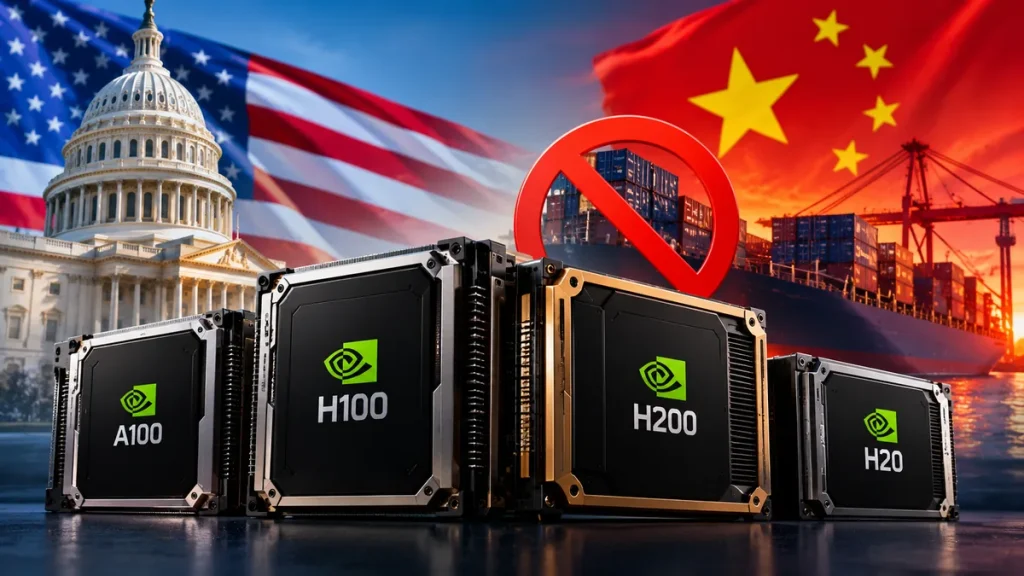
Nvidia’s latest SEC filing says export rules specifically affect products including A100, H100 and numerous other advanced GPUs and systems.
Why Are Nvidia AI Chips Restricted in China?
The U.S. government’s stated rationale is that sufficiently powerful advanced-computing chips can have both civilian and military applications.
Modern data-center GPUs can train and run large artificial-intelligence models, accelerate scientific computing, perform simulations and process enormous datasets.
DOJ describes H100 and H200 GPUs as high-speed processors used for AI and high-performance computing and says such chips can support both civilian and military applications. Justice.gov
For that reason, the Commerce Department’s Bureau of Industry and Security, or BIS, regulates exports and reexports of certain advanced computing products.
The U.S. position is that restricting access to particular high-performance technologies can reduce the ability of countries or entities of national-security concern to use American technology for military, intelligence or advanced computing applications.
Those are the government’s stated policy objectives; Nvidia has separately warned investors that broad restrictions can hurt U.S. suppliers, reduce its access to the Chinese market and help competitors develop larger ecosystems. SEC
What Is BIS?
BIS stands for the:
Bureau of Industry and Security.
It is part of the U.S. Department of Commerce.
BIS administers the Export Administration Regulations, commonly abbreviated as the EAR.
The EAR regulate exports, reexports and certain transfers of commodities, software and technology subject to U.S. jurisdiction.
The rules include the Commerce Control List, which places controlled items into specific classifications.
A transaction may require government authorization depending on factors including the item, destination, customer, ultimate parent organization and intended use.
That means export compliance is considerably more complicated than asking:
“Is Nvidia allowed in China?”
The correct question is closer to:
“Is this particular Nvidia product allowed to be transferred to this particular customer, parent company and end use under the rules currently in force?”
When Did the U.S. Restrict Nvidia H100 and A100 Chips?
The first major restrictions relevant to Nvidia’s modern AI accelerators arrived in:
August 2022.
Nvidia says the U.S. government introduced export licensing requirements targeting China’s semiconductor and supercomputing industries and that these restrictions specifically affected its:
A100
and:
H100
integrated circuits, as well as DGX systems and other systems or boards incorporating those chips. SEC
The rules did not remain static.
They evolved as technology evolved.
What Changed in 2023?
The U.S. government expanded its advanced-computing restrictions in October 2023.
According to Nvidia’s current SEC disclosures, the expanded rules affected products exceeding specific performance thresholds, including various models such as:
- A100
- A800
- H100
- H800
- L4
- L40
- L40S
- RTX 4090
- GB200 NVL72
- B200
The rules also extended beyond a product’s immediate shipping address.
They can apply when a customer is headquartered—or its ultimate parent is headquartered—in a restricted country group that includes China.
This parent-company element is important because it makes simply routing equipment through another jurisdiction insufficient if the transaction still falls within U.S. controls.
What Is the Nvidia H100?
The Nvidia H100 Tensor Core GPU became one of the defining processors of the generative-AI boom.
It was designed for large-scale artificial-intelligence and high-performance-computing workloads.
DOJ court filings describe the H100 as a data-center GPU built to deliver a major performance increase for AI and HPC applications.
Unlike a normal graphics card primarily intended to render video games, H100 systems are commonly deployed in servers and large computing clusters.
Thousands of GPUs can be connected together to train sophisticated AI models.
That is why a shipment containing dozens or hundreds of H100s can represent millions of dollars of computing hardware.
What Is the Nvidia A100?
The A100 is the previous-generation Nvidia data-center accelerator that preceded the H100.
It was also designed for:
AI training,
machine learning,
data analytics,
and:
high-performance computing.
Although newer Nvidia architectures are now available, A100 chips remain powerful enough to fall within U.S. advanced-computing export controls.
Federal prosecutors alleged in another 2025 case that conspirators illegally exported 400 Nvidia A100 GPUs to China between October 2024 and January 2025.
That illustrates an important principle:
Export controls do not automatically disappear when a chip is no longer Nvidia’s newest product.
Is the Nvidia H200 Banned in China?
The answer is more complicated than a simple yes or no.
Nvidia says the U.S. government began granting licenses in February 2026 allowing it to ship small amounts of H200 products to specific China-based customers.
Those shipments remain tightly controlled.
Nvidia says licensed H200 units must go through a U.S. inspection process before being shipped to the customer. The company also says it has shipped only a fraction of the amount permitted under those licenses, and H200 China-program shipments represented less than 1% of its latest quarterly Data Center revenue.
Nvidia additionally says Chinese government restrictions have limited its ability to complete all sales permitted by the U.S. licenses.
So the accurate description is:
Certain H200 shipments to specific China-based customers can occur under U.S. licenses, but the product is not freely exportable to China.
Why Is the H200 Different From the H100?
The H200 is a later Nvidia data-center accelerator building on the Hopper architecture used in the H100 generation.
Its role is similar in broad terms:
accelerating large AI and high-performance-computing workloads.
The regulatory difference in 2026 is not that the H200 is less powerful than the H100.
Rather, the government has permitted a limited licensed program for some H200 shipments under specific conditions.
Nvidia’s filings emphasize that such licenses do not amount to unrestricted China market access.
What Happened to Nvidia H20?
The H20 has its own regulatory history.
Nvidia developed lower-performance products for the Chinese market as earlier U.S. export-control thresholds restricted more capable data-center GPUs.
But in April 2025, Nvidia says the U.S. government informed the company that exports of the H20 to China and certain other destinations would also require licenses.
The financial impact was substantial.
Nvidia recorded approximately:
$4.5 billion
in charges associated with H20 excess inventory and purchase obligations during fiscal 2026 after the new licensing requirement reduced demand.
The U.S. later granted licenses allowing certain H20 products to be shipped to specific Chinese customers.
Nvidia reported approximately:
$60 million
of H20 revenue under those licenses.
Again, licensed sales are different from unrestricted sales.
Can Nvidia Sell Any GPUs in China?
Yes.
Not every Nvidia product is controlled in exactly the same way.
Nvidia’s latest regulatory filing says the company has continued shipping uncontrolled products, including some gaming and workstation GPUs, into China.
The major regulatory focus is the advanced-computing market.
Nvidia says that, under the current U.S. and Chinese regulatory environment, it has effectively been prevented from competing broadly in China’s data-center compute market with products that receive approval from both governments. SEC
That distinction matters.
“China cannot buy Nvidia” is inaccurate.
A more accurate statement is:
China’s access to some Nvidia products—particularly advanced data-center computing products—is heavily restricted or subject to licensing requirements.
How Do Alleged Nvidia Chip Smuggling Schemes Work?
There is no single method.
However, several recent federal cases contain similar alleged patterns.
Prosecutors have alleged the use of:
third-country destinations,
false end-user information,
shell companies,
straw purchasers,
misclassified shipping documents,
and:
freight-forwarding companies.
One common allegation involves transshipment.
A controlled item may be shipped from the United States to a country where the initial shipment appears permissible.
It is then allegedly moved onward to a restricted destination such as China.
DOJ alleged this type of arrangement in the Greg Lui case, saying servers were sent through locations including Malaysia and Singapore before reaching China. Justice.gov
Is Shipping Nvidia Hardware Through Malaysia Illegal?
No.
Shipping computers or GPUs to Malaysia is not inherently illegal.
Malaysia is a major technology manufacturing and logistics center.
The legal issue arises when an exporter allegedly knows that an intermediary destination is being used to conceal a controlled item’s true ultimate destination or end user.
The Greg Lui indictment alleges exactly that type of conduct, but those charges remain allegations that prosecutors must prove in court.
The difference is therefore between:
a legitimate Malaysian customer
and:
an alleged transshipment arrangement designed to evade U.S. controls.
What Is a Reexport?
A reexport occurs when an item subject to U.S. export controls is moved from one foreign country to another foreign destination.
This concept is crucial to understanding AI-chip controls.
U.S. rules do not necessarily stop applying once a controlled product leaves an American port.
BIS regulations expressly address exports, reexports and in-country transfers of advanced-computing items. Bureau of Industry and Security
That is why moving a controlled server from:
United States → Malaysia
and subsequently:
Malaysia → China
can still implicate U.S. export rules.
What Is Transshipment?
Transshipment simply means cargo passes through an intermediate country or logistics point on the way to its final destination.
It is a normal part of global commerce.
For example, millions of lawful products move through ports in:
Singapore,
Malaysia,
Hong Kong,
Dubai,
and Rotterdam.
Transshipment becomes legally problematic when it is used to circumvent applicable export restrictions or conceal the true consignee, buyer or destination.
The concept is therefore neutral.
The intent and legal requirements surrounding the transaction determine whether conduct is lawful.
Have There Been Other Nvidia Smuggling Cases?
Yes.
The Greg Lui prosecution is not the first U.S. criminal case alleging illicit Nvidia GPU exports to China.
In November 2025, DOJ charged four people in an alleged conspiracy involving Nvidia GPUs.
Federal prosecutors said that:
400 A100 GPUs
were successfully exported to China between October 2024 and January 2025.
Authorities also disrupted attempted shipments involving:
10 HPE supercomputers containing H100 GPUs
and:
50 H200 GPUs.
The defendants were accused of using false paperwork and misleading authorities about the actual destination.
What Was Operation Gatekeeper?
Another major enforcement action was known as:
Operation Gatekeeper.
DOJ announced the operation in December 2025 and said it disrupted a China-linked AI-technology smuggling network.
Authorities said they seized more than:
$50 million
in Nvidia technology and cash.
One company owner pleaded guilty to smuggling and unlawful export activities involving Nvidia H100 and H200 GPUs.
Court documents described agreements to purchase thousands of GPUs worth approximately:
$160.8 million.
Prosecutors alleged some shipments passed through Singapore and Malaysia.
Why Are H100 and H200 Chips So Valuable?
Artificial intelligence increasingly depends on computing scale.
Training a sophisticated AI model requires repeatedly performing enormous numbers of mathematical operations over huge datasets.
GPUs are particularly suited to this kind of parallel computation.
A single high-end AI GPU is useful.
Thousands operating together inside a data center can train models with far greater computational requirements.
This is why high-end GPUs have become infrastructure rather than simply electronic components.
The AI industry increasingly competes over:
compute capacity,
electricity,
data centers,
networking,
semiconductor supply,
and:
access to advanced accelerators.
Are Nvidia RTX Gaming Cards Restricted Too?
Some have been affected by advanced-computing rules.
Nvidia’s SEC filings identify the RTX 4090 among products affected by expanded export licensing requirements introduced in 2023.
However, it would be inaccurate to say every GeForce gaming card is banned from China.
Controls rely on technical thresholds and other regulatory conditions.
Nvidia says it continues to sell some uncontrolled gaming and workstation GPUs into the Chinese market.
What Does ECCN Mean?
ECCN stands for:
Export Control Classification Number.
It is a classification used under the Commerce Control List.
An ECCN helps identify what controls apply to a particular item.
DOJ court documents involving H100 and H200 hardware have identified relevant advanced GPU systems under export-control classifications requiring licenses for China.
But determining the correct classification of a real product can require detailed technical and legal analysis.
Businesses should rely on BIS guidance and qualified export-compliance professionals rather than a general news article when making an actual shipment decision.
Does a License Mean the Export Is Automatically Approved?
No.
A license requirement means the exporter generally needs government authorization unless an applicable exception or other authorization permits the transaction.
BIS also maintains license exceptions that apply only when specified requirements are satisfied.
For example, current advanced-computing rules include the Notified Advanced Computing, or NAC, framework and other authorizations with detailed eligibility conditions.
The rules can also change.
That makes old articles about which Nvidia chip is “legal in China” particularly risky if they are not updated.
Can China Companies Legally Buy H200 GPUs in 2026?
Some can, under limited circumstances.
Nvidia says U.S. authorities granted licenses allowing small quantities of H200 products to be shipped to specific China-based customers beginning in February 2026.
That does not create a general right for every Chinese company to purchase H200 systems.
Customer-specific approval and other requirements remain relevant.
Nvidia also says Chinese restrictions have prevented it from completing all sales allowed under its U.S. licenses.
Why Does Nvidia Say Export Controls Hurt Its Business?
China has historically been an important technology market.
Restrictions prevent Nvidia from freely selling some of its most capable data-center products there.
Nvidia told investors that it has effectively been foreclosed from China’s data-center compute market under the current combination of U.S. controls and Chinese restrictions.
The company warns this can have several consequences.
Chinese and other competitors may gain customers.
Developers may adopt competing hardware.
Alternative AI ecosystems can grow.
Nvidia may have to reserve or write down inventory.
And the company can lose revenue it otherwise might have generated.
How Much Have China Restrictions Cost Nvidia?
Two recent examples show the financial impact.
When the U.S. imposed new H20 licensing requirements in April 2025, Nvidia recorded approximately:
$4.5 billion
in charges associated with excess inventory and purchase commitments.
The company later recorded another approximately:
$400 million
charge connected with H200 inventory and obligations as demand under the limited China licensing program diminished.
Those figures demonstrate that export controls can have material commercial consequences even for a company as large as Nvidia.
Does China Restrict Nvidia Too?
Yes.
The commercial relationship is affected by regulation on both sides.
Nvidia says the Chinese government restricted sales that had received U.S. licenses for certain H20 and H200 products.
The company also reports that Chinese regulators have investigated issues surrounding its business and its commitments associated with the earlier Mellanox acquisition.
That means Nvidia needs products and transactions acceptable under:
U.S. rules
and:
Chinese rules.
The company says finding a competitive data-center product that satisfies both governments has become extremely difficult.
Are U.S. Export Controls Permanent?
Not necessarily.
Export-control regulations change in response to:
technology,
security assessments,
foreign policy,
industry developments,
and government policy.
The U.S. has already revised advanced-computing restrictions multiple times since 2022.
BIS currently maintains detailed and frequently updated rules for advanced-computing items.
Therefore, statements such as:
“This Nvidia chip is permanently banned in China”
should be treated cautiously.
The legally relevant rules are the ones in force at the time of the transaction.
Nvidia China Export-Control Timeline
| Date | Major Development |
|---|---|
| August 2022 | U.S. restrictions affect Nvidia A100 and H100 exports to China |
| October 2023 | Rules expand to additional products and performance thresholds |
| April 2025 | H20 exports to China become subject to a license requirement |
| August 2025 | Certain H20 licenses granted |
| November 2025 | DOJ announces charges involving alleged A100/H100/H200 exports |
| December 2025 | Operation Gatekeeper announced |
| February 2026 | Limited H200 licenses begin for specific Chinese customers |
| October 2026 | Greg Lui charged in alleged $300M controlled-server scheme |
Frequently Asked Questions About Nvidia China Export Controls
Is Nvidia banned in China?
No.
Nvidia can still sell certain products in China. However, many advanced data-center GPUs are restricted, require licenses or are affected by other regulatory limitations.
Is Nvidia H100 banned in China?
H100 falls under U.S. advanced-computing export licensing requirements affecting China. It cannot simply be exported there like an unrestricted commercial product.
Can Nvidia H200 be sold to China?
Certain H200 shipments have been permitted under U.S. licenses for specific Chinese customers since February 2026. Nvidia says the program remains limited.
Is Nvidia H20 allowed in China?
The H20 became subject to U.S. licensing requirements in April 2025. Certain licenses were later granted, but sales remain constrained.
Is the Nvidia A100 restricted?
Yes. A100 was among the Nvidia chips specifically affected by U.S. China-related export requirements beginning in 2022.
Why does the U.S. restrict Nvidia AI chips?
U.S. authorities cite national-security concerns and the potential use of advanced computing hardware in sophisticated AI, military and intelligence applications.
Did Greg Lui smuggle Nvidia chips?
Federal prosecutors have charged Lui in an alleged export-control and smuggling scheme. He has not been convicted. DOJ’s public release refers to U.S.-made GPUs, while reporting on the indictment identifies Nvidia H100 and A100 hardware.
Can companies bypass the rules by shipping through Malaysia?
Legitimate exports to Malaysia are lawful when regulatory requirements are satisfied. Using a third country to conceal the true destination of a controlled export can violate U.S. law, depending on the facts and applicable regulations.
What is BIS?
BIS is the Commerce Department’s Bureau of Industry and Security, which administers the Export Administration Regulations.
What is an export license?
It is government authorization permitting a transaction that would otherwise be restricted under applicable export-control rules.
Are gaming GPUs banned from China?
Not universally. Some models have fallen within advanced-computing restrictions, while Nvidia says other gaming and workstation products remain uncontrolled.
Are Nvidia Blackwell chips restricted?
Nvidia’s disclosures identify certain Blackwell systems, including B200 and GB200 NVL72, among products affected by expanded U.S. licensing requirements when they meet applicable conditions.
Can the rules change?
Yes. U.S. advanced-computing export controls have already been modified several times since 2022, so current BIS regulations should be checked for actual transactions.
The phrase “Nvidia chip ban” oversimplifies what is actually a complex export-control system.
The United States does not prohibit every Nvidia product from being sold in China.
Instead, specific advanced-computing products and transactions are subject to restrictions or licensing requirements based on technical capabilities, destination, end user, corporate ownership and intended use.
Nvidia’s A100 and H100 have been affected by China-related restrictions since 2022.
The rules expanded in 2023.
H20 became subject to additional licensing requirements in 2025.
And in 2026, U.S. authorities have permitted limited H200 shipments to specific Chinese customers under licenses while Nvidia says Chinese restrictions have also constrained those sales.
The issue is especially relevant now because alleged attempts to circumvent those controls are generating substantial public attention.
Federal prosecutors have pursued several cases involving alleged shipments of Nvidia GPUs through third countries, including Operation Gatekeeper and the new Greg Lui prosecution.