Google Project Suncatcher: Why Google Is Testing AI Data Centers in Space
Google Project Suncatcher: Why Google Is Testing AI Data Centers in Space
Google has taken one of its most unusual artificial-intelligence experiments into orbit.
On October 1, 2026, the company launched the first prototype satellite for Project Suncatcher, a long-term research program exploring whether advanced AI computing infrastructure could eventually operate in space.
The prototype was built with satellite company Planet and launched aboard a SpaceX Falcon 9 as part of the Transporter-18 rideshare mission.
Google confirmed after launch that it had established contact with the spacecraft and that the satellite was operating as expected.
The mission is not a commercial AI data center.
It is an early technology experiment.
Google wants to learn whether the same specialized processors it uses for artificial intelligence on Earth can survive and operate reliably in the extreme conditions of low Earth orbit.
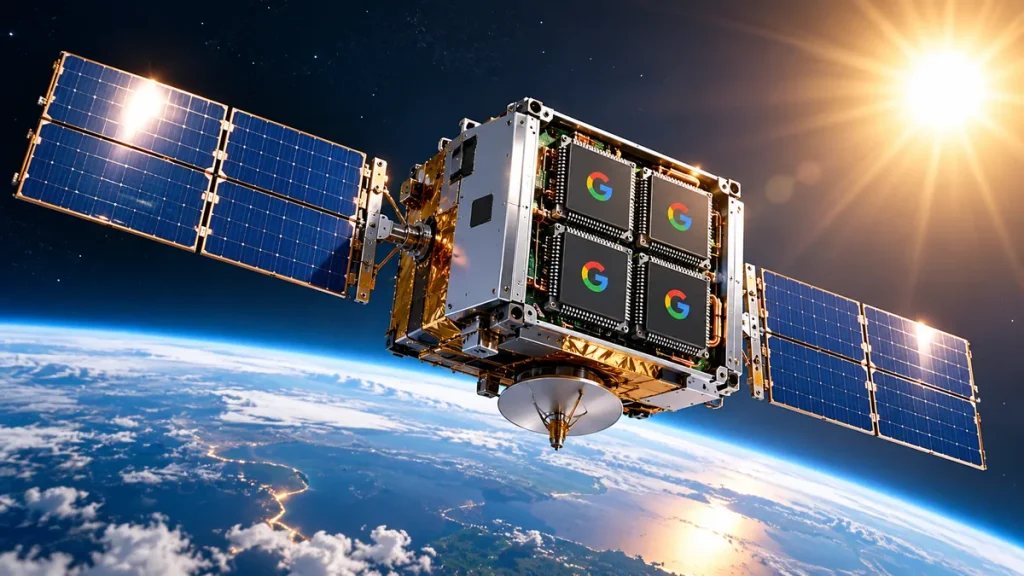
The test satellite carries several of Google’s Tensor Processing Units, or TPUs, which are specialized chips designed for machine-learning workloads.
The experiment will study:
- radiation exposure;
- extreme temperatures;
- launch vibration;
- heat dissipation;
- power generation;
- long-duration chip reliability.
If the technology works, Google believes future satellites could potentially form large computing networks powered by near-continuous sunlight.
That raises a remarkable possibility:
Some of the AI data centers of the future may not be located on Earth at all.
Project Suncatcher at a Glance
| Feature | Project Suncatcher |
|---|---|
| Company | |
| Project type | Orbital AI computing research |
| First prototype launch | October 1, 2026 |
| Launch provider | SpaceX |
| Rocket | Falcon 9 |
| Mission | Transporter-18 |
| Satellite partner | Planet |
| Orbit | Low Earth orbit |
| AI hardware | Google Tensor Processing Units |
| Number of TPUs | Four in first prototype |
| Main objective | Test AI hardware in space |
| Power source | Solar energy |
| Main challenges | Cooling, radiation, launch cost |
| Future goal | Networked AI satellites |
| Next major test | Two-satellite optical-link experiment |
| Expected next phase | 2027 |
| Commercial service available? | No |
What Is Google Project Suncatcher?
Project Suncatcher is Google’s research program investigating whether machine-learning computing infrastructure can operate in space.
Instead of building increasingly large terrestrial AI data centers, Google is exploring whether some future computing capacity could be placed aboard satellites.
These satellites could potentially use:
solar power
to operate specialized AI processors.
Eventually, Google imagines multiple satellites connected together through extremely fast optical communication links.
Rather than one satellite acting as a complete data center, many satellites could potentially work together as a distributed computing network.
That is the long-term vision.
The current mission is much smaller.
Google’s first satellite is primarily a technology-validation platform.
Its job is to answer basic engineering questions before anything larger can be considered.
When Did Project Suncatcher Launch?
Google’s first Project Suncatcher satellite launched on:
October 1, 2026.
The spacecraft traveled aboard a:
SpaceX Falcon 9 rocket
on the:
Transporter-18 rideshare mission.
Transporter missions allow multiple satellites from different companies and organizations to share the same rocket.
Google did not launch a dedicated Falcon 9 solely for Project Suncatcher.
Instead, the experimental satellite traveled alongside many other payloads headed into low Earth orbit.
After deployment, Google confirmed contact with the spacecraft.
The company said the satellite was operating as expected.
That milestone moved Project Suncatcher from a laboratory experiment into an actual spaceflight program.
Is Google Really Building a Data Center in Space?
Not yet.
This distinction is important.
Google has not launched a full AI data center into orbit.
The October 2026 spacecraft is a prototype.
It carries only a small number of AI processors compared with a terrestrial data center.
Modern Earth-based AI facilities can contain:
thousands,
tens of thousands,
or potentially hundreds of thousands
of specialized AI accelerators.
Project Suncatcher’s first satellite carries only:
four TPUs.
The goal is therefore not to compete with an Earth-based Google data center.
The goal is to test whether the fundamental building blocks could eventually work in orbit.
What Is a TPU?
TPU stands for:
Tensor Processing Unit.
A TPU is a specialized processor developed by Google for machine learning.
Traditional CPUs are designed to perform many different types of computing tasks.
GPUs were originally developed primarily for graphics but became extremely important for artificial intelligence because they can perform many calculations simultaneously.
Google’s TPUs are built specifically around machine-learning workloads.
They are used for tasks such as:
- training AI models;
- running AI inference;
- large-scale numerical calculations;
- processing neural networks.
Google already operates large TPU systems inside its terrestrial data centers.
Project Suncatcher asks a new question:
Can those same types of processors operate reliably in space?
How Many AI Chips Are on the Project Suncatcher Satellite?
The first Project Suncatcher prototype carries:
four Google TPUs.
That is tiny compared with a commercial AI cluster.
But the number is enough to conduct important experiments.
Google does not need thousands of processors to learn whether:
radiation damages the hardware,
cooling systems work,
electrical systems remain stable,
or processors can execute workloads in orbit.
The first mission is about proving basic engineering assumptions.
If those assumptions prove correct, later spacecraft could carry more computing hardware.
How Big Is the Project Suncatcher Satellite?
The first prototype has been described as roughly:
refrigerator-sized.
This makes it much larger than a tiny CubeSat but far smaller than a terrestrial server room.
Inside the spacecraft are:
- TPUs;
- computing electronics;
- power systems;
- communications hardware;
- thermal-control equipment;
- satellite-control systems.
The hardware must survive both launch and long-term operation in orbit.
That creates engineering problems that normal data-center equipment never experiences.
Why Does Google Want AI Data Centers in Space?
The biggest reason is:
energy.
Artificial intelligence requires enormous amounts of electricity.
Training frontier AI models can involve thousands of accelerators operating continuously.
Data centers also require substantial power for:
servers,
networking,
cooling,
storage,
and supporting infrastructure.
As AI usage grows, electricity availability is becoming one of the most important constraints facing technology companies.
Space offers a potentially attractive energy source:
the Sun.
Why Is Solar Power Better in Space?
Solar panels on Earth face several limitations.
They experience:
nighttime,
clouds,
atmospheric absorption,
seasonal changes,
and weather.
Satellites in carefully selected orbits can receive sunlight for much larger portions of their orbit.
Google says suitable orbital configurations could provide up to approximately:
eight times more usable solar energy
than comparable solar panels on Earth.
That does not mean a satellite automatically receives eight times the total electricity of an Earth data center.
The comparison relates to the amount of solar energy available to appropriately positioned panels.
But the potential is significant.
Near-continuous sunlight could allow orbital computing systems to generate large amounts of clean electricity without relying on terrestrial power grids.
Why Are Earth Data Centers Becoming a Problem?
AI data centers are expanding rapidly.
That expansion creates several challenges.
They require enormous amounts of:
electricity.
They also need:
water or other cooling infrastructure.
Large facilities require:
land,
power transmission,
network connections,
backup power,
and local permitting.
In some areas, proposed data centers have faced opposition because residents worry about:
electricity prices,
water consumption,
noise,
land use,
and grid reliability.
Space would avoid some of those local constraints.
But it introduces an entirely different set of engineering problems.
The Biggest Challenge: Cooling AI Chips in Space
Cooling may be the most difficult problem Project Suncatcher has to solve.
AI chips generate substantial heat.
On Earth, data centers can remove that heat using:
air cooling,
liquid cooling,
cooling towers,
water systems,
and large mechanical infrastructure.
Space is different.
There is essentially no atmosphere.
That means there is no surrounding air capable of carrying heat away from electronics.
A fan cannot cool a computer in the same way it does on Earth.
Instead, spacecraft must primarily remove heat through:
radiation.
Heat travels from internal components into specialized structures and is then radiated into space.
How Does Project Suncatcher Cool Its TPUs?
The prototype uses thermal-management technology involving components such as:
heat pipes
and:
radiators.
Heat generated by the TPUs is moved away from the processors and ultimately released as infrared radiation.
The first prototype has limited cooling capacity.
As a result, the TPUs are expected to operate in relatively short computing periods rather than continuously at maximum performance.
Reports indicate the processors may run for roughly:
15-minute intervals
before cooling periods are required.
That illustrates why the current spacecraft is an experiment rather than an operational data center.
Future systems would need dramatically more capable thermal-control systems.
Why Is Radiation a Problem for AI Chips?
Earth’s atmosphere protects electronic devices from much of the radiation found in space.
Satellites receive far greater exposure.
High-energy particles can interfere with electronics.
Potential effects include:
- temporary calculation errors;
- corrupted memory;
- damaged transistors;
- permanent component degradation.
Spacecraft often use radiation-hardened electronics.
But the most advanced commercial AI chips are designed primarily for Earth-based data centers.
Making specialized radiation-hardened versions could dramatically increase development costs.
Google therefore wants to understand whether commercial-style TPU hardware can survive real orbital conditions with reasonable protection.
Did Google Test the TPUs Before Launch?
Yes.
Google conducted extensive ground testing before sending the hardware into orbit.
The tests included simulated launch vibration.
Rocket launches expose satellites to:
intense vibration,
acceleration,
mechanical shock,
and acoustic forces.
Hardware designed for a quiet server rack must survive all of those stresses before it can even begin operating in space.
Google also conducted radiation testing to understand how its TPU hardware responds to energetic particles.
But laboratory tests cannot perfectly reproduce long-term orbital conditions.
That is why Google ultimately needed to launch actual hardware.
What AI Will Run on Project Suncatcher?
The experimental satellite is expected to run relatively modest AI workloads.
The purpose is not to train Google’s largest Gemini models in orbit.
Instead, engineers want to understand whether the hardware can successfully execute machine-learning calculations while exposed to real space conditions.
One reported test involves Google’s:
Gemma
family of open AI models.
Small workloads can help engineers measure:
performance,
power consumption,
error rates,
thermal behavior,
and reliability.
The mission is about collecting engineering data.
Why Not Train Gemini in Space Immediately?
The computing requirements would be enormous.
Training a frontier AI model can require clusters containing thousands of accelerators operating continuously for weeks or months.
Project Suncatcher has:
four processors.
That makes large-scale AI training impossible on the current spacecraft.
Google first needs to solve much more basic problems.
Those include:
- chip survival;
- cooling;
- power management;
- networking;
- reliability;
- launch economics.
Only after those challenges are addressed could orbital AI training become realistic.
Why Would Multiple Satellites Need to Work Together?
A future orbital data center could be distributed across many satellites.
Each spacecraft might contain processors and solar panels.
The satellites would need to communicate extremely quickly.
That is because AI training requires processors to exchange enormous quantities of data.
Inside terrestrial AI data centers, GPUs and TPUs are connected using extremely fast networking systems.
If equivalent computing hardware is distributed across space, satellites would need similarly high-speed communication.
Google’s proposed solution is:
laser links.
What Are Space Laser Links?
Laser communication uses beams of light to transmit information between spacecraft.
Compared with traditional radio communication, optical links can potentially provide extremely high bandwidth.
Future Suncatcher satellites could use lasers to exchange information directly.
That could allow many separate spacecraft to behave more like one large computing cluster.
Google plans to test this concept in a future mission.
What Happens to Project Suncatcher in 2027?
Google plans another important experimental phase in:
2027.
The company has discussed launching:
two prototype satellites
designed to test high-bandwidth communication between spacecraft.
That experiment will be significantly different from the October 2026 mission.
The current satellite primarily tests:
hardware survival
and:
thermal behavior.
The next phase is expected to focus more heavily on whether multiple satellites can work together.
That capability is essential if orbital computing is ever going to scale.
Why Doesn’t Google Just Build One Giant Space Data Center?
Launching one enormous data-center satellite would create serious problems.
A massive spacecraft would be:
expensive,
difficult to launch,
difficult to repair,
and vulnerable to a single failure.
Smaller modular satellites could offer more flexibility.
A constellation could potentially allow Google to:
add new hardware,
replace failed satellites,
scale capacity gradually,
and distribute computing resources.
This is similar to how companies build large satellite constellations for communications.
But AI computing would require much more power and much faster networking between spacecraft.
Could Project Suncatcher Reduce AI Energy Use on Earth?
Potentially—but not anytime soon.
Orbital data centers could theoretically reduce demand on terrestrial electrical grids.
Solar-powered satellites could generate electricity independently.
However, the full environmental calculation would also need to include:
rocket launches,
satellite manufacturing,
spacecraft replacement,
communications infrastructure,
and eventual deorbiting.
It is therefore too early to claim that space-based AI data centers would automatically be greener than Earth-based systems.
The project is still experimental.
What Would Orbital AI Data Centers Be Used For?
Several possible applications could make sense.
Satellite Image Processing
Earth-observation satellites generate enormous volumes of imagery.
Instead of transmitting every raw image to Earth, AI could analyze data in orbit.
Only useful results might need to be transmitted.
That could reduce communications requirements.
Weather and Climate Analysis
Space-based sensors collect huge amounts of environmental data.
AI processors could potentially analyze some information closer to where it is generated.
Defense and Security Applications
Governments could potentially use orbital computing for:
satellite monitoring,
communications,
reconnaissance,
and other workloads.
Commercial AI Computing
The most ambitious possibility would involve large orbital computing clusters performing general-purpose AI workloads.
That goal remains much further away.
Could Users Access AI From Space?
In principle, yes.
An orbital data center could process a request and return the answer through satellite communication networks.
However, latency would matter.
Low Earth orbit is much closer than traditional geostationary satellites, reducing communication delay.
Even so, terrestrial fiber networks remain extremely fast.
Orbital AI may therefore initially make more sense for applications already involving satellite data rather than ordinary consumer chatbot requests.
Is Google the First Company to Put AI Chips in Space?
No.
Other companies have also explored orbital computing.
Several startups are developing concepts involving:
GPUs,
data storage,
AI accelerators,
and cloud computing
in space.
One notable effort previously placed an Nvidia H100-class computing system in orbit for experimental purposes.
Google’s involvement is significant because of its scale.
Google already operates some of the world’s largest AI and cloud-computing infrastructure.
Its decision to seriously explore orbital computing suggests that electricity and data-center expansion are becoming strategically important issues for the AI industry.
Is SpaceX Building AI Data Centers Too?
SpaceX and companies associated with Elon Musk have also discussed ideas involving large satellite computing networks.
SpaceX already operates Starlink, one of the world’s largest satellite constellations.
That gives the company substantial experience with:
satellite manufacturing,
launch operations,
orbital networking,
and large constellation management.
However, Project Suncatcher is a Google research program.
SpaceX’s role in the first mission was primarily providing launch services through Falcon 9.
Is Amazon Working on Space Computing?
Amazon already operates major terrestrial cloud infrastructure through AWS and is developing its own satellite communications network.
The broader industry is increasingly interested in combining:
cloud computing,
satellite communications,
and artificial intelligence.
That does not mean every major cloud company has committed to building orbital AI data centers.
But the idea is receiving far more serious attention than it did several years ago.
How Much Would a Space AI Data Center Cost?
No reliable commercial price exists yet.
Project Suncatcher is still a research experiment.
Any large-scale orbital computing system would need to pay for:
processors,
spacecraft,
solar arrays,
radiators,
communications equipment,
launch services,
mission operations,
replacement satellites,
and ground infrastructure.
Launch cost remains one of the biggest barriers.
Even if the computing hardware becomes affordable, moving thousands of tons of infrastructure into orbit would be extremely expensive.
Reusable rockets could gradually reduce those costs.
But orbital AI infrastructure will need major economic improvements before it can compete with terrestrial data centers.
What Could Make Space Data Centers Economically Viable?
Several trends would need to occur.
Lower Launch Costs
Reusable rockets must become significantly cheaper.
More Efficient AI Chips
Processors must generate more computing performance per watt.
Better Cooling
Satellite radiators need to remove much more heat.
High-Speed Laser Networking
Thousands of processors must communicate effectively across separate spacecraft.
Longer Satellite Lifetimes
Hardware must operate reliably for years.
Larger AI Demand
The economic value of additional compute must remain high enough to justify orbital infrastructure.
If several of these trends improve simultaneously, the economics could change dramatically.
What Are the Risks of AI Data Centers in Space?
Orbital computing could create new problems.
Space Debris
More satellites increase collision risks.
A damaged spacecraft can create thousands of pieces of debris.
Radiation
Long-term exposure can damage electronics.
Cooling Failures
Processors may overheat if thermal systems fail.
Launch Failures
Every rocket launch carries some risk.
Cybersecurity
Satellite computing infrastructure could become an attractive target for cyberattacks.
Regulation
Countries may eventually create new rules governing orbital computing.
Environmental Impact
Large constellations could increase atmospheric effects from rocket launches and satellite reentry.
These challenges make orbital data centers significantly more complicated than simply placing servers on satellites.
Could Space Become the Next Cloud Computing Region?
Possibly, but that scenario remains speculative.
Today, cloud-computing providers build regions around the world.
Each region contains physical data centers connected by high-speed networks.
Orbital infrastructure could theoretically create a new type of computing region.
Instead of servers located in:
Virginia,
Oregon,
Singapore,
or Europe,
some computing capacity could exist in:
low Earth orbit.
But Project Suncatcher has not demonstrated anything close to that scale.
The current mission is an engineering experiment involving only a handful of processors.
Why Project Suncatcher Matters for the AI Industry
The most important part of Project Suncatcher may not be the satellite itself.
It reveals how serious the AI infrastructure challenge is becoming.
For much of the history of computing, progress depended primarily on:
faster processors
and:
better software.
AI has added another constraint:
massive infrastructure.
AI companies increasingly need:
gigawatts of electricity,
large data centers,
advanced cooling,
network infrastructure,
and huge numbers of specialized chips.
That creates pressure to find entirely new sources of energy and physical space.
Project Suncatcher represents one of the most extreme proposed solutions.
Instead of bringing more energy to the data center:
move the data center closer to the energy.
Project Suncatcher vs Earth Data Centers
| Feature | Earth Data Center | Orbital Data Center |
|---|---|---|
| Power | Electrical grid | Solar |
| Cooling | Air/liquid systems | Radiative cooling |
| Maintenance | Relatively easy | Extremely difficult |
| Launch required | No | Yes |
| Physical access | Yes | No |
| Network latency | Very low | Higher |
| Radiation exposure | Low | High |
| Solar availability | Limited | Near continuous in some orbits |
| Construction cost | High | Potentially much higher |
| Technology maturity | Established | Experimental |
| Commercial availability | Yes | No |
Frequently Asked Questions About Project Suncatcher
What is Google Project Suncatcher?
Project Suncatcher is Google’s research program exploring whether artificial-intelligence computing infrastructure can operate on solar-powered satellites in space.
Did Google launch Project Suncatcher?
Yes.
The first prototype satellite launched on October 1, 2026.
What rocket launched Project Suncatcher?
A SpaceX Falcon 9 launched the satellite as part of the Transporter-18 rideshare mission.
Is Project Suncatcher an AI data center?
Not yet.
The current spacecraft is a prototype designed to test AI hardware in orbit.
How many AI chips are on the satellite?
The first prototype carries four Google Tensor Processing Units.
What is a TPU?
A TPU is Google’s specialized processor designed for machine-learning and artificial-intelligence workloads.
Why does Google want data centers in space?
One major reason is access to abundant solar energy without relying on terrestrial electrical grids.
How much more solar energy is available in space?
Google says appropriate orbital systems could potentially access up to about eight times more solar energy than equivalent terrestrial installations.
How does Google cool AI chips in space?
Spacecraft use technologies such as heat pipes and radiators to transfer and radiate heat into space.
Can fans cool computers in space?
Not effectively in the same way as on Earth because space lacks surrounding air.
How long can Project Suncatcher’s TPUs operate?
The prototype is expected to run computing workloads in relatively short periods because of thermal limitations.
Will Google train Gemini in space?
Not with the current prototype.
The spacecraft carries far too little computing hardware for frontier-model training.
Does Project Suncatcher use Gemini?
The project is focused primarily on hardware testing, though small Google AI workloads can be used to evaluate the processors.
Is Project Suncatcher powered by solar panels?
Yes.
Solar energy is central to the long-term concept.
Who built Google’s satellite?
Google developed the mission in partnership with Planet.
What will happen in 2027?
Google plans further satellite experiments, including tests involving communication between spacecraft using high-speed optical links.
Could space data centers replace Earth data centers?
Not in the foreseeable future.
Orbital computing remains experimental and faces major economic and engineering challenges.
Is Google the only company working on space computing?
No.
Several companies are experimenting with orbital computing, GPUs and data storage.
Is Project Suncatcher a Google Cloud product?
No commercial Google Cloud service based on Suncatcher is currently available.
When could orbital AI data centers become commercially available?
Google has not announced a commercial launch date.