GPT-6 Luna vs GPT-6 Sol: Pricing, Features & Which Model Should You Use?
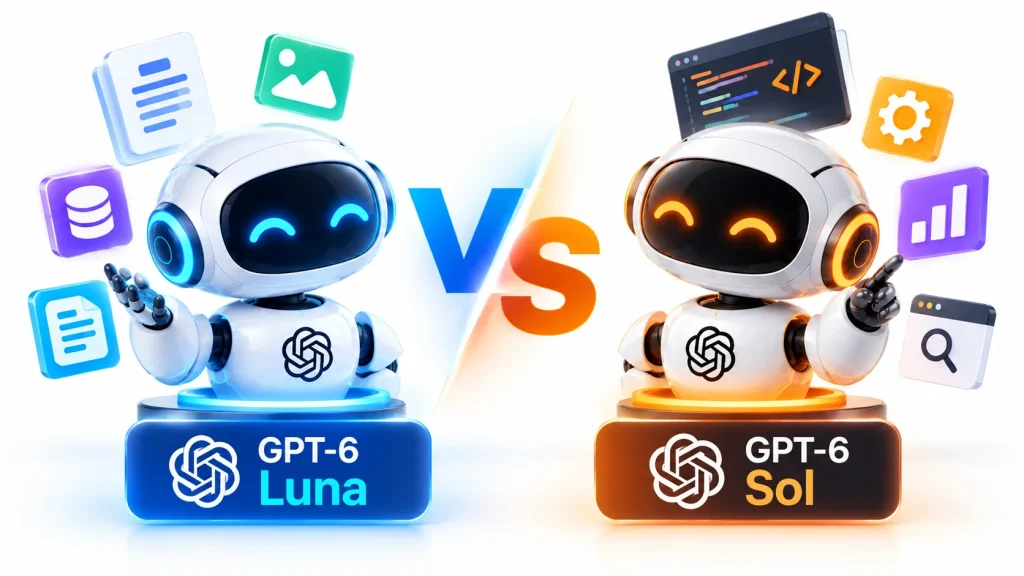
GPT-6 Luna vs GPT-6 Sol
Choosing between GPT-6 Luna vs GPT-6 Sol mainly comes down to one question:
Do you need maximum efficiency for frequent, well-defined tasks, or stronger capability for complex coding and agentic workflows?
OpenAI released GPT-6 Luna and GPT-6 Sol on September 22, 2026. Both models support reasoning, text and image input, a 1.05-million-token context window, up to 128,000 output tokens, structured outputs, function calling and modern AI tools.
The biggest differences are their intended workloads and price.
OpenAI describes:
GPT-6 Luna as its most efficient model for focused, high-volume tasks.
GPT-6 Sol as a model built for complex coding and agentic workflows.
The pricing difference is substantial.
For standard short-context API usage, GPT-6 Luna costs $0.10 per million input tokens and $0.50 per million output tokens.
GPT-6 Sol costs $2 per million input tokens and $10 per million output tokens.
That means Sol is 20 times more expensive per standard input and output token than Luna at those listed rates.
But price alone does not determine which model is better.
This guide compares GPT-6 Luna and GPT-6 Sol across pricing, reasoning, coding, AI agents, automation, context window, tools and real-world use cases so you can choose the model that fits your workload.
GPT-6 Luna vs GPT-6 Sol at a Glance
| Feature | GPT-6 Luna | GPT-6 Sol |
|---|---|---|
| Main purpose | Efficient high-volume work | Complex coding and agentic workflows |
| Model ID | gpt-6-luna | gpt-6-sol |
| Standard input price | $0.10 / 1M | $2 / 1M |
| Standard output price | $0.50 / 1M | $10 / 1M |
| Cached input | $0.01 / 1M | $0.20 / 1M |
| Context window | 1,050,000 | 1,050,000 |
| Max output | 128,000 | 128,000 |
| Reasoning | none to max | none to max |
| Text input | Yes | Yes |
| Image input | Yes | Yes |
| Structured outputs | Yes | Yes |
| Function calling | Yes | Yes |
| Web search | Yes | Yes |
| File search | Yes | Yes |
| Computer use | Yes | Yes |
| Knowledge cutoff | May 18, 2026 | April 20, 2026 |
OpenAI’s current model catalog and comparison documentation provide these specifications.
What Is GPT-6 Luna?
GPT-6 Luna is the efficiency-focused model in OpenAI’s current GPT-6 family.
OpenAI describes Luna as its most efficient model for focused, high-volume tasks.
It is designed for workloads where:
- Tasks run frequently
- Cost matters
- Instructions are relatively clear
- The problem is well scoped
- Large numbers of requests must be processed
- Maximum frontier-model intelligence is not required for every step
Possible use cases include:
- Data extraction
- Request classification
- Content tagging
- Document processing
- Customer-support triage
- Routine summarization
- Workflow routing
- High-volume automation
- AI-agent sub-tasks
If you want the complete model breakdown, read our dedicated guide to GPT-6 Luna.
What Is GPT-6 Sol?
GPT-6 Sol is the middle model in OpenAI’s GPT-6 flagship lineup.
OpenAI describes it as built to power complex coding and agentic workflows.
It sits between Luna and GPT-6 Astra.
OpenAI’s current model guidance frames the family roughly as:
- Luna: efficient, repeatable work at scale
- Sol: strong reasoning for demanding tasks
- Astra: highest capability for the hardest end-to-end work
GPT-6 Sol therefore makes more sense when tasks require greater judgment, deeper analysis or more sophisticated tool use.
Typical uses include:
- Software engineering
- Multi-step research
- Complex AI agents
- Coding workflows
- Document review
- Advanced automation
- Tool-heavy workflows
- Professional knowledge work
GPT-6 Luna vs GPT-6 Sol Pricing
Pricing is one of the largest differences between the two models.
For standard processing with shorter contexts, OpenAI currently lists:
| API Cost | GPT-6 Luna | GPT-6 Sol |
|---|---|---|
| Input / 1M tokens | $0.10 | $2.00 |
| Cached input / 1M | $0.01 | $0.20 |
| Cache writes / 1M | $0.125 | $2.50 |
| Output / 1M tokens | $0.50 | $10.00 |
At these rates, Sol costs:
20× more per input token
and
20× more per output token
than Luna.
That is a major difference when processing millions or billions of tokens.
GPT-6 Luna vs Sol Cost Example
Suppose your application processes:
10 million input tokens
and generates:
2 million output tokens.
GPT-6 Luna
Input:
10 × $0.10 = $1
Output:
2 × $0.50 = $1
Estimated model-token cost:
$2
GPT-6 Sol
Input:
10 × $2 = $20
Output:
2 × $10 = $20
Estimated model-token cost:
$40
In this simplified example, the same raw token volume costs approximately:
Luna: $2
Sol: $40
This calculation uses OpenAI’s listed standard short-context token rates and excludes tool calls, regional pricing, cache behavior and other possible charges.
That difference explains why model routing can matter so much.
You may not need Sol for every step of a workflow.
Long-Context Pricing
Both models become more expensive when prompts enter OpenAI’s long-context pricing tier.
OpenAI currently lists the following standard long-context rates:
| Long-Context Pricing | GPT-6 Luna | GPT-6 Sol |
|---|---|---|
| Input / 1M | $0.20 | $4 |
| Cached input | $0.02 | $0.40 |
| Cache writes | $0.25 | $5 |
| Output / 1M | $0.75 | $15 |
Developers planning to use the models’ full million-token context should account for these higher rates.
Context Window: Is Luna Smaller Than Sol?
No.
Both GPT-6 Luna and GPT-6 Sol have the same listed context window:
1,050,000 tokens.
Both also support up to:
128,000 output tokens.
This is important because Luna’s lower price does not mean it has a dramatically smaller context window.
Both models can process very large bodies of information.
Potential examples include:
- Large document collections
- Research archives
- Code repositories
- Business reports
- Customer histories
- Knowledge bases
- Technical documentation
The difference is more about capability and workload positioning than raw context capacity.
GPT-6 Luna vs GPT-6 Sol Reasoning
Both models support OpenAI’s reasoning system.
OpenAI lists the following reasoning-effort settings for Luna and Sol:
- none
- low
- medium
- high
- xhigh
- max
The default is medium.
This means developers can adjust how much reasoning effort the model uses depending on task difficulty.
A straightforward extraction job may work with Luna at a relatively low effort level.
A complicated research or coding workflow may justify Sol with higher reasoning effort.
OpenAI recommends evaluating the models on representative real-world tasks rather than automatically selecting the strongest configuration.
GPT-6 Luna vs Sol for Coding
If coding is your primary workload, GPT-6 Sol is the model OpenAI explicitly positions for complex coding workflows.
OpenAI describes Sol as built for:
complex coding and agentic workflows.
That makes Sol the more natural starting point for tasks such as:
- Repository-wide changes
- Complicated debugging
- Multi-file refactoring
- Architecture work
- Code review
- Large migrations
- Tool-driven development
- Complex testing
Luna can still perform coding tasks.
It may be appropriate for:
- Code classification
- Simple transformations
- Documentation
- Repetitive test generation
- Code summarization
- Well-defined edits
- High-volume code processing
The important distinction is task difficulty.
Using Sol for thousands of easy code-formatting jobs may waste money.
Using Luna for a difficult architectural migration may reduce output quality.
For another model focused heavily on agentic coding, see our guide to Claude Opus 5.5.
GPT-6 Luna vs GPT-6 Sol for AI Agents
Both models support the types of features needed for modern AI-agent workflows.
OpenAI lists support for:
- Function calling
- Web search
- File search
- Computer use
- Structured outputs
- Image input
for both models.
But they may serve different roles inside the same agent system.
Imagine an AI agent handling customer inquiries.
Luna Could Handle
- Intent classification
- Simple extraction
- Ticket categorization
- Basic retrieval
- Routine summaries
- Repetitive workflow decisions
Sol Could Handle
- Ambiguous customer problems
- Complex research
- Multi-step reasoning
- Difficult tool coordination
- Exception handling
- Detailed judgment
This approach is often called model routing.
Instead of sending every task to the same model, an application sends simple tasks to a cheaper model and escalates harder tasks when necessary.
That architecture may become increasingly important as AI agents for small business become more common.
GPT-6 Luna vs Sol for Small Business
Small businesses do not necessarily need one model for everything.
Consider a business receiving 5,000 customer inquiries every month.
Many may be simple:
- What time do you open?
- Where is my order?
- Do you serve this ZIP code?
- Can I reschedule?
A Luna-powered workflow could potentially handle classification and other routine processing economically.
But a complicated dispute or unusual request could be escalated to:
- GPT-6 Sol
- A human employee
- Both
This is particularly relevant for AI customer service agents for small business.
The strongest system is not necessarily the one using the most expensive model.
It is the one that sends each problem to the right level of capability.
GPT-6 Luna vs Sol for AI Receptionists
AI voice systems frequently perform many small tasks during a single telephone conversation.
For example:
- Identify caller intent.
- Extract a name.
- Determine service category.
- Check appointment data.
- Decide the next response.
- Create a lead.
Cost can accumulate quickly if every step uses an expensive model.
A lower-cost model such as Luna may therefore be useful for predictable portions of a voice workflow.
More ambiguous situations can then be escalated.
Businesses specifically interested in phone automation can read our guide to AI receptionist for small business.
GPT-6 Luna vs Sol for Document Processing
Luna may have a particularly strong economic case for high-volume document workflows.
Examples include:
- Invoice extraction
- Email classification
- Resume parsing
- Product categorization
- Form processing
- Basic report summaries
- Metadata extraction
These tasks often have:
- Clear expected outputs
- Repeatable instructions
- High volume
- Easy validation
That combination fits OpenAI’s description of Luna as a model for scoped tasks and frequent automation.
Sol may become more useful when documents require deeper interpretation.
Examples include:
- Comparing conflicting reports
- Complex legal-document review
- Multi-document research
- Detailed technical analysis
- Ambiguous decision support
GPT-6 Luna vs Sol for Research
OpenAI’s model-selection guidance describes Sol at medium effort as appropriate for everyday research and workflows requiring judgment and completeness.
That makes Sol the stronger default for substantial research tasks.
Luna can still be effective for:
- Finding structured information
- Extracting facts
- Categorizing sources
- Summarizing known material
- Repetitive research sub-tasks
A useful architecture might therefore be:
Luna gathers and organizes → Sol analyzes and synthesizes.
GPT-6 Luna vs Sol for Content Creation
For simple content automation, Luna may be sufficient.
Examples include:
- Product descriptions
- Metadata
- Short summaries
- Tag generation
- Template-based copy
- Content classification
Sol is more appropriate when writing requires:
- Stronger judgment
- Complex instructions
- Research
- Nuance
- Multiple source integration
- Long-form structure
Again, this is not because Luna cannot write.
The difference is whether the task benefits enough from additional capability to justify the cost.
Tools Supported by Both Models
Both GPT-6 Luna and GPT-6 Sol support OpenAI’s modern tool ecosystem.
According to the current model catalog, this includes:
Function Calling
The model can request actions from developer-defined functions.
Web Search
The model can use supported web-search tools to retrieve current information.
File Search
Applications can retrieve relevant information from files or knowledge sources.
Computer Use
The models can work with OpenAI’s supported computer-use systems.
These capabilities make both models relevant to agentic applications.
Responses API vs Chat Completions
OpenAI recommends using the Responses API when working with built-in tools and modern agent workflows.
Both Luna and Sol support Responses and Chat Completions.
However, OpenAI notes that function calling through Chat Completions is supported for Sol and Luna only when reasoning_effort is set to none.
For tool-heavy workflows, the Responses API is therefore the more appropriate interface.
Async Tool Calling in GPT-6
The GPT-6 family adds support for asynchronous tool calling.
OpenAI explains that GPT-6 can continue reasoning, call other tools or work on independent portions of a request while an application’s external tool is still running.
This matters for complex agents.
Traditional agent workflows often wait for each external action to finish before doing anything else.
Asynchronous tool use can allow more efficient parallel workflows.
Mid-Turn Steering
GPT-6 also supports mid-turn steering.
This means an application can provide additional user instructions while the model is already working.
For example:
“Also prioritize suppliers in California.”
or:
“Ignore the previous date restriction.”
OpenAI lists mid-turn steering among the new GPT-6 model-family features.
This can make agents more responsive when requirements change during a longer task.
Structured Outputs
Both GPT-6 Luna and GPT-6 Sol support structured outputs.
This allows developers to enforce schemas instead of relying on unpredictable free-form text.
For example, a support-routing system could return:
- Customer type
- Intent
- Priority
- Department
- Confidence
- Escalation status
Structured output is particularly useful when model responses feed directly into software systems.
Image Input
Both models accept images as well as text.
This enables workflows involving:
- Screenshots
- Charts
- Documents
- Photographs
- Interfaces
- Diagrams
- Visual forms
Neither is therefore limited to text-only automation.
Knowledge Cutoff
There is a small difference in the models’ listed knowledge cutoffs.
GPT-6 Luna:
May 18, 2026
GPT-6 Sol:
April 20, 2026
A later cutoff does not automatically make Luna more capable than Sol.
Knowledge cutoff and reasoning capability are different dimensions.
For current events, both models may require web search or another current retrieval source.
Is GPT-6 Luna Faster Than GPT-6 Sol?
OpenAI’s model-selection documentation positions Luna as the more efficient option and recommends it for cost-sensitive, frequent automation.
However, actual latency can depend on:
- Reasoning effort
- Input length
- Output length
- Tool calls
- Processing tier
- Application architecture
Developers should benchmark both models using their real requests rather than assuming one fixed latency difference across every workload.
Which Model Is Better for High-Volume Automation?
For well-defined, repeatable automation, GPT-6 Luna is the model OpenAI specifically positions for this kind of work.
Examples include:
- Categorizing thousands of records
- Processing customer requests
- Extracting structured information
- Routine workflow routing
- Repeated content transformations
Its much lower token pricing makes the economic difference particularly significant at scale.
Which Model Is Better for Complex Coding?
For complex coding, GPT-6 Sol is the more appropriate starting point based on OpenAI’s own positioning.
This includes workloads such as:
- Multi-file development
- Complex debugging
- Code architecture
- Agentic coding
- Tool-heavy engineering workflows
If the task is unusually difficult, GPT-6 Astra may also be worth evaluating.
Which Model Is Better for AI Agents?
The answer depends on what the agent actually does.
Use Luna when the agent performs:
- Frequent repetitive actions
- Clear classifications
- Structured extraction
- Routine automation
Consider Sol when the agent performs:
- Complex reasoning
- Coding
- Multi-step research
- Ambiguous decision-making
- Sophisticated tool coordination
Many production systems may benefit from using both.
Should You Use GPT-6 Luna and Sol Together?
Yes, model routing can be a practical architecture.
For example:
Step 1 — Luna
Classify an incoming request.
Step 2 — Luna
Retrieve basic information.
Step 3 — Routing Logic
Determine complexity.
Step 4A — Luna
Handle simple request.
Step 4B — Sol
Escalate complex request.
Step 5
Send to human if necessary.
This approach can preserve capability without paying Sol-level prices for every interaction.
GPT-6 Luna vs GPT-6 Sol vs GPT-6 Astra
The overall GPT-6 family is easiest to understand as three capability/cost tiers.
| Model | Best Fit |
|---|---|
| GPT-6 Luna | Efficient high-volume workloads |
| GPT-6 Sol | Complex coding and agentic work |
| GPT-6 Astra | Hardest end-to-end reasoning and professional tasks |
OpenAI explicitly recommends Astra for maximum capability, Sol for balancing intelligence and cost, and Luna for cost-sensitive high-volume workloads.
GPT-6 Astra currently costs $10 per million short-context standard input tokens and $50 per million output tokens, making it considerably more expensive than either Sol or Luna.
GPT-6 Luna vs Sol: Practical Decision Guide
Choose GPT-6 Luna when:
- Cost is critical
- Volume is high
- Tasks are predictable
- Outputs are easy to validate
- Automation runs frequently
- You need large context economically
Choose GPT-6 Sol when:
- Coding is complex
- Tasks require more judgment
- Agents must coordinate tools
- Research requires deeper synthesis
- Failure is more expensive than additional token cost
Consider using both when your application handles a mixture of easy and difficult requests.
Frequently Asked Questions
What is the difference between GPT-6 Luna and GPT-6 Sol?
GPT-6 Luna is OpenAI’s efficiency-focused model for scoped, high-volume tasks. GPT-6 Sol is positioned for complex coding and agentic workflows.
Is GPT-6 Luna cheaper than GPT-6 Sol?
Yes. Standard short-context pricing is $0.10 per million Luna input tokens versus $2 for Sol, and $0.50 per million Luna output tokens versus $10 for Sol.
How much cheaper is GPT-6 Luna?
At standard short-context rates, Luna’s listed input and output token prices are one-twentieth of Sol’s.
Do Luna and Sol have the same context window?
Yes. Both have a 1,050,000-token context window.
Do Luna and Sol have the same maximum output?
Yes. Both support up to 128,000 output tokens.
Which is better for coding?
OpenAI specifically positions GPT-6 Sol for complex coding and agentic workflows. Luna may be more economical for simple or repetitive coding tasks.
Which is better for AI agents?
Both can power AI agents. Luna is better aligned with frequent, well-defined steps, while Sol is positioned for more demanding agentic workflows.
Does GPT-6 Luna support web search?
Yes. OpenAI lists web search as a supported tool.
Does GPT-6 Sol support web search?
Yes. Sol supports web search, file search, function calling and computer use.
Do both models support images?
Yes. Both accept image input.
Do both models support structured outputs?
Yes. Structured outputs are supported by both models.
Can I use GPT-6 Luna for customer support?
Yes, depending on your implementation. Its low price may make it attractive for classification, routing and routine support workflows.
For a full implementation overview, see AI customer service agents for small business.
Can GPT-6 Sol build AI agents?
Sol is specifically positioned by OpenAI for complex agentic workflows.
What are the model IDs?
Use:
gpt-6-luna
and
gpt-6-sol
What reasoning levels do they support?
Both support none, low, medium, high, xhigh and max, with medium documented as the default.
Is GPT-6 Sol always better than Luna?
No. Sol has stronger positioning for demanding workloads, but using it for simple high-volume jobs may increase cost unnecessarily.
The Bottom Line
The GPT-6 Luna vs GPT-6 Sol decision is primarily about matching model capability to workload complexity.
Both models provide:
- A 1.05M-token context window
- 128K maximum output
- Reasoning support
- Image input
- Structured outputs
- Function calling
- Web search
- File search
- Computer use
But they target different jobs.
GPT-6 Luna is designed for efficient, repeatable, high-volume work.
Its standard short-context pricing begins at:
$0.10 per million input tokens
and:
$0.50 per million output tokens.
GPT-6 Sol is designed for more demanding coding and agentic workflows.
Its equivalent listed rates are:
$2 per million input tokens
and:
$10 per million output tokens.
For many businesses and developers, the most efficient answer may not be choosing only one.
Use Luna for routine work.
Escalate difficult tasks to Sol.
Reserve the most expensive models for situations where additional capability actually delivers measurable value.
If you are new to Luna, start with our complete GPT-6 Luna guide.
For broader business automation, read AI agents for small business.
If customer support is your main use case, continue with AI customer service agents for small business.
For phone automation, see AI receptionist for small business.
And if you are evaluating competing frontier AI models, read our guide to Claude Opus 5.5.