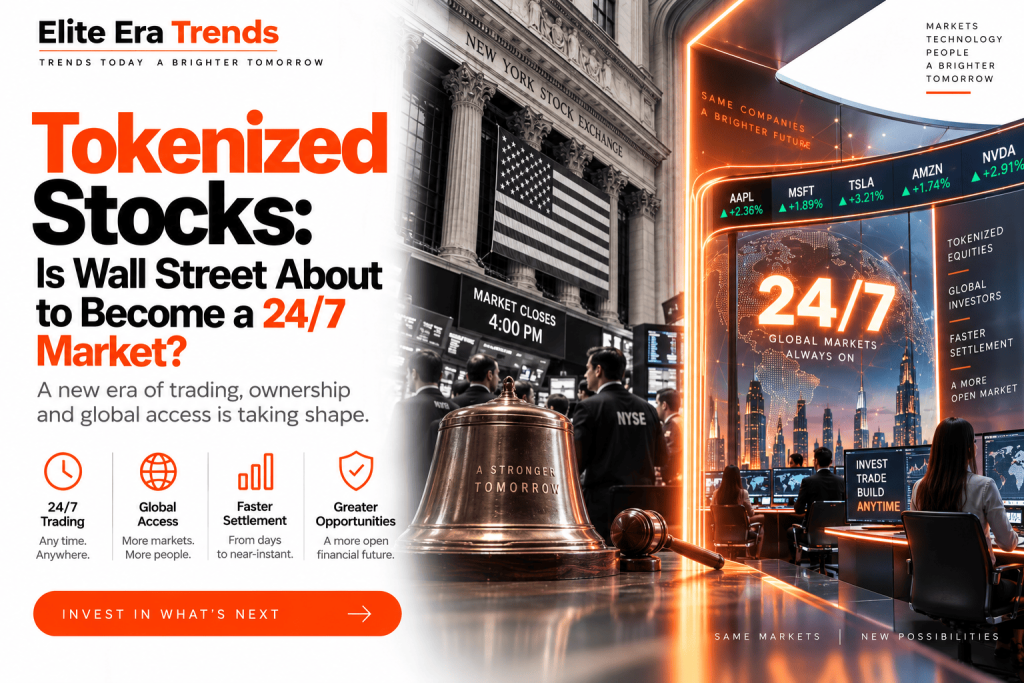
Tokenized Stocks: Is Wall Street About to Become a 24/7 Market?
For more than two centuries, stock markets have operated around a simple idea:
The market opens.
The market closes.
Investors wait.
Then they trade again tomorrow.
But that structure is beginning to look increasingly outdated in a world where cryptocurrency trades continuously, news travels instantly and investors participate from almost every time zone.
Now Wall Street may be moving toward its biggest structural change in decades.
The catalyst?
Tokenized stocks.
On September 1, 2026, the London Stock Exchange announced plans to develop tokenized UK equities and partnered with Payward, the company behind Kraken, to explore tokenized public-equity markets. The initiative is connected to the exchange’s broader work on a 24-hour trading venue, digital securities depository and digital settlement infrastructure.
Meanwhile, the U.S. Securities and Exchange Commission is preparing a September 17, 2026 roundtable dedicated to 24-hour equity trading, with participants from exchanges, brokers, market makers, asset managers and settlement infrastructure providers.
Nasdaq is developing its own equity-token framework.
Robinhood has expanded stock tokens internationally.
Registered tokenized investment funds can already trade around the clock in certain structures.
Taken together, these developments point toward a much bigger possibility:
The stock market may be evolving from a place that opens every morning into an always-on digital network.
Welcome to the next chapter of finance.
What Exactly Is a Tokenized Stock?
A tokenized stock is a blockchain-based digital representation connected in some way to a traditional security.
But there is one extremely important detail:
Not all stock tokens are the same.
The SEC says tokenized securities broadly fall into two categories.
One involves securities tokenized by or on behalf of the actual issuer.
The other involves tokens created by an independent third party and linked in some way to an existing security.
That distinction affects what the investor actually owns.
For example, a company could eventually issue shares where ownership itself is officially recorded using distributed-ledger technology.
That would be very different from purchasing a derivative token that merely follows the price of Apple, Tesla or another company.
Both might be called “tokenized stocks.”
Legally and economically, however, they can be very different products.
1. The London Stock Exchange Is Moving Toward Tokenized Equities
Perhaps the strongest indication that tokenization is leaving the crypto fringe came from one of the world’s oldest major stock exchanges.
The London Stock Exchange announced on September 1 that it is examining structures through which UK-listed companies could have tokenized equity while retaining the shareholder rights, governance standards and investor protections associated with public markets.
The exchange is also working with Payward to explore digital distribution of UK public equities.
The project sits alongside several other LSEG initiatives:
- LSE 24, its planned 24-hour trading venue;
- the LSEG Digital Securities Depository;
- and its Digital Settlement House infrastructure.
Reuters reported that the initiative aims to broaden international access to UK-listed shares and that the planned tokenized products are expected to connect with the emerging 24-hour trading environment, subject to regulatory approval.
This is significant.
Blockchain-based equities are no longer simply something being proposed by crypto startups.
Traditional exchanges are building for them.
2. The United States Is Preparing for 24-Hour Stock Trading
America’s market regulators are discussing another fundamental change.
The SEC will hold a public roundtable on September 17, 2026 specifically focused on preparations for 24-hour equity trading.
Its agenda includes:
- exchange and broker readiness;
- overnight market surveillance;
- liquidity;
- clearing and settlement;
- cybersecurity;
- market-data continuity;
- system resilience;
- investor protection;
- and the possibility of eventually moving toward 24/7 markets.
Participants include representatives from organizations such as Nasdaq, NYSE, Robinhood, BlackRock, Schwab, UBS, Interactive Brokers, Jane Street, Citadel Securities, DTCC and others.
The discussion itself tells us something important.
The debate is moving beyond:
“Should stock markets trade longer?”
toward:
“How do we build an infrastructure capable of supporting it safely?”
3. Nasdaq Is Designing Stocks for an Always-On World
Nasdaq is also working on tokenization.
In March 2026, Nasdaq announced plans for an equity-token design intended to allow public companies to participate in tokenization while preserving issuer control, ownership rights, transparency and governance.
Nasdaq says it wants tokenized equities to function within regulated public markets rather than creating an entirely separate universe of synthetic assets.
Its proposal builds on an SEC filing seeking to allow securities traded on Nasdaq to settle in tokenized form through existing regulated market infrastructure.
Nasdaq expects elements of its equity-token program and additional distributed-ledger services to become operational beginning in the first half of 2027, subject to regulatory processes.
The exchange explicitly connects tokenization with its broader vision for always-on markets.
That combination is powerful:
longer trading hours + digital ownership + faster settlement.
4. Some Tokenized Investments Already Trade 24/7
This future is not entirely theoretical.
In February 2026, WisdomTree announced 24/7 secondary-market trading and instant settlement for shares of its tokenized Treasury money-market fund.
The SEC granted exemptive relief allowing the registered fund’s tokenized shares to trade continuously through WisdomTree’s affiliated broker-dealer under the structure described by the firm.
That does not mean ordinary Apple or Microsoft shares suddenly trade seven days a week.
But it demonstrates something important:
Regulated securities can operate on genuinely always-on infrastructure.
The technological barrier is increasingly becoming less significant than the regulatory, liquidity and market-structure questions.
5. Robinhood Is Already Showing Consumers What Stock Tokens Look Like
Robinhood offers another model.
Its European Classic Stock Tokens track publicly traded stocks and ETFs.
But Robinhood explicitly tells customers that purchasing one does not mean purchasing the actual underlying share.
Instead, the customer enters into a derivatives contract whose value follows the underlying security.
That distinction has major consequences.
Holders do not receive all the shareholder rights associated with directly owning the underlying stock, including voting rights.
Robinhood’s regulatory filings also state that its newer Stock Tokens provide economic exposure to underlying securities but do not give holders legal or beneficial ownership rights in those underlying companies.
This is why investors need to read beyond the word “stock.”
A stock token might represent:
actual ownership
or
economic exposure
or
a derivative contract
depending on how the product is structured.
6. Why Tokenize Stocks at All?
If conventional stocks already work, why rebuild them on blockchain infrastructure?
Because financial markets contain a surprising amount of friction.
When you press Buy in a brokerage app, it feels instantaneous.
But behind the screen, numerous systems may be involved in:
- executing the trade;
- confirming ownership;
- clearing obligations;
- transferring cash;
- settling securities;
- updating custody records;
- calculating collateral;
- distributing dividends;
- processing corporate actions.
Tokenization could potentially connect some of those functions more closely.
Nasdaq says potential benefits include more efficient settlement, improved collateral mobility and enhanced market access.
The real innovation therefore may not simply be putting stocks “on blockchain.”
It is redesigning what happens after you press Buy.
7. Settlement Could Become Much Faster
Traditional U.S. equities currently use a T+1 settlement cycle, meaning settlement normally occurs one business day after a trade.
Tokenized systems can potentially settle much faster because the asset and payment can interact within programmable infrastructure.
Some digital securities can already settle nearly instantaneously under specific structures.
WisdomTree’s tokenized fund, for example, advertises instant settlement for its approved 24/7 secondary-market model.
Why does that matter?
Because until settlement occurs, financial institutions must manage:
- counterparty exposure;
- collateral;
- cash;
- securities delivery;
- and operational risk.
Faster settlement could reduce some of those burdens.
But instant settlement also creates new challenges.
Traditional markets often use netting, where many transactions are combined before final settlement.
Moving everything instantly could require market participants to have cash and securities available continuously.
Faster does not automatically mean simpler.
8. Global Investors Could Gain Easier Access to Foreign Markets
Consider someone living in Asia who wants exposure to a company trading in New York.
Traditional international investing can involve:
- foreign brokerage access;
- different currencies;
- market-opening times;
- custody arrangements;
- settlement infrastructure;
- and jurisdiction-specific restrictions.
Tokenized markets could make international distribution easier.
This is one reason platforms are interested in offering blockchain-based exposure to major global companies.
Robinhood describes tokenization as part of its international strategy, while the London Stock Exchange says its project is intended in part to broaden access to UK capital markets.
The long-term vision is compelling.
A company could remain listed on its home exchange while its economic exposure—or eventually properly structured tokenized equity—becomes accessible through digital platforms worldwide.
That could make capital markets considerably more global.
9. But Does a Token Holder Really Own the Company?
This may become the defining question of the tokenized-stock era.
Suppose you buy something called:
“Company X Stock Token.”
Do you:
Own a Company X share?
Own a claim against someone who owns a Company X share?
Own a derivative linked to Company X?
Own a blockchain token whose issuer promises to track Company X?
Those are not equivalent.
The SEC’s January 2026 statement specifically warns that tokenized securities can use different structures with different rights for holders.
SEC Commissioner Hester Peirce has likewise stressed a straightforward principle:
moving a security onto blockchain infrastructure does not change the fact that it remains subject to securities law.
For investors, the lesson is simple:
Look at the legal ownership structure—not just the ticker symbol.
10. Companies Are Starting to Push Back
Those ownership questions are already producing conflict.
In early September 2026, AMC Entertainment CEO Adam Aron publicly objected to Robinhood-linked tokens tracking AMC shares.
The dispute centered partly on the fact that the products offer economic exposure without representing direct ownership of AMC shares or providing ordinary shareholder rights.
The controversy illustrates a major unresolved question:
Should somebody be allowed to tokenize exposure to a company’s shares without the company’s involvement?
Issuer-sponsored tokenization and third-party tokenization are fundamentally different models.
Nasdaq’s emerging approach emphasizes placing companies themselves at the center of the tokenization process.
That debate could become one of the most important regulatory battles in digital finance.
11. Would 24/7 Trading Actually Be Better for Investors?
An always-open stock market sounds convenient.
But convenience comes with trade-offs.
Traditional markets concentrate trading activity into defined sessions.
That concentration helps create liquidity.
At 11 a.m. in New York, millions of investors, institutions and trading systems are participating simultaneously.
At 3 a.m., that may not be true.
Lower overnight participation can produce:
- wider bid-ask spreads;
- lower liquidity;
- more volatile price movements;
- greater pricing uncertainty;
- and potentially larger market impact from individual orders.
Robinhood already warns investors using extended-hours trading that these periods can involve lower liquidity, increased volatility, wider spreads and pricing uncertainty.
The SEC’s upcoming roundtable specifically includes overnight liquidity and investor protection among the issues to be examined.
So the real question isn’t:
“Can markets stay open all night?”
Technology can make that possible.
The harder question is:
“Can markets remain fair, liquid and resilient all night?”
12. What Happens When Earnings Come Out at Midnight?
Today, many companies deliberately announce important information outside ordinary market hours.
That gives investors some time to process:
- earnings;
- acquisitions;
- CEO changes;
- regulatory announcements;
- guidance;
- geopolitical developments.
An always-on market changes that rhythm.
Imagine a company announcing catastrophic earnings at 2:17 a.m.
Algorithms react immediately.
Overseas investors begin trading.
AI systems digest the announcement.
Prices move before much of the company’s domestic investor base wakes up.
The concept of a single dramatic market open could gradually disappear.
Price discovery could become continuous.
That might make markets more responsive.
It could also make investing feel relentless.
13. AI Could Become Even More Important in 24/7 Markets
Humans sleep.
Markets may not.
That creates an obvious role for artificial intelligence.
Investors could increasingly use AI systems to:
- monitor portfolios;
- analyze overnight news;
- track risk;
- summarize earnings;
- detect unusual market activity;
- and potentially execute authorized trades.
Professional institutions already rely heavily on automated systems.
But an always-on retail market could push automation deeper into everyday investing.
Your future investment assistant might not simply tell you what happened while you slept.
It could be authorized to respond to predefined situations while you sleep.
That introduces another set of questions around:
- permission;
- risk controls;
- model errors;
- cybersecurity;
- and accountability.
Always-on markets may therefore evolve alongside always-on financial AI.
Tokenized Stocks vs Traditional Stocks
| Feature | Traditional Share | Issuer-Backed Tokenized Share | Third-Party Stock Token |
|---|---|---|---|
| Represents company ownership | Yes | Potentially yes | Often no |
| Voting rights | Usually | Can potentially preserve them | Often absent |
| Dividends | Generally eligible | Can be supported | Depends on structure |
| Blockchain-based | No/usually not | Yes | Yes |
| Continuous trading potential | Increasing | High | High |
| Fast digital settlement | Traditional infrastructure | Potentially | Potentially |
| Issuer involved | Yes | Yes | Not necessarily |
| Regulatory structure | Established | Emerging within securities law | Depends heavily on design |
The important point is that “tokenized stock” is not one standardized product.
The details determine what you actually own.
What Could the Stock Market Look Like by 2030?
Imagine opening an investing app several years from now.
There is no countdown to the opening bell.
Apple is trading.
A Japanese company is trading.
UK equities are trading.
Treasury funds are trading.
Tokenized bonds are trading.
Your cash balance settles immediately.
Your securities move directly into digital custody.
AI continuously monitors your investments.
You can potentially move certain assets between compatible platforms without waiting days for transfers.
Dividends and other corporate actions can be distributed through programmable infrastructure.
A person in Singapore, London or Dubai can access markets according to local eligibility without having to organize their life around New York trading hours.
The world’s financial markets start behaving more like the internet:
global, digital and increasingly continuous.
That future is not fully here.
But several of its building blocks already exist.
The Opening Bell May Eventually Become Symbolic
Stock exchanges have always been associated with clocks.
9:30 a.m.
The bell rings.
Trading begins.
At 4 p.m., regular U.S. trading ends.
That rhythm has shaped Wall Street for generations.
But technology does not care what time it is.
Neither does blockchain infrastructure.
Neither does global news.
And investors increasingly live everywhere.
As of September 2026, the London Stock Exchange is developing tokenized-equity infrastructure, Nasdaq is building an equity-token framework, some regulated digital securities already support 24/7 transactions, international brokers are distributing stock tokens, and the SEC is preparing an industry-wide discussion about 24-hour U.S. trading.
None of this guarantees that every major stock exchange will become fully 24/7.
There are major questions about liquidity, settlement, corporate rights, cybersecurity, regulation and investor protection still to solve.
But the direction is difficult to ignore.
The future stock market may not simply be a faster version of today’s market.
It may operate according to an entirely different assumption:
Markets do not need to close.
And if tokenization, continuous trading and digital settlement continue converging, future investors may look back at the idea of waiting until Monday morning to trade a stock the same way we now look at waiting for a bank branch to open.
Wall Street is becoming software.
The opening bell may eventually remain.
But someday, it might only be ceremonial.
— Elite Era Trends
Disclaimer: This article is for educational and informational purposes only and does not constitute investment, financial, legal or tax advice. Tokenized securities vary substantially in structure, ownership rights, regulatory treatment and risk. Always verify what a particular product represents before investing.