The Weekend Bank Transfer Is Here: How Tokenized Deposits Could Reinvent Banking
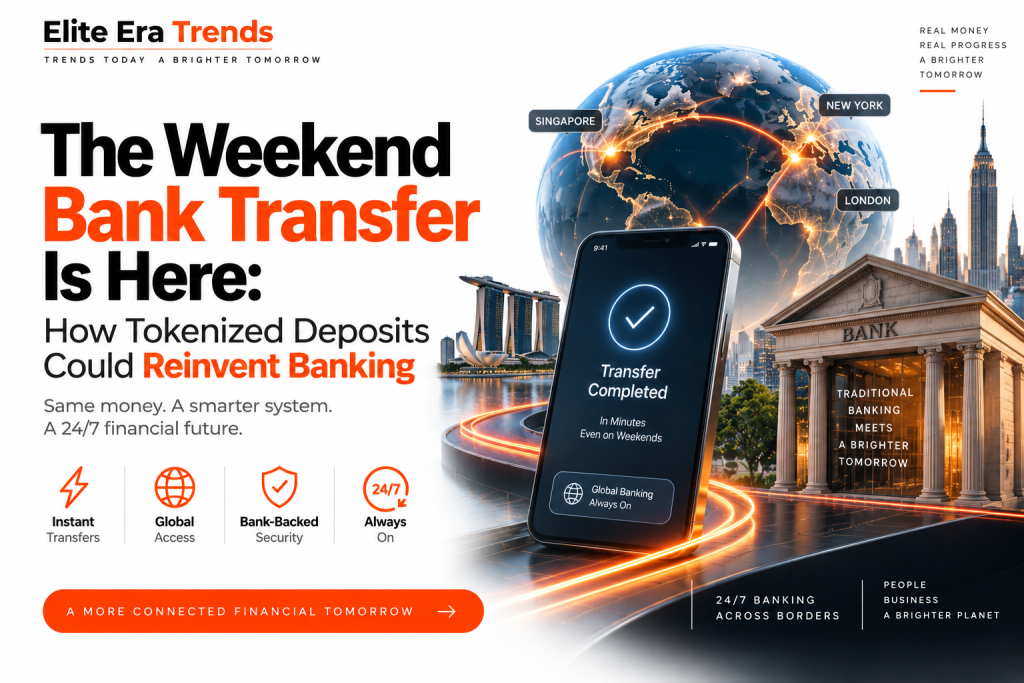
Imagine sending millions of dollars from Singapore to New York on a Saturday.
No waiting until Monday.
No banking-hours problem.
No two-business-day settlement window.
The money arrives within minutes.
That is no longer purely theoretical.
On September 5, 2026, DBS and Citi successfully completed a U.S.-dollar payment between Singapore and the United States over a weekend using tokenized bank deposits on Swift’s blockchain-based Digital Ledger.
DBS announced the transaction on September 7, saying it took minutes rather than the industry norm of up to two business days for some cross-border payments.
And this development could point toward something much bigger:
Banking is beginning to become 24/7.
Not cryptocurrency.
Not another speculative token.
Actual bank deposits.
Welcome to one of the biggest emerging finance trends of 2026: tokenized money.
What Is a Tokenized Deposit?
A tokenized deposit sounds complicated, but the core idea is surprisingly simple.
Imagine you have $1,000 in your bank account.
Normally, your bank records that $1,000 inside its conventional banking databases.
A tokenized deposit represents that same bank liability on a programmable digital ledger.
The Bank for International Settlements defines tokenized deposits as commercial-bank deposits represented on programmable or tokenized ledgers. They remain liabilities of the issuing bank and are intended to remain transferable or redeemable at par with ordinary deposits.
So this is not simply another cryptocurrency.
Instead of inventing a new form of money, banks are experimenting with giving familiar money new digital rails.
Think of it like this:
Traditional bank deposit + blockchain-style infrastructure = tokenized deposit.
That combination could fundamentally change how money moves.
Why September 2026 Could Be a Turning Point
The DBS-Citi transaction was not an isolated experiment.
On August 27, 2026, HSBC and UOB announced live cross-border Hong Kong-dollar transactions using Swift’s blockchain-based ledger.
UOB became the first Singapore-headquartered bank to execute live transactions on the platform and said it planned Singapore-dollar and U.S.-dollar transactions during September.
Then, on September 2, Citi announced that it had processed live transactions with First Abu Dhabi Bank and OCBC.
Citi described itself as the first U.S. bank to conduct live native-ledger transactions through the initiative and said DBS and UOB were among the banks preparing additional transactions.
Days later, the DBS-Citi weekend payment happened.
The timeline is accelerating.
And behind it is one of the world’s most important financial-messaging networks: Swift.
1. Swift Is Putting Blockchain Into Traditional Banking
When many people hear “blockchain,” they think about Bitcoin.
But one of the biggest blockchain developments of 2026 is happening inside the traditional financial system.
In July 2026, Swift announced that its blockchain-based ledger was ready for initial use.
The network said 17 banks across six continents were preparing to conduct live transactions using tokenized deposits.
The objective is straightforward:
Allow regulated banks to move money 24/7.
Traditional international banking relies on complicated networks of institutions, ledgers, payment messages and settlement systems.
Different banks may maintain separate records of the same transaction.
Those records must be reconciled.
Systems operate across different jurisdictions.
Settlement windows differ.
And weekends still matter.
A shared digital ledger changes part of that architecture.
Instead of institutions constantly reconciling independent databases, multiple authorized participants can interact with a synchronized record.
That could make international money significantly more efficient.
2. Why Does Banking Still Have Weekends?
It sounds almost absurd when compared with the rest of the digital world.
Netflix works on Sunday.
Cloud computing works on Sunday.
Amazon works on Sunday.
Artificial intelligence works on Sunday.
Financial markets increasingly trade outside traditional hours.
Yet many banking processes still depend on business days.
Why?
Because banking infrastructure was built over decades around settlement systems, operating schedules, cut-off times, liquidity arrangements and regulatory processes.
Money may appear digital on your banking app, but behind that clean interface is an enormous network of financial infrastructure.
Tokenization attempts to modernize that infrastructure rather than merely redesign the app.
The September DBS-Citi transaction is significant precisely because it occurred during a weekend.
DBS said the payment was executed in minutes despite the Singapore-U.S. time-zone difference.
That is the type of change consumers may eventually notice.
3. Tokenized Deposits vs Stablecoins
This is where things become particularly interesting.
Stablecoins and tokenized deposits can both represent dollar-like value on digital ledgers.
But they are not the same thing.
| Tokenized Deposit | Stablecoin | |
|---|---|---|
| Issuer | Commercial bank | Stablecoin company or permitted issuer |
| What it represents | Bank deposit liability | Token backed according to issuer structure |
| Bank regulation | Inherits banking framework | Subject to stablecoin-specific framework |
| Blockchain compatible | Yes | Yes |
| Potentially programmable | Yes | Yes |
| 24/7 transfers | Potentially | Usually |
| Deposit relationship | Yes | No conventional bank deposit relationship |
| Primary emerging use | Banking and institutional settlement | Crypto, payments and digital commerce |
The IMF describes tokenized deposits as digital extensions of existing commercial-bank liabilities.
This means they can retain the institutional framework surrounding bank deposits while gaining some features associated with programmable digital assets.
That could give banks a powerful response to stablecoins.
Rather than watching blockchain companies reinvent money, banks can put bank money itself onto programmable infrastructure.
4. The Real Revolution May Be Programmable Money
Faster payments are useful.
But speed may not ultimately be the most transformative feature.
Programmability could be.
Traditional money mostly sits separately from the software controlling financial agreements.
Smart contracts potentially allow conditions and payments to operate together.
For example:
Pay the supplier automatically when the shipment is verified.
Or:
Release collateral immediately when predefined financial conditions are satisfied.
Or:
Transfer securities and payment simultaneously.
The IMF identifies programmability, shared ledgers and atomic settlement as three important features distinguishing tokenization from earlier stages of financial digitization.
That means money stops being merely digital.
It can become software-compatible.
This could eventually automate enormous portions of corporate finance.
5. Cross-Border Payments Could Be One of the Biggest Winners
Moving money between countries remains surprisingly complicated.
A business may have money in Singapore but need to pay a supplier in the United States.
Depending on the transaction, institutions may need to coordinate across:
- multiple banks;
- currencies;
- jurisdictions;
- time zones;
- compliance systems;
- settlement networks;
- and operating hours.
Tokenization does not magically eliminate every one of these requirements.
Regulatory compliance still matters.
Currency conversion still matters.
Banks still need liquidity.
But shared ledgers could eliminate some unnecessary friction between institutions.
The BIS’s Project Agorá has been exploring precisely this problem.
In May 2026, the BIS said its prototype demonstrated the potential for tokenized commercial-bank deposits and tokenized central-bank reserves to support atomic settlement of wholesale cross-border transactions across currencies and jurisdictions. The project is moving toward testing involving real value.
That means experimentation is progressing beyond presentations and PowerPoint slides.
Actual money is beginning to move.
6. Your Bank Account Could Eventually Become Much Smarter
Tokenized deposits are currently focused heavily on wholesale and institutional banking.
The BIS says they are not yet widely used for ordinary everyday payments.
So your checking account probably will not suddenly become a blockchain wallet tomorrow.
But consider where the technology could eventually lead.
Your future bank balance might support:
Instant global transfers
Money could potentially move across participating financial networks continuously.
Automated savings
Rules could automatically move funds depending on your income or spending.
Programmable business payments
Invoices could trigger payment after agreed conditions are digitally verified.
Faster investment settlement
Cash and financial assets could move simultaneously.
AI-powered transactions
Authorized AI agents could execute financial instructions using programmable money.
The interesting part is that consumers may never need to understand the underlying technology.
Your banking app might look almost exactly the same.
The infrastructure underneath it could be radically different.
7. Tokenized Stocks Could Connect to Tokenized Money
Money is only one half of a financial transaction.
The other half is the asset being purchased.
And tokenization is now expanding there too.
On September 1, 2026, the London Stock Exchange announced plans to develop UK tokenized equity structures and explore tokenized public-equity markets with Payward, the company behind Kraken.
The London Stock Exchange is also working on digital securities infrastructure and a 24-hour trading venue.
Now imagine combining the two developments.
You have:
tokenized stocks
and
tokenized bank deposits.
A future investor could potentially exchange digital cash for digital securities on interconnected infrastructure.
Instead of:
trade → clearing → reconciliation → settlement
the transaction could become much more synchronized.
The IMF says tokenized securities have the potential to compress functions including issuance, trading, settlement, custody and compliance into increasingly integrated workflows.
That would represent more than faster investing.
It could redesign Wall Street’s plumbing.
8. Why Banks Like Tokenized Deposits
Stablecoins presented the banking industry with an interesting problem.
People could potentially transfer dollar-denominated value without traditional bank-payment infrastructure.
Banks therefore face a choice:
Fight tokenization—or participate in it.
Increasingly, they appear to be choosing participation.
Tokenized deposits offer banks several potential advantages.
They allow banks to experiment with programmable finance while keeping the money inside the regulated banking framework.
They could help banks offer faster international payments.
They could improve corporate liquidity management.
They can potentially integrate with tokenized securities.
And they allow financial institutions to modernize infrastructure without necessarily surrendering customer relationships to stablecoin issuers.
The BIS has recently argued that tokenized deposits may offer a promising route for integrating tokenization into the existing two-tier monetary system, while also emphasizing that significant technical, liquidity and governance challenges remain.
In other words:
Banks may not need to become crypto companies.
They can take some of crypto’s technology and rebuild banking with it.
9. The Hidden Challenge: Banks May Need Money Available 24/7 Too
Instant settlement sounds universally positive.
But finance always involves trade-offs.
Suppose banks must settle payments continuously.
They can no longer depend as heavily on end-of-day processes to manage incoming and outgoing cash.
A company may want to send $100 million at 2 a.m. on Sunday.
The bank needs enough liquidity available right then.
The IMF warns that around-the-clock tokenized settlement could require banks to manage liquidity continuously rather than relying on traditional netting and settlement cycles.
The Federal Reserve Bank of Dallas has similarly examined how tokenized deposits could affect bank liquidity and maturity transformation.
So 24/7 money may eventually require something else:
24/7 treasury management.
That is a significant operational change for the banking industry.
10. Faster Finance Could Also Mean Faster Financial Stress
There is another uncomfortable reality.
If money can move instantly, financial panic can move instantly too.
Think about a bank run.
Historically, customers might have needed to visit branches.
Then online banking made withdrawals easier.
Programmable 24/7 money could potentially make movement even faster.
The IMF warns that tokenization can cause liquidity demands to materialize in real time and that automated processes could propagate stress faster than institutions or regulators can respond.
Smart contracts introduce another category of risk.
What if there is faulty code?
What if a data source feeds incorrect information into an automated contract?
What if a digital infrastructure provider fails?
The financial system could become more efficient while simultaneously becoming more dependent on software.
That makes cybersecurity, governance, system resilience and human override mechanisms increasingly important.
The Bigger Picture: Finance Is Moving From Databases to Shared Ledgers
The digital revolution already transformed banking once.
Paper statements became online banking.
Branches became mobile apps.
Cash became electronic payments.
But most of those innovations changed the interface.
They did not fundamentally change the underlying architecture of money.
Tokenization could.
The IMF argues that previous financial digitization largely improved efficiency inside existing structures, whereas tokenization has the potential to alter how settlement, trust and risk management themselves are organized.
That distinction is enormous.
Internet banking digitized access to your account.
Tokenized banking could digitize the account itself in a programmable financial network.
What the Future Banking System Could Look Like
Imagine the financial system in the early 2030s.
A Singapore company buys equipment from Germany.
Its AI treasury system automatically chooses the cheapest settlement route.
Tokenized bank deposits move immediately.
Foreign exchange happens digitally.
The payment and commercial documentation synchronize automatically.
Meanwhile, an investor buys tokenized securities.
Payment and asset ownership transfer together.
Corporate bonds automatically distribute coupon payments.
Collateral can move between institutions at any hour.
Banks remain involved.
Central banks remain involved.
Regulators remain involved.
But underneath everything is a network of interoperable digital ledgers.
Money no longer waits for Monday morning.
Does This Mean Blockchain Finally Won?
Not exactly.
The biggest mistake would be viewing this as another contest between “crypto” and “traditional finance.”
What is happening is more nuanced.
Blockchain concepts are increasingly being absorbed into mainstream financial infrastructure.
The winners may ultimately be hybrid systems combining:
banking regulation + central-bank money + distributed ledgers + programmable assets + traditional financial institutions.
Swift itself describes its digital ledger initiative as a bridge between existing financial infrastructure and emerging digital assets.
That could prove much more consequential than speculative cryptocurrency trading.
Final Thoughts
On September 5, 2026, money moved between Singapore and the United States during a weekend using tokenized bank deposits.
It took minutes.
That single transaction does not mean the world’s banking system has suddenly become blockchain-powered.
Tokenized deposits remain concentrated primarily in institutional experimentation, pilots and emerging deployments rather than everyday consumer banking.
But something important is clearly happening.
Swift has launched blockchain-based ledger infrastructure.
Major global banks are conducting live transactions.
Central banks and international institutions are studying tokenized settlement.
The London Stock Exchange is exploring tokenized equities.
Programmable finance is gradually moving from crypto experiments into regulated financial markets.
The banking revolution may therefore look very different from what people expected.
Bitcoin may not replace your bank.
Your bank may instead learn to operate more like the internet.
Instant.
Programmable.
Always available.
And someday soon, asking whether money can move on a Sunday may sound as strange as asking whether email works on a Sunday.
Welcome to the beginning of 24/7 banking.
— Elite Era Trends
Disclaimer: This article is for educational and informational purposes only. Tokenized deposits and related financial infrastructure remain emerging technologies, and functionality, regulations, consumer protections and availability vary by institution and jurisdiction.