Meta Muse Wonder vs Wonder Full: Pricing, Features, 1M Context and Access
Meta Muse Wonder vs Wonder Full: Pricing, Features, 1M Context and Access
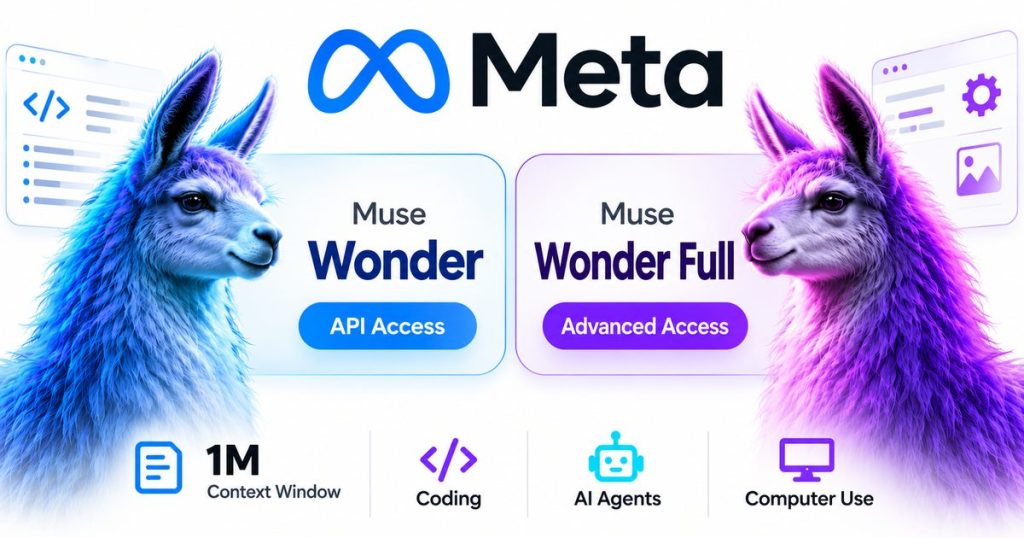
Meta has launched Muse Wonder and Muse Wonder Full, two new frontier AI models designed for advanced coding, long-running AI agents, computer use and complex multi-step work.
The models were officially introduced on October 12, 2026, expanding Meta’s Muse ecosystem beyond the earlier Muse Spark models.
For developers, the biggest difference is access: Muse Wonder is available through the Meta Model API and Muse Code, while the more capable Muse Wonder Full is currently limited to qualifying Muse Code subscriptions.
Both models support a 1 million-token context window, while Muse Wonder API pricing starts at $4 per million input tokens and $20 per million output tokens.
Here is everything developers and AI users need to know about Meta Muse Wonder, including pricing, features, context size, Muse Code access and the differences between Wonder and Wonder Full.
Meta Muse Wonder at a Glance
| Feature | Muse Wonder | Muse Wonder Full |
|---|---|---|
| Developer | Meta | Meta |
| Announced | October 12, 2026 | October 12, 2026 |
| Context window | 1M tokens | 1M tokens |
| Meta Model API | Yes | No |
| Muse Code | Yes | Yes |
| API input price | $4 per 1M tokens | Not available through pay-as-you-go API |
| Cached input | $0.20 per 1M tokens | Subscription access |
| API output price | $20 per 1M tokens | Subscription access |
| Coding | Yes | Yes |
| Long-running agents | Yes | Yes |
| Computer use | Yes | Yes |
| Sub-agent delegation | Yes | Yes |
| Best for | API developers and advanced agents | Highest-end Muse Code workloads |
What Is Meta Muse Wonder?
Muse Wonder is Meta’s new frontier AI model for demanding agentic and software-development tasks.
Unlike an ordinary chatbot that primarily answers individual prompts, Muse Wonder is designed to work through longer sequences of actions.
Meta says the model is built for tasks including:
- Advanced software development
- Long-running AI agents
- Multi-step reasoning
- Computer use
- Tool use
- Large code repositories
- Failure recovery
- Sub-agent delegation
The official model identifier for API developers is:
muse-wonder-1.0
Meta currently describes Muse Wonder as a preview model.
One of its most important capabilities is its ability to maintain a plan across complicated workflows rather than treating every step as an isolated request.
For example, a coding agent could inspect a repository, identify relevant files, make changes, run tests, discover an error and revise its approach without requiring the user to manually restart every step.
What Is Muse Wonder Full?
Muse Wonder Full is Meta’s higher-capability version of the Wonder model family.
Meta describes Wonder Full as its most advanced model for particularly demanding coding and agentic workloads.
However, access works differently from standard Muse Wonder.
Muse Wonder Full is not currently available through Meta’s normal pay-as-you-go Model API.
Instead, developers access it through Muse Code on Meta’s:
- Power Usage plan
- Maximum Usage plan
That distinction matters.
If you want to integrate a Wonder model directly into your own application through an API, Muse Wonder is currently the relevant option.
If you want Meta’s highest-end Wonder model inside its coding environment, Muse Wonder Full requires an eligible Muse Code subscription.
Muse Wonder Pricing
Meta currently charges the following prices for Muse Wonder through the Meta Model API:
| Usage | Price |
|---|---|
| Input tokens | $4.00 per 1 million tokens |
| Cached input | $0.20 per 1 million tokens |
| Output tokens | $20.00 per 1 million tokens |
| Web-search grounding | $2.50 per 1,000 searches |
Meta’s documentation also says there is no additional long-context premium for Muse Wonder.
That means the per-token rate does not automatically increase simply because a request uses a large portion of the model’s available context window.
Muse Wonder Cost Example
Suppose an application sends 250,000 uncached input tokens to Muse Wonder.
The input calculation would be:
250,000 ÷ 1,000,000 × $4 = $1.00
Now assume the model generates 20,000 output tokens.
The output calculation would be:
20,000 ÷ 1,000,000 × $20 = $0.40
The total token cost would therefore be approximately:
$1.00 + $0.40 = $1.40
That example does not include additional tool charges such as web-search grounding.
Muse Wonder Full Pricing
Muse Wonder Full does not have a standard per-token API price because Meta currently restricts it to qualifying Muse Code subscription plans.
Meta lists the relevant plans as:
| Muse Code Plan | Monthly Price | Muse Wonder Full |
|---|---|---|
| Everyday Usage | $5 | No |
| High Usage | $15 | No |
| Power Usage | $50 | Yes |
| Maximum Usage | $200 | Yes |
The Power Usage plan includes 20 times the usage allowance of Meta’s Everyday Usage plan.
The Maximum Usage plan provides 80 times the Everyday Usage allowance.
Actual usage is still subject to Meta’s subscription limits and reset policies.
For developers who only need normal Muse Wonder API access, a Muse Code subscription is not required because the model can also be used on a pay-as-you-go basis through Meta Model API.
Muse Wonder Has a 1 Million-Token Context Window
Both Muse Wonder and Muse Wonder Full support approximately a 1 million-token context window.
Meta’s technical documentation lists the context capacity as 1,048,576 tokens.
A large context window can be useful when an AI system needs to work with substantial amounts of information at once.
Potential examples include:
- Large software repositories
- Extensive documentation
- Long research material
- Multiple files
- Lengthy conversations
- Large agent histories
- Complex project specifications
For coding applications, this can allow a model to examine considerably more of a project before making decisions.
However, a large context window does not guarantee that every answer will become more accurate.
Developers still need to provide relevant information and design prompts and agent workflows carefully.
What Is Active Memory?
Meta says the Muse Wonder family includes a capability called Active Memory.
Active Memory is designed to help an agent retain information that matters across conversations and surface it again when relevant.
For a personal or professional AI agent, this could include information such as:
- User preferences
- Previous decisions
- Project requirements
- Ongoing goals
- Relevant historical context
This is different from simply fitting more information into a single prompt.
A large context window helps an AI process information available during a request, while memory is intended to help useful context persist across interactions.
Meta says Muse Wonder will eventually help power more experiences inside the broader Muse personal-agent platform.
What Is Active Focus?
Meta also introduced a capability called Active Focus.
Active Focus is intended to help Muse Wonder continue working toward a goal when a task becomes difficult.
Instead of simply stopping after the first failed approach, the model can potentially:
- Try another strategy
- Recover from errors
- Continue a multi-step plan
- Incorporate new information
- Ask the user for clarification when necessary
- Check with the user before important actions
This is particularly important for long-running AI agents.
Real tasks rarely proceed perfectly from beginning to end.
A coding agent, for example, might make a change, run a test, encounter an unexpected failure and need to diagnose the problem before continuing.
Meta designed Muse Wonder to handle more of that process within the agent workflow.
Muse Wonder Can Delegate Work to Sub-Agents
Another important feature is sub-agent delegation.
Meta says Muse Wonder can break complicated work into smaller tasks and delegate them to multiple agents.
This can be useful when different parts of a project can be worked on simultaneously.
Imagine asking an AI system to build a web application.
One agent might work on:
- Front-end code
Another might handle:
- Back-end logic
Another could inspect:
- Tests and potential bugs
And another could review:
- Documentation or deployment requirements
A coordinating agent can then bring those results together.
Meta provides developer examples involving multi-agent orchestration and parallel agent workflows for Muse Wonder.
Muse Wonder for Coding
Coding is one of the primary use cases for the Wonder series.
Meta says Muse Wonder is designed to work across large repositories and handle complicated engineering tasks requiring multiple changes.
Potential workflows include:
- Understanding unfamiliar codebases
- Editing several files
- Debugging errors
- Running tests
- Building applications
- Reviewing code
- Using command-line tools
- Coordinating multiple coding agents
- Working through longer software-development projects
Muse Wonder is also integrated into Muse Code, Meta’s terminal-based coding agent.
Meta describes Muse Code as a tool for building, debugging and shipping software through an agentic workflow.
What Is Muse Code?
Muse Code is Meta’s coding-agent environment.
Rather than using Muse Wonder only as a model behind an API call, developers can use Muse Code to let Meta’s AI models work directly through a coding-oriented workflow.
Muse Code supports capabilities such as:
- Editing project files
- Running shell commands
- Debugging applications
- Coordinating agents
- Reviewing code
- Working across longer development tasks
Muse Wonder is available through Muse Code, while Muse Wonder Full is restricted to its Power and Maximum subscription tiers.
Muse Wonder Supports Computer Use
Meta also highlights advanced computer use as one of Muse Wonder’s major capabilities.
Computer-use models can interpret what is happening in a graphical interface and interact with software more like a human user.
That can potentially allow an agent to work with:
- Browsers
- Desktop applications
- Web interfaces
- Development tools
- Other graphical software
This is important because not every digital task has a convenient API.
An AI agent capable of using a graphical interface can potentially interact with existing software through the same controls available to a person.
Users should still carefully review consequential actions, particularly when an AI system can interact with accounts, data or external services.
Muse Wonder Works With the Meta Model API
Developers can access Muse Wonder directly through Meta Model API.
Meta has also designed its API to make migration easier for developers already using popular AI SDKs.
According to Meta’s documentation, developers using an OpenAI-compatible client can connect to Meta Model API by changing the appropriate API endpoint and selecting the Muse Wonder model.
The official Wonder model name is:
muse-wonder-1.0
This can make experimentation easier for developers who already have applications built around familiar AI API structures.
Muse Wonder vs Muse Spark
Meta’s Muse family now includes models designed for different cost and capability requirements.
Muse Wonder
Better suited to:
- Difficult coding tasks
- Long-running agents
- Complex reasoning
- Computer-use workflows
- Large projects
- High-value tasks where capability matters more than minimum cost
Muse Spark
Better suited to:
- Higher-volume workloads
- Less demanding agent tasks
- Cost-sensitive applications
- Lightweight tool calls
- Supporting sub-agents
Developers do not necessarily need to use the most expensive model for every step of an agent workflow.
A sophisticated system could potentially use Muse Wonder for difficult planning while routing simpler work to a cheaper model.
Muse Wonder Standard Mode and Contributor Mode
Developers should also pay attention to Meta’s data-use settings.
For pay-as-you-go Muse Wonder API usage, Meta lists the model in Standard mode.
Meta states that content submitted in Standard mode is not used to train Meta models.
Muse Code subscriptions work differently.
Meta says Muse Code subscriptions currently default to Contributor mode. In Contributor mode, users receive additional usage in exchange for allowing Meta to use submitted content—including prompts, code, files, context and model responses—to train future Meta models.
Meta says Muse Code users can turn Contributor mode off in settings.
Developers working with proprietary source code, confidential business information or sensitive project data should therefore review the selected mode and Meta’s current terms before submitting that information.
Muse Wonder vs Muse Wonder Full: Which Should You Use?
For most developers choosing between the two models, the decision primarily comes down to access method and workload complexity.
Choose Muse Wonder if:
- You need API access
- You want pay-as-you-go pricing
- You are building your own AI application
- You need a 1M-token context window
- You need advanced coding or agent capabilities
- You want to use your existing API-based infrastructure
Choose Muse Wonder Full if:
- You use Muse Code
- You have a Power or Maximum subscription
- You need Meta’s highest-capability Wonder variant
- You are working on especially demanding coding workloads
- Subscription-based Muse Code access fits your workflow
Muse Wonder Full should not be confused with a special API reasoning setting.
Meta specifically documents it as a separate higher-capability model available through eligible Muse Code subscriptions.
How Does Muse Wonder Fit Into Meta Muse?
Muse Wonder is not only a developer model.
Meta says it will also begin powering additional experiences inside Muse, the company’s personal AI agent.
Muse was introduced earlier in 2026 as an agent designed to do more than answer questions.
It can work toward goals and interact with supported applications and services on a user’s behalf.
Muse initially used Meta’s Muse Spark technology.
With Wonder, Meta is adding a more capable model family for tasks requiring greater intelligence, persistence and complex reasoning.
Readers who are new to the platform can also read our What Is Meta Muse AI? guide and our How to Use Meta Muse AI beginner’s guide.
Why Muse Wonder Matters
Muse Wonder reflects a broader change taking place in artificial intelligence.
The competition is increasingly moving beyond models that simply generate good individual answers.
AI companies are now building systems that can:
- Remember useful information
- Continue working over longer periods
- Use tools
- Operate software
- Coordinate other agents
- Recover from failures
- Complete multi-stage tasks
That moves AI closer to functioning as an active software agent rather than only a conversational interface.
Muse Wonder’s combination of a large context window, coding capabilities, computer use, memory and long-running execution makes it particularly relevant to this shift.
Frequently Asked Questions
What is Meta Muse Wonder?
Muse Wonder is a frontier AI model from Meta designed for advanced coding, long-running agents, computer use and complex multi-step workflows.
When was Muse Wonder released?
Meta officially announced Muse Wonder and Muse Wonder Full on October 12, 2026.
Is Muse Wonder available through an API?
Yes. Muse Wonder is available through Meta Model API.
The current model identifier is muse-wonder-1.0.
What does Muse Wonder cost?
Muse Wonder currently costs $4 per million input tokens, $0.20 per million cached input tokens and $20 per million output tokens through Meta Model API.
How large is the Muse Wonder context window?
Meta lists a context window of approximately 1 million tokens, technically documented as 1,048,576 tokens.
Is Muse Wonder Full available through the API?
No.
Meta currently makes Muse Wonder Full available through Muse Code on the Power Usage and Maximum Usage subscription plans.
How much does Muse Wonder Full cost?
Muse Wonder Full is included with qualifying Muse Code subscriptions.
The Power Usage plan costs $50 per month, while the Maximum Usage plan costs $200 per month.
What is the difference between Muse Wonder and Wonder Full?
Muse Wonder is available through both Meta Model API and Muse Code.
Muse Wonder Full is Meta’s higher-capability variant and is currently limited to eligible Muse Code subscriptions.
Can Muse Wonder use a computer?
Meta lists advanced computer use as one of the Wonder family’s major capabilities.
Can Muse Wonder work with other AI agents?
Yes. Meta says Muse Wonder can plan tasks and delegate work to sub-agents, including parallel agent workflows.
Does Meta use Muse Wonder API data for model training?
Meta says pay-as-you-go Muse Wonder operates in Standard mode, where submitted content is not used to train Meta models.
Muse Code subscriptions default to Contributor mode, which has different data-use terms, although Meta says users can turn Contributor mode off.
Meta Muse Wonder is one of Meta’s most significant AI model releases of 2026.
The standard Muse Wonder model combines a 1 million-token context window, advanced coding, long-running agents, computer use, sub-agent delegation, Active Memory and Active Focus.
For API developers, pricing currently starts at $4 per million input tokens and $20 per million output tokens, with cached input priced at $0.20 per million tokens.
Muse Wonder Full provides Meta’s higher-end Wonder experience but is currently restricted to the $50-per-month Power Usage and $200-per-month Maximum Usage Muse Code plans.
For developers building their own AI products, standard Muse Wonder is the more accessible option because it can be called directly through Meta Model API.
For developers already working heavily inside Muse Code and tackling particularly demanding software projects, Muse Wonder Full is the model worth evaluating.
As Meta expands Wonder into its broader Muse ecosystem, the model family could become an increasingly important part of the company’s push toward personal and professional AI agents.