2027 SSI Increase: New $1,029 & $1,544 Payments Start December 31: What You’ll Get
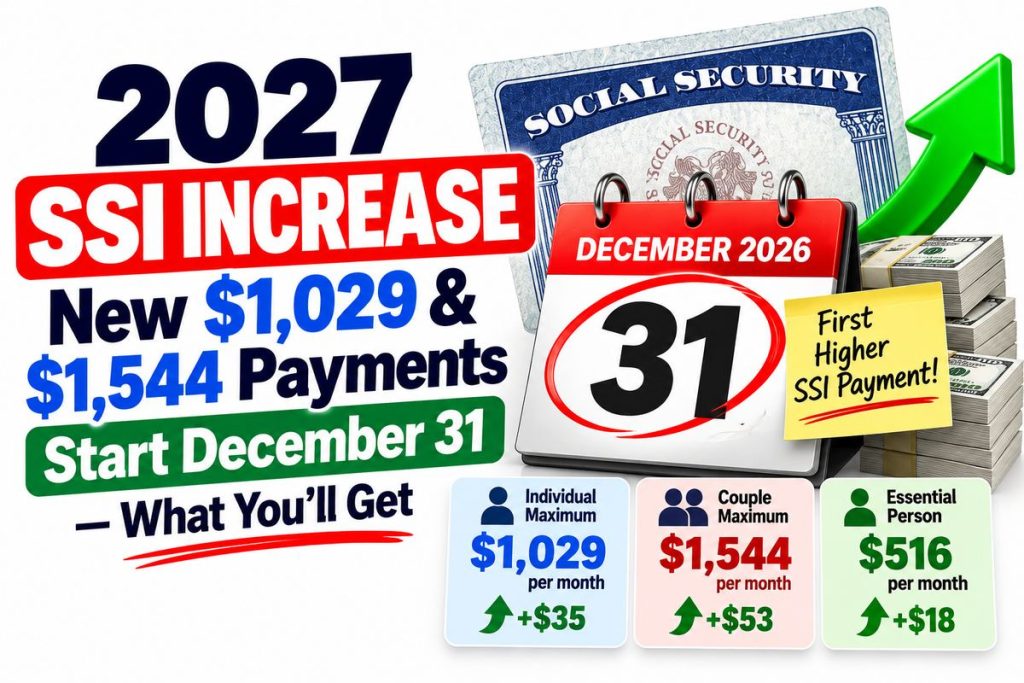
New $1,029 & $1,544 Payments Start December 31
Supplemental Security Income recipients will receive higher federal payments in 2027 after the Social Security Administration confirmed a 3.6% cost-of-living adjustment.
The new maximum federal SSI payment amounts are:
$1,029 per month for an eligible individual
and:
$1,544 per month for an eligible couple.
There is also a new maximum of:
$516 per month for a qualifying essential person.
But millions of SSI recipients will not have to wait until January to see the higher amount.
The first SSI payment reflecting the new 2027 rates is scheduled for:
December 31, 2026.
That happens because January 1, 2027 is New Year’s Day, so the January SSI payment is delivered on the previous business day.
There is an important catch:
$1,029 and $1,544 are maximum federal SSI amounts.
Your actual payment can be lower depending on income, living arrangements, other benefits and other SSI rules.
Here is exactly how much SSI is increasing in 2027, when the new payments begin and why your deposit may differ from the headline amount.
2027 SSI Payment Amounts
The Social Security Administration has officially confirmed the following maximum federal SSI payments for 2027:
| SSI category | 2026 maximum | 2027 maximum | Monthly increase |
|---|---|---|---|
| Eligible individual | $994 | $1,029 | $35 |
| Eligible couple | $1,491 | $1,544 | $53 |
| Essential person | $498 | $516 | $18 |
These new amounts reflect the official:
3.6% 2027 COLA.
The amounts become effective for January 2027 SSI benefits.
Because January 1 is a federal holiday, the January payment is scheduled to arrive one day early:
Thursday, December 31, 2026.
How Much Is SSI Increasing in 2027?
For an eligible individual receiving the full federal maximum, monthly SSI increases from:
$994
to:
$1,029.
That is:
$35 more per month.
Over 12 months, that represents as much as:
$420 more
at the federal maximum rate.
For an eligible couple receiving the full federal maximum, the payment rises from:
$1,491
to:
$1,544.
That is:
$53 more per month
or up to:
$636 more over 12 months.
For a qualifying essential person, the maximum rises from:
$498
to:
$516
for an increase of:
$18 per month.
Why Is SSI Increasing by 3.6%?
SSI federal payment amounts are generally adjusted using the same annual cost-of-living adjustment applied to Social Security benefits.
For 2027, the official COLA is:
3.6%.
The annual adjustment is tied to inflation as measured through the Consumer Price Index for Urban Wage Earners and Clerical Workers, commonly known as:
CPI-W.
The goal of the COLA is to help federal benefit payments keep up with rising consumer prices.
The 2027 adjustment applies to approximately 76 million people receiving Social Security and/or SSI benefits.
When Does the 2027 SSI Increase Start?
The new SSI rates are effective for:
January 2027.
But the first higher payment is scheduled to arrive:
December 31, 2026.
Why?
SSI normally pays benefits on the:
first day of the month.
The normal January 2027 SSI payment date would therefore be:
January 1, 2027.
But January 1 is New Year’s Day and a federal holiday.
SSA moves the payment to the preceding business day.
That makes the actual payment date:
Thursday, December 31, 2026.
Does That Mean There Are Two SSI Checks in December 2026?
Yes—but the second check is not a bonus payment.
SSI recipients are scheduled to receive:
December 1, 2026 — December SSI payment
and:
December 31, 2026 — January 2027 SSI payment
The December 31 deposit belongs to:
January 2027.
It simply arrives early because of the holiday.
Recipients should therefore budget the December 31 deposit as:
January money.
Our complete Social Security December 2026 Payment Schedule explains the unusual year-end payment pattern in more detail.
Does the December 31 Payment Include the 3.6% COLA?
Yes.
SSA specifically says increased SSI payments reflecting the 2027 COLA begin with the:
December 31, 2026 payment.
That means someone receiving the maximum federal individual rate could see:
December 1 payment: up to $994
followed by:
December 31 payment: up to $1,029.
For an eligible couple receiving the maximum federal amount:
December 1: up to $1,491
and:
December 31: up to $1,544.
The exact payment can differ depending on the recipient’s circumstances.
Will Everyone on SSI Receive $1,029?
No.
This is one of the most important points to understand.
$1,029 is the maximum federal SSI payment for an eligible individual.
It is not a guaranteed payment for every SSI recipient.
Your actual SSI benefit may be lower because SSA considers factors including:
- countable income;
- wages;
- Social Security benefits;
- pensions;
- other income;
- living arrangements;
- help with shelter expenses;
- marital status;
- state supplemental benefits.
SSA generally starts with the applicable federal benefit rate and subtracts countable income.
That means two people who are both eligible for SSI can receive different monthly payments.
Why Might My 2027 SSI Payment Be Less Than $1,029?
One major reason is:
countable income.
SSI is a needs-based program.
Unlike Social Security retirement benefits, the amount is not primarily determined by how much you paid in Social Security payroll taxes during your career.
SSI considers your financial situation.
Some income is counted.
Some income is excluded.
The more countable income you have, the lower your federal SSI payment may be.
Does Social Security Income Reduce SSI?
It can.
If you receive another Social Security benefit, such as:
- retirement benefits;
- SSDI;
- survivor benefits;
part of that payment can generally count as unearned income for SSI.
This is why someone can receive both:
Social Security and SSI
but still receive less than the full SSI federal maximum.
SSI can sometimes supplement another relatively small Social Security benefit.
Does Work Income Reduce SSI?
Work income can affect SSI, but SSA does not count every dollar of wages.
Under standard SSI earned-income rules, SSA generally excludes:
the first $65 of earned income per month
plus:
one-half of the remaining earned income.
There is also generally a:
$20 general income exclusion
that may apply.
This means earning $500 from work does not automatically reduce SSI by $500.
SSI work calculations are considerably different from the Social Security retirement earnings test.
Simple SSI Work Example
Suppose someone has:
$865 in monthly wages
and no other income to which the $20 general exclusion is applied.
A simplified calculation can look like:
$865
minus $20 general exclusion
= $845
minus $65 earned-income exclusion
= $780
divide remaining amount by two
= $390 in countable earned income.
That countable amount—not the full $865—would generally be used in calculating the SSI payment.
Actual calculations can differ depending on other income and applicable exclusions.
2027 SSI Student Earned Income Exclusion
Some students who receive SSI have an additional work incentive.
For 2027, SSA has increased the Student Earned Income Exclusion to:
$2,500 per month
up to a maximum of:
$10,080 during the year.
This rule can apply to certain blind or disabled students who are regularly attending school or qualifying training programs.
The 2026 amounts were:
$2,410 per month
and:
$9,730 annually.
The increase reflects the 3.6% COLA.
What Are the 2027 SSI Resource Limits?
Unlike the federal monthly benefit rate, the basic SSI resource limits are not increasing in 2027.
The limits remain:
$2,000 for an individual
and:
$3,000 for a couple.
SSA confirmed those amounts in its official 2027 COLA fact sheet.
These resource limits have remained unchanged for decades.
What Counts as a Resource?
Resources can include things you own that could potentially be converted to cash.
Examples can include:
- money in checking accounts;
- money in savings accounts;
- certain investments;
- certain property;
- cash.
However, SSA does not count every asset.
For example, certain assets may be excluded under SSI rules.
Because SSI resource rules can be complicated, beneficiaries should not assume an asset automatically makes them ineligible without checking the applicable SSA rule.
Does Your Home Count Against the SSI Resource Limit?
A home you live in generally receives special treatment under SSI resource rules and is not simply treated like cash in a bank account.
Other exclusions can also apply.
The basic point is:
$2,000 does not mean everything you own must be worth less than $2,000.
It refers to:
countable resources.
Can Someone Own a Car and Receive SSI?
Potentially, yes.
SSI has exclusions for certain resources, including treatment of vehicles under applicable rules.
Owning a vehicle therefore does not automatically mean someone is ineligible for SSI.
The important question is whether SSA considers an asset:
countable.
Can Living With Someone Else Reduce SSI?
Yes, depending on the circumstances.
Living arrangements can affect SSI because the program considers certain help with:
shelter expenses.
For example, your SSI may be reduced if someone else pays some or all of your:
- rent;
- mortgage;
- electricity;
- heating fuel;
- other qualifying shelter costs.
SSA calls some forms of this support:
in-kind support and maintenance.
However, the rules changed in 2024.
Food provided by other people generally is no longer included in the same SSI in-kind support calculation.
Shelter assistance can still matter.
What If I Pay My Fair Share of Rent?
If you live with other people but pay your share of applicable shelter expenses, you may avoid certain living-arrangement reductions.
SSI calculations depend on the exact arrangement.
Recipients should keep records showing:
- rent payments;
- utility contributions;
- household expense sharing.
That can be especially important when SSA reviews living arrangements.
Can State SSI Supplements Increase Your Payment?
Yes.
The $1,029 and $1,544 figures are:
federal maximum SSI amounts.
Some states provide additional SSI payments.
That means certain recipients can receive a combined payment above the federal rate.
State supplement rules vary substantially.
Some states administer their own supplements, while SSA administers certain supplements for some states.
So your total payment can depend on:
where you live.
Is SSI the Same as SSDI?
No.
SSI and SSDI are frequently confused, but they are different programs.
SSI
Supplemental Security Income is primarily based on:
- limited income;
- limited resources;
- disability, blindness, or age 65 or older;
- other eligibility requirements.
SSDI
Social Security Disability Insurance is generally based on:
- disability;
- your work history;
- Social Security work credits.
SSDI does not use the same $1,029 federal maximum payment.
Someone’s SSDI benefit is calculated using their Social Security earnings record.
Can Someone Receive Both SSI and SSDI?
Yes.
Some people receive:
SSDI + SSI
at the same time.
This is sometimes referred to as receiving concurrent benefits.
For example, a person might qualify for a relatively low SSDI payment based on their earnings record and also qualify for SSI depending on their income and resources.
Because SSDI can count as income for SSI purposes, the person generally would not simply receive the full amount of each program added together.
What Is the 2027 SSDI Amount?
There is no single standard SSDI check for every disabled worker.
SSA estimates that the average monthly benefit for disabled workers will rise from approximately:
$1,642
before the 2027 COLA
to approximately:
$1,701
after the adjustment.
That is an estimated average.
Individual SSDI benefits can be higher or lower depending primarily on the person’s earnings record.
This is different from SSI’s federal payment standard.
Are SSI and Social Security Retirement Payments Increased on the Same Date?
No.
The same:
3.6% COLA
applies, but the first higher payments arrive on different dates.
SSI
First higher payment:
December 31, 2026
because January 1 is a holiday.
Social Security retirement, SSDI and survivor benefits
Higher benefits generally begin with:
January 2027 payments.
For most beneficiaries on the birthday schedule, January payments fall on the applicable second, third or fourth Wednesday.
Why Doesn’t SSI Wait Until January?
Technically, the December 31 payment is the January payment.
SSI is normally scheduled for the first day of each month.
When that date is:
- a weekend; or
- federal holiday;
SSA generally pays on the previous business day.
January 1, 2027 is a federal holiday.
Therefore:
January’s payment arrives December 31.
Is the December 31 SSI Check an Extra Payment?
No.
This deserves repeating because it causes confusion almost every year.
The December 31 deposit is:
not a bonus
and:
not a third or extra SSI benefit.
It is simply the regular:
January 2027 SSI benefit paid early.
Recipients should avoid treating that deposit as additional December income for normal budgeting purposes.
How Can I Find My Exact 2027 SSI Amount?
Your personalized SSI amount depends on your individual circumstances.
SSA sends COLA information showing updated benefit amounts.
Many beneficiaries can also use a:
my Social Security account
to view benefit and notice information online.
SSA says COLA notices are made available online to many beneficiaries through the Message Center, while paper notices are mailed during December.
Your notice is more useful than simply multiplying your current check by 3.6% because it reflects your actual benefit calculation.
Why Might My Increase Be Less Than 3.6%?
The federal payment standard rises by 3.6%.
But your personal deposit may not increase by exactly the same dollar amount as the maximum.
Factors that can affect the result include:
- changes in other income;
- earnings;
- Social Security benefits;
- living arrangements;
- shelter assistance;
- state supplements;
- other eligibility changes.
So someone receiving $800 today should not automatically assume:
$800 × 1.036 = their exact new bank deposit.
Their personalized SSA calculation is what matters.
Can My SSI Payment Be Higher Than $1,029?
Yes, in some circumstances.
The $1,029 figure is the:
maximum federal SSI benefit rate for an individual.
Some states provide:
supplemental payments.
That can make the combined benefit higher than the federal amount.
The specific total depends on the state’s rules and the beneficiary’s circumstances.
Who Can Qualify for SSI?
In general, SSI is intended for people who have:
- little or no income;
- limited resources;
and who are:
- age 65 or older;
- blind; or
- disabled under Social Security’s rules.
Children with qualifying disabilities can also receive SSI if applicable financial and other requirements are met.
There are also citizenship and qualifying noncitizen requirements.
Are SSI Resource Limits Increasing With the COLA?
No.
This is an important distinction.
The monthly federal payment standard increases because of the 3.6% COLA.
But the basic resource limits remain:
$2,000 individual
and:
$3,000 couple.
So the COLA does not automatically increase every financial threshold within the SSI program.
2027 SSI Changes at a Glance
| 2027 SSI item | New amount / rule |
|---|---|
| COLA | 3.6% |
| Individual federal maximum | $1,029/month |
| Couple federal maximum | $1,544/month |
| Essential person | $516/month |
| First higher SSI payment | Dec. 31, 2026 |
| Individual resource limit | $2,000 |
| Couple resource limit | $3,000 |
| Student earned-income exclusion | $2,500/month |
| Student annual exclusion | $10,080/year |
How Much More Will an Individual Receive?
If you currently receive the full 2026 individual federal maximum of:
$994
the new maximum is:
$1,029.
Difference:
$35 per month.
Potential annual difference:
$420.
Again, this assumes the person remains eligible for the maximum federal amount.
How Much More Will an Eligible Couple Receive?
The federal couple maximum increases from:
$1,491
to:
$1,544.
Difference:
$53 per month.
Potential yearly increase:
$636.
The actual payment can be lower when countable income or other factors apply.
How Much More Will an Essential Person Receive?
The essential-person amount increases from:
$498
to:
$516.
Difference:
$18 per month.
Potential annual increase:
$216.
This category applies only under specific SSI rules.
2027 SSI Payment Example
Consider a recipient currently receiving the full:
$994 monthly federal SSI amount.
If nothing else changes in their eligibility and they qualify for the full 2027 federal maximum:
December 1, 2026:
$994
December 31, 2026:
$1,029
February 1, 2027:
$1,029
and so on, subject to future changes in income, living arrangements or eligibility.
The December 31 payment represents:
January 2027.
What Should SSI Recipients Do Before 2027?
There are several practical steps worth taking.
Check your SSA notice
Review your personalized COLA notice when it becomes available.
Check your bank information
Make sure direct-deposit information is correct.
Report income changes
SSI recipients generally need to keep SSA informed about relevant changes to income.
Report living-arrangement changes
Changes in where you live or who pays shelter expenses can affect SSI.
Watch your resources
Remember that the federal resource limit remains:
$2,000 for an individual
and:
$3,000 for a couple.
Budget the December 31 payment for January
Do not mistake the early January payment for extra December money.
Frequently Asked Questions
How much will SSI be in 2027?
The maximum federal SSI payment is:
$1,029 per month for an eligible individual
and:
$1,544 per month for an eligible couple.
How much is SSI increasing in 2027?
The federal SSI payment standard is increasing by:
3.6%.
At the maximum rate, an individual increases by $35 per month and an eligible couple increases by $53 per month.
When does the 2027 SSI increase start?
The increased federal rates are effective for January 2027.
The first increased SSI payment arrives:
December 31, 2026.
Why is January’s SSI payment coming in December?
January 1, 2027 is a federal holiday.
SSA therefore sends the January SSI payment on the preceding business day:
December 31, 2026.
Will SSI recipients get two checks in December 2026?
They are scheduled to receive two SSI deposits:
December 1 — December benefit
and:
December 31 — January benefit paid early.
The second payment is not a bonus.
Will everyone receive $1,029?
No.
$1,029 is the maximum federal amount for an eligible individual.
Actual SSI payments may be lower because of countable income, living arrangements and other factors.
How much will couples get from SSI in 2027?
The maximum federal rate for an eligible individual with an eligible spouse is:
$1,544 per month.
What is the 2027 SSI resource limit?
The limits remain:
$2,000 for an individual
and:
$3,000 for a couple.
Did the SSI resource limit increase by 3.6%?
No.
The federal payment standard increased, but the basic resource limits remain unchanged.
Does working automatically stop SSI?
No.
SSI has earned-income exclusions, and SSA generally does not count every dollar of earnings when calculating the benefit.
Can I receive SSI and SSDI together?
Yes, some people qualify for both programs.
Other Social Security benefits can affect how much SSI is payable.
Is SSI the same as Social Security retirement?
No.
SSI is a needs-based federal benefit.
Social Security retirement is primarily based on a person’s covered earnings and work record.
Can I receive more than $1,029?
Potentially.
Some states provide supplemental SSI payments in addition to the federal amount.
Bottom Line
The 2027 SSI increase is now official.
The maximum federal SSI payment rises to:
$1,029 per month for an eligible individual
and:
$1,544 per month for an eligible couple.
A qualifying essential-person amount increases to:
$516 per month.
The increase reflects the official:
3.6% COLA.
And the first higher SSI payment arrives earlier than many people expect:
December 31, 2026.
That payment is the January 2027 benefit paid one day early because January 1 is a federal holiday.
It is:
not an extra check
and:
not a bonus payment.
Recipients should also remember that the headline $1,029 amount is the maximum federal payment.
Your actual SSI check can depend on:
- income;
- wages;
- other Social Security benefits;
- living arrangements;
- shelter assistance;
- state supplements;
- other SSI rules.
One number that does not increase for 2027 is the SSI resource limit.
It remains:
$2,000 for an individual
and:
$3,000 for a couple.
For many SSI recipients, the date to remember is therefore:
December 31, 2026 — the first payment reflecting the new 2027 SSI rates.