Missouri Congressional Map 2026: New Districts, Court Rulings & What Happens Next
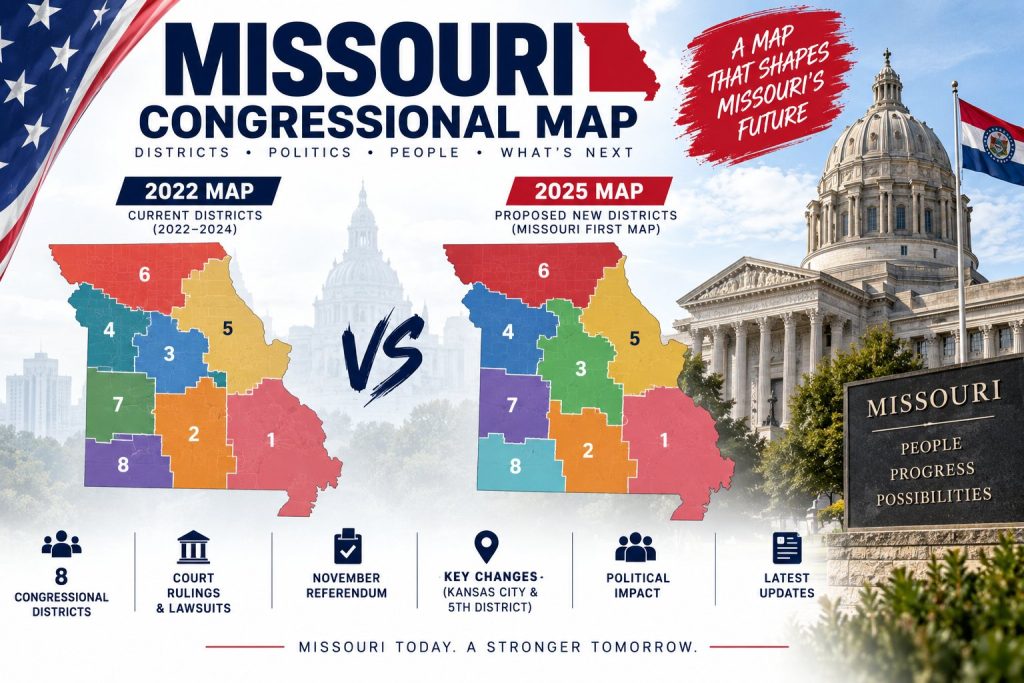
Missouri Congressional Map 2026
The Missouri congressional map has become one of the most closely watched redistricting battles ahead of the 2026 midterm elections.
Missouri lawmakers approved a new congressional map in 2025 that substantially reshaped the Kansas City-based 5th Congressional District and was designed to improve Republican prospects for winning seven of the state’s eight U.S. House seats. But a successful referendum petition, a unanimous Missouri Supreme Court ruling, a U.S. Supreme Court decision and a conflicting federal court order have left the state’s 2026 congressional boundaries in an extraordinary legal dispute.
As of September 9, 2026, I cannot confirm that the legal dispute over which map election officials ultimately must use is completely resolved. The Missouri Supreme Court has ordered the state to use the 2022 congressional map, while a federal district judge subsequently issued an order pointing election officials toward the 2025 map.
Here is what Missouri voters need to know.
Missouri Congressional Map 2026 at a Glance
| Issue | Latest status |
|---|---|
| Number of Missouri congressional districts | 8 |
| Map used in 2022 and 2024 | 2022 congressional map |
| New map passed | September 2025 |
| Legislation | House Bill 1 |
| New map nickname | Missouri First Map |
| Main district affected | 5th Congressional District |
| Current U.S. House delegation | 6 Republicans, 2 Democrats |
| Potential effect of 2025 map | Could favor Republicans in 7 of 8 seats |
| Missouri Supreme Court ruling | 2022 map remains in force unless voters approve HB 1 |
| U.S. Supreme Court action | Declined Missouri’s emergency request to revive the 2025 map |
| Federal court development | Separate federal judge ordered use of the newer map |
| November referendum | HB 1 is headed to Missouri voters |
Missouri continues to have eight congressional districts, with one U.S. representative elected from each district.
What Is the New Missouri Congressional Map?
Republican Gov. Mike Kehoe called a special legislative session in 2025 to consider new congressional boundaries before the 2026 midterm elections.
The General Assembly passed House Bill 1, and Kehoe signed it on September 28, 2025. His administration calls the plan the “Missouri First Map.”
The governor’s office said the plan:
- splits fewer counties and municipalities,
- keeps two congressional districts unchanged, and
- keeps every sitting member of Missouri’s congressional delegation within his or her district.
The official proposed statewide map prepared by Missouri House Research shows eight redesigned districts and includes detailed insets for Kansas City and St. Louis.
Why Did Missouri Redraw Its Congressional Map?
Congressional districts are normally redrawn after the once-a-decade U.S. Census.
Missouri had already enacted a new congressional map in 2022 following the 2020 Census.
The 2025 effort was therefore a mid-decade redistricting, meaning lawmakers changed the boundaries before the next census-driven redistricting cycle.
Gov. Kehoe said the new lines would better represent Missouri and make districts more compact while reducing county and municipal splits.
The political impact was also significant.
Reuters reported that the new Missouri map was designed to give Republicans an advantage in seven of the state’s eight congressional seats, potentially converting one Democratic-held seat into a Republican opportunity.
The redistricting occurred as multiple Republican- and Democratic-led states pursued mid-decade map changes ahead of the 2026 battle for control of the U.S. House.
What Changed in Missouri’s 5th Congressional District?
The biggest changes center on the 5th Congressional District, represented by Democratic Rep. Emanuel Cleaver.
Under Missouri’s 2022 map, the district is centered heavily around Kansas City and Jackson County.
The 2025 map divides parts of the Kansas City metropolitan area among multiple districts while extending the remaining 5th District farther into more Republican-leaning rural areas.
The Associated Press estimated that about 59% of voters in the redesigned 5th District would be new to the district.
That is why the 5th District has become the centerpiece of the redistricting fight.
If the 2025 boundaries ultimately govern an election, Republicans could have a substantially stronger opportunity to capture a seat that has long been held by Democrats.
How Is Kansas City Affected?
The changes go beyond simply adding rural territory to the 5th District.
Democratic state Sen. Barbara Anne Washington said the 2025 plan divides Kansas City and Jackson County among three congressional districts and argued that the changes weaken Kansas City’s unified representation.
Supporters take a different view.
The Kehoe administration argues that the map improves compactness and reduces the number of divided counties and municipalities compared with the previous boundaries.
Those competing arguments—community representation versus district compactness and political balance—have remained central to the debate.
What Happened With the Missouri Redistricting Referendum?
Opponents of House Bill 1 launched a referendum petition challenging the new map.
The petition, identified as 2026-R004, asks Missouri voters whether they approve HB 1 and its replacement congressional boundaries. The Secretary of State’s official ballot language describes HB 1 as repealing the existing congressional plan and replacing it with boundaries that keep more counties intact.
Organizers submitted hundreds of thousands of petition signatures.
The resulting legal fight focused heavily on whether Missouri’s Constitution allows voters to use the referendum process to challenge an act establishing congressional districts.
What Did the Missouri Supreme Court Rule?
On September 3, 2026, the Missouri Supreme Court unanimously ruled that the referendum petition was legal, timely and contained the required number of valid signatures.
The court concluded that HB 1 therefore never took effect for purposes of replacing the existing map and cannot take effect unless Missouri voters approve it.
The court stated:
“The 2022 map is the only map in effect.”
It ordered the secretary of state to place the referendum on the November ballot and restrained state officials from implementing the 2025 map under that decision.
The ruling meant that, under the Missouri Supreme Court’s interpretation of state law, the congressional districts enacted in 2022 remain in force for the November 2026 general election.
What Did the U.S. Supreme Court Do?
Missouri officials then sought emergency relief from the U.S. Supreme Court.
They asked the court to allow the 2025 map to be used despite the Missouri Supreme Court decision, arguing that changing district boundaries after the August primary would create serious election-administration problems.
On September 8, Justice Brett Kavanaugh denied Missouri’s emergency request.
He did not provide a detailed explanation for the denial.
Importantly, the denial did not constitute a full U.S. Supreme Court ruling on every constitutional issue in the case. But it meant that the Court did not grant Missouri the emergency relief it had requested against the state Supreme Court decision.
Why Is the Missouri Congressional Map Still Confusing?
Hours surrounding those developments produced another significant twist.
U.S. District Judge Stephen Clark issued a temporary federal order that conflicted with the Missouri Supreme Court’s direction.
The federal order blocked the use of the older districts and directed state officials toward the newer Republican-drawn map.
That created a highly unusual situation:
Missouri Supreme Court: Use the 2022 map.
U.S. Supreme Court emergency action: Did not suspend the Missouri Supreme Court ruling.
Federal district court: Issued a separate order supporting use of the 2025 map.
Because those orders point in different directions, the final election-administration consequences were still being litigated as of this update.
That is why claims that either map is unquestionably the final 2026 map should be treated cautiously until the conflicting federal and state orders are reconciled.
Which Missouri Congressional Map Was Used in the 2026 Primary?
Missouri held its August 4, 2026 primary under the 2025 congressional boundaries.
That happened before the September Missouri Supreme Court ruling that concluded HB 1 had not taken legal effect because of the referendum petition.
This created one of the central practical problems in the case.
Candidates were nominated in districts drawn one way, while the state Supreme Court later directed that the general election use the older boundaries.
Missouri officials argued that changing maps between the primary and general election would create voter confusion and administrative difficulties. Referendum supporters argued those difficulties resulted from officials proceeding with the new map while litigation remained unresolved.
2022 Missouri Congressional Map vs. 2025 Map
The difference can be summarized this way:
| 2022 Map | 2025 Missouri First Map |
|---|---|
| Created after 2020 Census | Mid-decade redraw |
| Used for 2022 and 2024 elections | Used for August 2026 primary |
| Produced 6R–2D current delegation | Designed to make 7R–1D possible |
| Keeps a Kansas City-centered 5th District | Extends 5th into more rural territory |
| Current map under Missouri Supreme Court ruling | Subject of November referendum |
| HB 2909 framework | HB 1 framework |
The 2022 congressional plan contains eight districts and is available through Missouri House redistricting records.
The 2025 plan also contains eight districts, but redraws several boundaries, particularly around Kansas City.
How Could the Map Affect Control of Congress?
Missouri currently sends six Republicans and two Democrats to the U.S. House.
The 2025 map was drawn in a way that could improve Republican prospects in the Democratic-held 5th District, potentially creating a 7-1 Republican advantage in Missouri’s congressional delegation.
One congressional seat could matter nationally because control of the U.S. House is being contested with a narrow partisan margin.
Missouri is also only one part of a much larger redistricting battle. Reuters reported that Republican-led map changes in several states could improve GOP prospects in as many as 16 seats, while Democratic-backed changes in other states could improve Democratic prospects in six.
Is the Missouri Map a Gerrymander?
“Gerrymander” is a political and legal characterization, so it is useful to distinguish competing positions.
Critics of the 2025 map argue that Kansas City was deliberately divided to weaken Democratic voting strength and create an additional Republican-leaning congressional district.
Supporters of the map argue that it creates more compact districts, keeps more counties and municipalities intact and appropriately reflects Missouri’s political geography.
Separate litigation also challenged the map’s compactness.
The Missouri Supreme Court rejected those particular constitutional challenges in May 2026, finding that challengers had not shown the new districts violated Missouri’s constitutional compactness requirements.
That decision is separate from the later referendum ruling.
Will Missouri Voters Decide the Congressional Map?
Under the Missouri Supreme Court’s September 3 ruling, yes.
The court directed the secretary of state to certify the HB 1 referendum for the November 3, 2026 general election.
The referendum asks voters whether they approve the legislature’s 2025 congressional redistricting act.
If voters approve HB 1, the legal status of the 2025 congressional boundaries would change according to the measure and subsequent election-law requirements.
If voters reject it, the 2025 redistricting law would not receive voter approval.
Because active litigation remains underway, however, the precise interaction between the referendum result and the immediate 2026 congressional election should continue to be checked against official court orders.
Frequently Asked Questions
What is the current Missouri congressional map?
The Missouri Supreme Court ruled that the 2022 congressional districts remain legally in force because the 2025 map was suspended by a valid referendum petition. A separate federal district court order has created conflicting instructions, so the litigation remains important to watch.
How many congressional districts does Missouri have?
Missouri has eight U.S. congressional districts.
Why did Missouri redraw its congressional map in 2025?
Gov. Mike Kehoe called a special session for mid-decade congressional redistricting. His administration argued the new map would create more compact boundaries and split fewer counties and municipalities. The plan also improves Republican electoral prospects in the Kansas City-area 5th District.
What changed in Missouri’s 5th Congressional District?
The 2025 map shifts portions of Kansas City into neighboring districts and extends the 5th District farther into more Republican-leaning rural territory. AP estimated that about 59% of voters in the redesigned district would be new to it.
Who represents Missouri’s 5th Congressional District?
The Kansas City-area 5th District is currently represented by Democrat Emanuel Cleaver.
Did the U.S. Supreme Court approve Missouri’s new map?
No. On September 8, 2026, Justice Brett Kavanaugh denied Missouri’s emergency request to block the Missouri Supreme Court ruling. The action did not constitute a final merits ruling by the full U.S. Supreme Court.
Will the Missouri congressional map be on the November ballot?
The Missouri Supreme Court ordered the HB 1 referendum placed on the November 2026 ballot after finding the petition legal, sufficient and timely.
Which map was used in the Missouri primary?
The 2025 map was used for the August 4, 2026 primary, creating complications after the Missouri Supreme Court later ordered use of the 2022 boundaries.
Bottom Line
The Missouri congressional map remains at the center of a major election-law battle.
Missouri’s Republican-controlled legislature passed a new map in 2025 that dramatically reshaped the Kansas City-area 5th District and could improve Republican chances of winning seven of the state’s eight House seats.
But the Missouri Supreme Court ruled on September 3 that a valid referendum petition prevented House Bill 1 from taking effect and ordered the state to return to the 2022 congressional map for the November election. The U.S. Supreme Court declined to grant Missouri emergency relief from that ruling on September 8.
A separate federal court order has since pointed in the opposite direction, creating an unresolved conflict over election administration.
For that reason, the most accurate description as of September 9, 2026 is that Missouri’s congressional map remains subject to active litigation and conflicting court orders. Any article stating definitively that the 2022 or 2025 map has permanently won the dispute risks becoming inaccurate as the courts act.