What Is Agentic AI? How It Works, Examples & AI Agents vs Generative AI
What Is Agentic AI? How It Works, Examples & AI Agents vs Generative AI
Agentic AI is artificial intelligence designed to do more than answer a question or generate content. It can work toward a goal, decide which steps are needed, use tools, observe the results and adjust what it does next.
A traditional chatbot might answer:
“Here are five hotels in Chicago.”
An agentic AI system could potentially go further:
- Search for suitable hotels.
- Compare prices and reviews.
- Check dates and availability.
- Filter results according to your preferences.
- Present the best options.
- Open the booking page.
- Complete permitted steps after receiving approval.
That difference—moving from generating an answer to taking actions toward a goal—is why agentic AI has become one of the biggest artificial-intelligence trends.
Google Cloud describes agentic AI as AI focused on autonomous decision-making and action, while MIT researcher Phillip Isola summarized the idea even more simply: agentic AI is AI that takes actions in the world.
Interest in the term has also grown dramatically. An OECD analysis of Google Trends data found that global searches for “agentic AI” surged sharply during 2025, showing how quickly the concept moved from a specialist technology term into mainstream AI discussion.
So what exactly is agentic AI, how is it different from an AI agent or generative AI, and what can these systems actually do?
Here is a complete guide.
What Is Agentic AI?
Agentic AI refers broadly to artificial-intelligence systems that can pursue goals through a sequence of decisions and actions rather than responding to each request with one isolated answer.
A typical agentic system may be able to:
- understand a goal;
- create a plan;
- decide what action to take;
- use external software or tools;
- retrieve information;
- observe what happened;
- revise its plan;
- continue working through multiple steps; and
- request human approval when necessary.
The exact definition is not completely standardized.
Some organizations use agentic AI as a broad description for highly autonomous AI systems.
Others use the term specifically for systems made up of multiple coordinated AI agents.
The OECD notes this terminology problem and distinguishes agentic AI from individual AI agents while acknowledging that the terms are often used inconsistently across the industry.
The practical idea, however, is much easier to understand:
Generative AI creates. Agentic AI can create, decide and act.
Agentic AI in Simple Terms
Imagine asking an AI:
“Help me organize a business conference.”
A standard generative AI chatbot might produce:
- a conference checklist;
- suggested venues;
- an email template;
- an agenda;
- speaker ideas.
Useful—but you still have to do the work.
An agentic AI system could potentially:
- Research venues.
- Compare availability.
- Create a budget.
- Draft invitations.
- organize potential speakers.
- create documents;
- monitor responses;
- update the schedule;
- prepare follow-up emails; and
- alert you when a decision or approval is required.
The user gives the goal.
The AI determines and executes many of the steps.
That is the key shift.
Why Is Agentic AI Becoming So Important?
The first major wave of generative AI focused primarily on:
prompt → response
You asked ChatGPT, Gemini or Claude something and received text, code, an image or another generated result.
Agentic AI changes the model to something closer to:
goal → plan → action → observation → adjustment → completion
This matters because much of real work is not completed in one step.
Booking travel, researching a market, processing invoices, handling customer support, creating reports or managing projects often requires several decisions across multiple systems.
Agentic AI attempts to automate more of that chain.
Google has increasingly incorporated agents into products such as Search and its enterprise AI ecosystem. At Google I/O 2026, the company described Search agents that can continuously monitor information on the web and provide updates when relevant information changes.
This moves AI beyond answering questions when prompted toward systems capable of continuing work over time.
How Does Agentic AI Work?
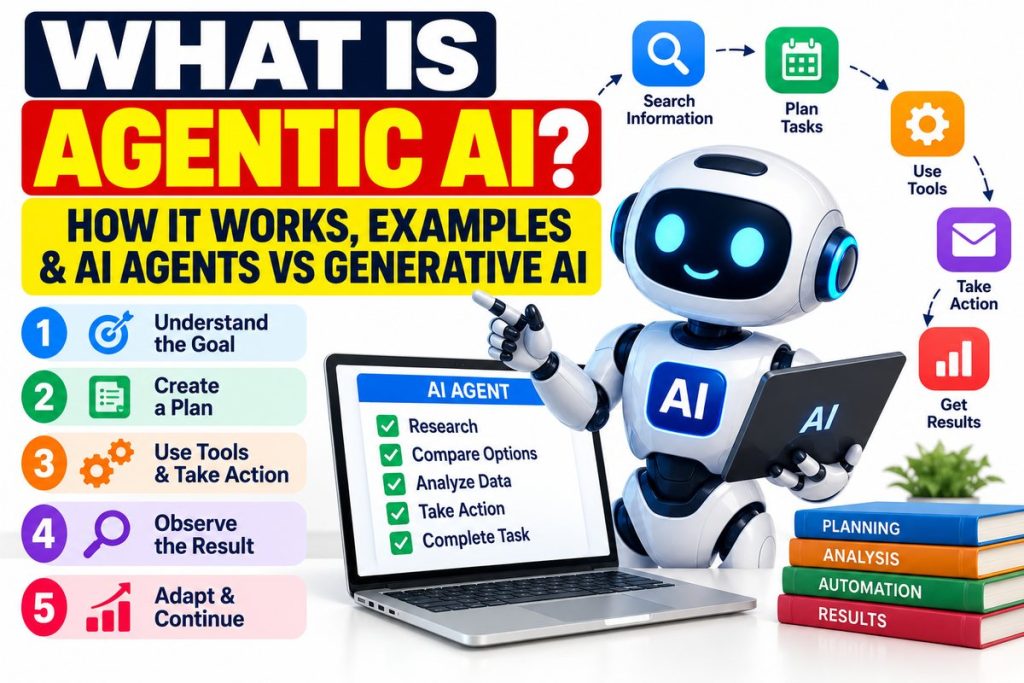
Most agentic AI systems can be understood through five basic stages.
1. Understand the Goal
Everything begins with an objective.
For example:
“Find the three best accounting tools for my business under $100 per month.”
The system first needs to interpret:
- what the user wants;
- what constraints exist;
- what information is required; and
- what a successful result should look like.
The goal is broader than a simple question.
The AI may need to determine how to achieve it.
2. Create a Plan
Next, the AI breaks the goal into smaller tasks.
For the accounting-software example, the plan could be:
- Identify relevant accounting products.
- Check current pricing.
- Compare features.
- Look for limitations.
- Evaluate options against the budget.
- Rank the best choices.
- Present the results.
A sophisticated agent may create this plan dynamically rather than following a workflow completely predefined by a programmer.
3. Use Tools
This is one of the biggest differences between a chatbot and an AI agent.
An agentic system may have access to external tools such as:
- web search;
- browsers;
- email;
- calendars;
- databases;
- cloud storage;
- business software;
- APIs;
- spreadsheets;
- code execution;
- payment or shopping systems; and
- internal company data.
The language model provides reasoning capabilities.
The tools allow the system to do something with that reasoning.
4. Observe the Result
After taking an action, the AI evaluates what happened.
Suppose an agent attempts to find a flight but discovers that the preferred flight is sold out.
A rigid automation may simply fail.
An agentic system could potentially observe the failure and ask:
What should I try next?
It could then:
- search another airline;
- change the departure time;
- check a nearby airport; or
- present alternative choices.
This feedback loop is one of the characteristics that makes agentic AI different from traditional automation.
5. Adapt and Continue
The process may repeat:
reason → act → observe → adjust
until the task is complete or human input is required.
That ability to dynamically re-plan is particularly important.
An agent that merely follows ten predetermined workflow steps is closer to advanced automation.
A more agentic system can determine that step four failed and change steps five through ten accordingly.
Agentic AI vs AI Agents: What’s the Difference?
“Agentic AI” and “AI agent” are frequently used interchangeably, but they are not necessarily identical.
Here is the simplest comparison:
| Term | Meaning |
|---|---|
| AI agent | A software system capable of performing tasks and taking actions |
| Agentic AI | The broader approach or behavior in which AI autonomously pursues goals through decisions and actions |
| Multi-agent system | Multiple AI agents working together |
| AI workflow | A sequence of automated steps, which may or may not be truly agentic |
Think of it this way:
An AI agent is something you can deploy.
Agentic AI describes the type of autonomous behavior the system can exhibit.
Some researchers and technology companies define the distinction differently, so it is better to judge a product by what it can actually do rather than simply whether the vendor calls it “agentic.”
If you want practical examples of individual systems, see our guide to AI agents for small business. AI Agents for Small Business: 15 Practical Uses in 2026
Agentic AI vs Generative AI
This is another important distinction.
Generative AI
Generative AI primarily produces new content.
Examples include:
- text;
- images;
- software code;
- audio;
- video;
- summaries;
- presentations.
The traditional interaction is:
User prompt → AI output
Agentic AI
Agentic AI can use generative AI capabilities while also:
- planning;
- making decisions;
- using tools;
- interacting with software;
- checking results;
- adapting to changes; and
- completing multi-step tasks.
The interaction becomes:
User goal → plan → actions → feedback → more actions → result
Simple Example
Ask generative AI:
“Write an email asking three suppliers for pricing.”
It writes the email.
Ask an appropriately connected agentic system:
“Get updated pricing from our three approved suppliers.”
The system could potentially:
- Find the approved suppliers.
- Locate their contact information.
- Draft individualized messages.
- Ask for your approval.
- Send the emails.
- Monitor replies.
- extract prices;
- compare offers; and
- prepare a purchasing recommendation.
That is a much larger level of automation.
Agentic AI vs Traditional Automation
Traditional automation is still extremely useful.
But most traditional workflows are deterministic.
For example:
When a form is submitted → add customer to CRM → send email → create task.
The sequence is known before the workflow begins.
Agentic AI can introduce dynamic decision-making.
Instead of:
always do A → B → C
the AI might decide:
A happened, so B is unnecessary. Try D instead.
That flexibility makes agentic AI useful for tasks where every situation cannot easily be predicted in advance.
However, traditional automation can still be safer, cheaper and more reliable for repetitive workflows where the correct steps never change.
Agentic AI should not replace deterministic automation simply because it is newer.
For practical examples of combining AI with workflows, see our guide on making money with AI automation. How to Make Money With AI Automation in 2026
Real Agentic AI Examples in 2026
Agentic AI is no longer just a research concept.
Several major technology companies are building products that demonstrate parts of the agentic model.
1. Google Gemini Agent for Work
Google has expanded Gemini toward a universal workplace agent designed to complete longer and more complicated tasks.
The system can work with organizational information, create content, write code and operate across business tools.
Instead of requiring a user to individually prompt every action, the goal is to let workers assign broader objectives.
We explain the new system in our full guide to Google Gemini Agent for Work. Google Gemini Agent for Work: Features and Availability
This is a good example of the shift from:
AI assistant
toward:
AI coworker or agent.
2. Meta Muse
Meta’s Muse is another example of consumer-oriented agentic AI.
Rather than operating only as a chatbot, Muse is designed around completing tasks on behalf of users.
Depending on available permissions and features, this can include interacting with websites, connected services and shopping workflows.
For a detailed explanation, read our guide to Meta Muse AI. What Is Meta Muse AI? Features, Shopping, WhatsApp & Safety
Meta itself describes modern agentic systems as moving from a question-and-answer interaction toward multi-step plans, actions and adaptation.
3. ChatGPT Data Agent
AI agents can also specialize in enterprise data.
OpenAI’s ChatGPT Data Agent is designed to work across connected company data and answer complex business questions.
Instead of simply receiving a spreadsheet and summarizing it, an AI data agent can investigate information from multiple connected sources and produce analysis or dashboards.
Our full guide explains how the ChatGPT Data Agent works. ChatGPT Data Agent Explained
This illustrates an important point:
Not every agent needs to perform dozens of unrelated tasks.
A specialized AI agent can be extremely useful when it operates deeply within one business domain.
4. Search Agents
Search itself is becoming more agentic.
Google announced information agents in Search that can operate in the background and monitor the web for changes related to a user’s request.
Instead of repeatedly searching:
“Has the price dropped?”
a user could potentially create an information agent that keeps monitoring relevant information.
Google says its Search agents can draw from sources such as websites, news, social content and fresh data while continuing to monitor a topic.
That changes search from a one-time activity into an ongoing automated process.
5. Small-Business AI Agents
Agentic systems can also be used for much less futuristic business tasks.
Examples include:
- following up with leads;
- categorizing support requests;
- preparing invoices;
- researching prospects;
- monitoring competitor prices;
- updating CRM records;
- drafting reports;
- organizing email;
- scheduling appointments; and
- processing documents.
Our AI agents for small business guide covers 15 practical examples. AI Agents for Small Business
What Can Agentic AI Be Used For?
Potential applications cover almost every knowledge-work category.
Customer Service
An AI agent could:
- Read a customer request.
- Look up the account.
- check previous tickets;
- find the relevant policy;
- determine possible solutions;
- perform permitted account actions; and
- escalate unusual situations to a human.
Sales
A sales agent might:
- research prospects;
- enrich CRM records;
- personalize outreach;
- identify follow-up opportunities;
- schedule meetings; and
- summarize conversations.
Finance
Potential tasks include:
- categorizing transactions;
- matching invoices;
- identifying anomalies;
- preparing reports;
- gathering financial information; and
- monitoring business metrics.
Important financial decisions should still receive appropriate human review.
Software Development
Coding agents can potentially:
- inspect a repository;
- identify relevant files;
- write code;
- run tests;
- inspect errors;
- revise the implementation; and
- prepare changes for human review.
This is one of the areas where agentic AI has progressed particularly quickly.
Research
A research agent could:
- break a question into subtopics;
- search multiple sources;
- extract evidence;
- compare conflicting information;
- identify gaps;
- conduct further searches; and
- produce a sourced report.
Marketing
Potential tasks include:
- researching competitors;
- monitoring trends;
- creating campaign drafts;
- analyzing performance;
- updating content calendars; and
- preparing variations for different channels.
What Are Multi-Agent Systems?
Agentic AI does not necessarily mean one AI does everything.
Some systems use multiple specialized agents.
Imagine a research task involving:
“Should our company enter the German market?”
A multi-agent architecture might use:
Research agent — gathers market data.
Competitor agent — analyzes competitors.
Financial agent — models costs and revenue.
Legal agent — identifies regulatory questions.
Coordinator agent — combines the results.
Instead of one model attempting every task, specialized agents collaborate.
The OECD’s analysis of agentic AI specifically discusses coordinated AI-agent systems capable of breaking down tasks and pursuing complex objectives over extended periods.
Does Agentic AI Work Without Humans?
Not necessarily—and usually it should not for high-impact decisions.
Autonomy exists on a spectrum.
An AI agent may be allowed to:
Low autonomy: Research and recommend.
Medium autonomy: Prepare actions but request approval.
Higher autonomy: Perform approved low-risk actions automatically.
A business might allow an AI agent to automatically categorize emails while requiring human approval before:
- sending money;
- signing contracts;
- deleting important data;
- making employment decisions; or
- communicating sensitive information externally.
The right amount of autonomy depends on the risk of the task.
What Is Human-in-the-Loop AI?
Human-in-the-loop systems keep people involved at important decision points.
For example:
AI: I found three flights matching your requirements.
Human: Choose option two.
AI: I have filled in the booking information. The total is $486. Approve purchase?
Human: Approve.
The AI completes the work but does not independently make the final financial decision.
This model can provide much of the efficiency of AI agents without giving the system unlimited autonomy.
What Are the Benefits of Agentic AI?
When implemented appropriately, agentic AI can potentially offer several advantages.
Less Manual Work
Instead of moving information manually between multiple applications, an agent can perform some of those steps.
Longer Tasks
Traditional chatbots are often optimized around one interaction.
Agents can potentially continue working across many steps.
Adaptability
Agents can react when circumstances change instead of following only one fixed workflow.
Tool Integration
An AI agent can potentially work across:
- documents;
- databases;
- browsers;
- APIs;
- productivity software; and
- business systems.
Personalization
Agents with appropriate context can adapt workflows to an individual user, customer or organization.
What Are the Risks of Agentic AI?
More autonomy also creates more risk.
The problem is simple:
An AI that can take actions can make actionable mistakes.
Important risks include:
Incorrect Decisions
Language models can still produce incorrect conclusions.
Giving an inaccurate model access to tools can turn a wrong answer into a wrong action.
Excessive Permissions
An agent should not receive more access than necessary.
An email-management agent may need access to email.
It probably does not need unrestricted access to a company’s banking system.
Security Risks
Agents can interact with untrusted information from:
- websites;
- emails;
- documents;
- users; and
- third-party tools.
Systems therefore need controls around what instructions agents can trust and what actions they can perform.
Privacy
Agentic systems may process significant amounts of personal or business information.
Organizations need to understand:
- what information is accessed;
- where it is processed;
- how it is stored;
- who can retrieve it; and
- whether third parties receive it.
Unintended Actions
An agent may technically complete the task requested while doing so in an undesirable way.
That makes constraints, monitoring and approval steps extremely important.
Does Agentic AI Mean AGI?
No.
Agentic AI and artificial general intelligence are not the same thing.
An AI system does not need human-level general intelligence to behave agentically.
A relatively specialized system can:
- use tools;
- make decisions;
- execute multiple steps; and
- adapt to results.
That makes it an agentic system even if it cannot perform most intellectual tasks humans can perform.
Agentic AI describes how a system operates.
AGI describes a much broader hypothetical level of intelligence.
Is Agentic AI the Same as Autonomous AI?
The terms overlap, but they are not always identical.
Autonomous AI emphasizes how independently a system operates.
Agentic AI usually emphasizes goal-directed reasoning, planning and action.
A highly agentic system may also be highly autonomous.
But autonomy exists on a spectrum.
An agent can behave agentically while still requiring human approval before important actions.
Are AI Agents Already Being Used by Businesses?
Yes.
MIT reported in 2026 that deployment of AI agents had already expanded substantially among surveyed organizations, while many additional organizations planned to implement agentic systems.
However, there is an important distinction between:
testing AI agents
and:
allowing autonomous AI to run critical business processes without supervision.
Many real deployments still use carefully restricted permissions and human oversight.
That is a sensible approach.
Will Agentic AI Replace Traditional Software?
Probably not.
Agentic AI is more likely to change how people interact with software.
Traditional software requires users to navigate menus and perform explicit actions.
An agentic interface can potentially allow the user to state a goal:
“Prepare my monthly sales report and highlight anything unusual.”
The agent then interacts with the underlying software.
The applications, databases and APIs still exist.
The agent becomes another layer through which people interact with them.
Will Agentic AI Replace Jobs?
Agentic AI can automate parts of jobs, especially work consisting of repeatable digital tasks.
But jobs usually contain many different activities.
An accountant may:
- review records;
- communicate with clients;
- interpret regulations;
- investigate unusual transactions;
- provide judgment;
- manage relationships; and
- sign off on financial work.
An AI agent may automate some of those activities without replacing the entire occupation.
The more useful question is often:
Which tasks inside a job can AI agents automate?
rather than:
Will this job disappear completely?
How Can a Small Business Start Using Agentic AI?
A small business does not need to build an enormous multi-agent system.
Start with one repetitive problem.
Good examples include:
- lead qualification;
- customer-service triage;
- appointment reminders;
- competitor monitoring;
- document processing;
- email organization; or
- recurring business reports.
Then define:
1. The goal
What should the system accomplish?
2. The tools
Which software does it need?
3. The permissions
What is it allowed to read or change?
4. The approval points
Which actions require human confirmation?
5. The success metric
How will you know whether the agent is actually useful?
This approach is safer than connecting an AI to every business system at once.
For more examples, see our guide to 15 practical AI-agent uses for small businesses. AI Agents for Small Business: 15 Practical Uses
What Is the Future of Agentic AI?
The direction of development is becoming clear.
AI systems are moving from:
answering
toward:
doing.
We are likely to see more AI products capable of:
- running longer tasks;
- using more external tools;
- coordinating specialized agents;
- remembering useful context;
- monitoring information over time;
- interacting with business systems; and
- requesting approval only when necessary.
Google’s Search agents, Meta’s agentic products and enterprise systems such as Gemini agents demonstrate that major AI companies are already moving in this direction.
The key challenge will not simply be making AI more autonomous.
It will be making autonomous systems:
reliable, controllable, secure and useful.
Frequently Asked Questions
What is agentic AI in simple words?
Agentic AI is artificial intelligence that can work toward a goal by planning steps, using tools, taking actions and adapting based on what happens instead of only generating a one-time answer.
What is an example of agentic AI?
An example would be an AI travel agent that researches flights, compares hotels, builds an itinerary and prepares bookings rather than simply suggesting destinations.
What is the difference between AI agents and agentic AI?
An AI agent is generally a software system that performs tasks or takes actions. Agentic AI is the broader approach or behavior involving goal-directed, increasingly autonomous decision-making and action. Definitions vary between organizations.
What is the difference between generative AI and agentic AI?
Generative AI primarily produces content such as text, code, images or audio. Agentic AI can use generative models while also planning, using tools, taking actions and adapting to results.
Is ChatGPT agentic AI?
Chatbots themselves traditionally operate through prompt-and-response interactions. However, modern AI products can add tools, connected applications, computer use, persistent tasks and agent capabilities around language models, creating increasingly agentic workflows.
Is Gemini an agentic AI?
Google is actively adding agent capabilities across Gemini, Google Cloud and Search. Its Gemini Agent for Work is specifically designed around longer, multi-step tasks and tool use. Read our Gemini Agent for Work guide
Is Meta Muse an AI agent?
Meta positions Muse around agentic behavior that can go beyond answering questions and work toward user goals. We cover its features separately in our Meta Muse AI guide. What Is Meta Muse AI?
Can agentic AI access the internet?
Some agentic systems can use web-search or browser tools when the product gives them that capability. Internet access is not automatic for every AI agent.
Can agentic AI send emails?
Potentially. An agent connected to an email service with appropriate permissions may be able to draft, organize or send messages. High-impact actions should use suitable permission and approval controls.
Can agentic AI make purchases?
Some agent systems can potentially assist with shopping and transaction workflows. Responsible systems should use clear user authorization before consequential financial actions.
Is agentic AI dangerous?
Agentic AI introduces risks because errors can lead to actions rather than only incorrect text. Appropriate permissions, security controls, monitoring and human approval can reduce those risks.
Is agentic AI the same as AGI?
No. Agentic AI describes AI systems capable of goal-directed action. AGI refers to the broader hypothetical concept of artificial intelligence with highly general capabilities comparable to or beyond human intelligence across many domains.
Why is agentic AI becoming popular?
AI models have become better at reasoning, tool use, coding, multimodal understanding and maintaining context across longer tasks. That makes it possible to build systems that do more than produce one response.
Bottom Line
Agentic AI is the shift from AI that answers to AI that acts.
Traditional generative AI is usually built around:
prompt → response
Agentic AI moves toward:
goal → plan → action → observation → adaptation → result
An agentic system can potentially:
- understand an objective;
- break it into steps;
- use external tools;
- interact with software;
- evaluate what happened;
- adjust its plan; and
- continue until the goal is complete.
That does not mean every AI agent should be completely autonomous.
In many real-world applications, the safest approach is:
AI handles routine work → human approves important decisions.
Agentic AI is already appearing across search, business software, coding, research, data analysis and consumer assistants.
And as products such as Google Gemini agents, Meta Muse and specialized data agents become more capable, the distinction between software you operate and software you assign work to is likely to become increasingly important.