CMS Removes ACA Subsidies for 189,000 Flagged Enrollees: What to Know
CMS Removes ACA Subsidies for 189,000 Flagged Enrollees: What to Know
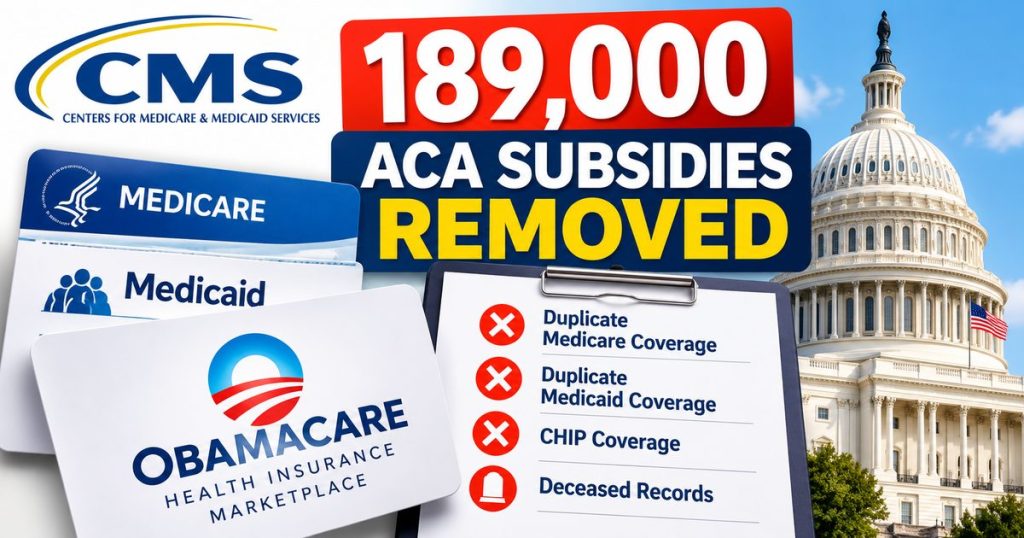
The Centers for Medicare & Medicaid Services has identified approximately 189,000 people receiving subsidized Affordable Care Act Marketplace coverage whose federal records also showed Medicare, Medicaid or Children’s Health Insurance Program coverage—or indicated that the enrollee was deceased.
CMS announced the action on October 14, 2026 as part of its program-integrity efforts involving federally subsidized Marketplace plans.
For people flagged for duplicate government coverage, one detail is especially important: CMS says affected individuals are contacted and given 30 days to dispute the finding before their Marketplace subsidies are ended.
CMS estimates the reviews could save taxpayers approximately $1.5 billion over the next year.
Here is what Marketplace enrollees need to know.
CMS Marketplace Subsidy Action at a Glance
| Key Detail | What CMS Says |
|---|---|
| Records identified in 2026 | Approximately 189,000 |
| Marketplace involved | Federal Health Insurance Marketplace |
| Duplicate programs | Medicare, Medicaid or CHIP |
| Other records involved | People federal records list as deceased |
| Initial dispute period | 30 days |
| Appeal after 30 days | Possible |
| Estimated taxpayer savings | Approximately $1.5 billion over the next year |
| Does this affect every ACA enrollee? | No |
What Did CMS Announce?
CMS said it identified approximately 189,000 people in 2026 who had subsidized coverage through the Federal Marketplace while government records indicated one of two situations.
The first involved people whose records showed that they also had coverage through:
- Medicare
- Medicaid
- Children’s Health Insurance Program, or CHIP
The second involved Marketplace records associated with people listed as deceased in federal data.
CMS says it took action to remove subsidies associated with these cases.
The announcement does not mean that 189,000 ordinary Marketplace customers were randomly removed from health insurance.
Instead, CMS says the records were identified through checks designed to detect overlapping government coverage or deceased enrollees.
Why Can Duplicate Coverage Cause Marketplace Subsidies to Stop?
Marketplace premium subsidies are intended for people who meet specific eligibility requirements.
Eligibility can change when someone becomes eligible for or enrolled in another qualifying government health program.
For example, HealthCare.gov says people generally cannot continue receiving Marketplace savings once they become eligible for Medicare Part A or once Medicare Part A or Medicare Advantage coverage begins.
Marketplace coverage and Medicare are separate systems.
Someone may sometimes keep a Marketplace plan after Medicare begins, but that does not mean they can continue receiving the same Marketplace financial assistance.
In many cases, they would have to pay the full Marketplace premium.
What Happens If CMS Thinks You Have Medicare and Marketplace Coverage?
Federal records are periodically checked to determine whether people receiving Marketplace savings remain eligible.
If CMS records indicate that someone is receiving Marketplace subsidies while also covered by Medicare, CMS says the individual is contacted.
The person receives 30 days to dispute the duplicate-coverage finding.
If the individual does not successfully resolve the discrepancy, CMS can stop the subsidies associated with the Marketplace plan.
HealthCare.gov also warns Medicare beneficiaries that continuing to receive premium tax credits after becoming ineligible can create tax consequences.
Does Marketplace Coverage Automatically End When Medicare Starts?
No.
This is an important detail.
HealthCare.gov says Marketplace coverage does not automatically end when Medicare begins.
A person transitioning to Medicare should update their Marketplace application and end Marketplace coverage for the household member beginning Medicare.
For example, if Medicare coverage begins on May 1, HealthCare.gov says Marketplace coverage can generally be scheduled to end on April 30.
Other family members who still need Marketplace coverage can remain on the Marketplace plan.
Can You Keep an ACA Marketplace Plan With Medicare?
In some circumstances, yes—but generally without Marketplace savings.
HealthCare.gov says that once someone is eligible for Medicare Part A, or once their Part A or Medicare Advantage coverage starts, they generally cannot receive savings on Marketplace premiums or out-of-pocket costs.
Someone who keeps the Marketplace policy may therefore have to pay its full price.
There is an important exception for some people who must pay a premium for Medicare Part A. Individual circumstances can differ, so consumers should check their eligibility rather than assuming the same rule applies in every situation.
Could You Have to Repay Marketplace Premium Tax Credits?
Potentially.
HealthCare.gov warns that someone who continues using the premium tax credit after becoming ineligible because of Medicare may have to repay the credit when filing a federal income-tax return.
A premium tax credit lowers the monthly cost of eligible Marketplace insurance.
The amount ultimately allowed is reconciled when the taxpayer files their federal tax return.
That makes the timing of a Medicare transition important.
Consumers should update their Marketplace application when Medicare begins rather than simply keeping both forms of coverage unchanged.
What Happens With Medicaid or CHIP?
CMS also checks for people who are simultaneously receiving subsidized Marketplace insurance while federal or state records indicate Medicaid or CHIP coverage.
The process is known as Medicaid/CHIP Periodic Data Matching, or PDM.
Federal regulations require exchanges to periodically examine enrollment information to identify potential duplicate coverage.
According to CMS, people identified through this process are contacted and given an opportunity to dispute the result.
What If Your Medicaid or CHIP Coverage Is Ending?
Being flagged for Medicaid or CHIP coverage does not necessarily mean a person permanently loses access to Marketplace financial assistance.
CMS says someone may be able to demonstrate that their Medicaid or CHIP coverage is about to lapse and regain Marketplace subsidies if they otherwise qualify.
That distinction can matter during transitions between insurance programs.
For example, a household may lose Medicaid eligibility because its income increases.
If that happens, the household may subsequently qualify for Marketplace coverage and premium assistance.
Consumers receiving a notice should therefore respond with updated information rather than ignoring it.
What Is the 30-Day Rule?
CMS says people whose records show both Marketplace subsidies and Medicaid or Medicare coverage are contacted and provided 30 days to dispute the duplicate-coverage finding.
That period gives consumers an opportunity to show that:
- The government information is incorrect
- Other coverage has already ended
- Other coverage will soon end
- Their eligibility circumstances have changed
- The record belongs to the wrong person or otherwise contains an error
If the person does not resolve the issue during the initial period, CMS says it ends the Marketplace subsidies.
However, the 30-day deadline is not necessarily the final opportunity to challenge the decision.
Can You Appeal After the 30 Days?
Yes.
CMS specifically says people may still appeal a duplicate-coverage determination after the initial 30-day period.
They may also provide information showing that Medicaid or CHIP coverage is about to end and potentially regain Marketplace subsidies.
Anyone disputing a determination should follow the instructions contained in the official notice they receive.
Do not rely on unsolicited phone calls, texts or emails claiming that payment is required to restore an ACA subsidy.
What Happens If Federal Records Incorrectly Say You Are Deceased?
CMS’s 2026 review also included Marketplace records associated with people federal databases list as deceased.
CMS says the individual—or the person’s estate—is contacted and provided 30 days to dispute the record.
If the record is not successfully disputed, CMS says both the Marketplace subsidy and the associated Marketplace plan are ended.
A living person who receives a notice incorrectly stating that they are deceased should respond promptly using the official process listed in the notice.
Incorrect death records can affect more than health insurance, so the underlying government record may also need to be corrected.
Is CMS Canceling Medicare or Medicaid?
No.
The October 14 announcement concerns subsidized Marketplace coverage, not a mass cancellation of Medicare or Medicaid benefits.
If CMS identifies someone as already having Medicare or Medicaid, the issue is whether the person should simultaneously receive federal subsidies toward a separate Marketplace policy.
That distinction is important.
People should not cancel Medicare or Medicaid simply because they receive a Marketplace data-matching notice without first confirming their actual coverage and eligibility.
Does This Affect All Obamacare or ACA Customers?
No.
The CMS action does not apply automatically to everyone enrolled through the Affordable Care Act Marketplace.
The approximately 189,000 cases identified by CMS involved records indicating:
- Duplicate Medicare coverage
- Duplicate Medicaid coverage
- Duplicate CHIP coverage
- A person listed as deceased
People who remain eligible for Marketplace financial assistance and who are not affected by one of these issues are not automatically losing subsidies because of this announcement.
What Is an ACA Premium Tax Credit?
A premium tax credit is federal financial assistance that can reduce the monthly premium for eligible Marketplace health insurance.
Eligibility depends on factors that can include:
- Household income
- Household size
- Access to other qualifying health coverage
- Marketplace eligibility rules
Many consumers choose to apply some or all of their expected premium tax credit in advance.
That reduces the amount they pay to their health insurer each month.
The tax credit is later reconciled when the consumer files a federal income-tax return.
Why Does Other Health Coverage Matter?
Marketplace subsidies are not designed to duplicate certain other forms of government health coverage.
This is especially relevant when people move from one program to another.
Common transitions include:
- Marketplace to Medicare
- Medicaid to Marketplace
- Marketplace to Medicaid
- CHIP to Marketplace
- Marketplace to employer coverage
Failing to update an application after a coverage change can result in outdated eligibility information.
Consumers should report changes promptly rather than waiting for an automated data match.
CMS Says Similar Checks Affected 551,000 Enrollees in 2025
The 2026 announcement follows earlier duplicate-enrollment enforcement.
CMS says duplicate Marketplace subsidies were ended for approximately 551,000 Medicaid enrollees in 2025 after duplicate-enrollment enforcement resumed.
The agency says the current 189,000 cases were identified during 2026.
CMS projects that the newest reviews could produce approximately $1.5 billion in taxpayer savings over the next year.
That $1.5 billion figure is a CMS projection, not a final audited savings total.
What Should You Do If You Receive a CMS or Marketplace Notice?
Do not ignore it.
If you receive an official notice about duplicate Medicare, Medicaid or CHIP coverage, review all of the information carefully.
1. Check the Name and Coverage Information
Confirm that the notice applies to you or a member of your household.
2. Verify Your Current Insurance
Determine whether the Medicare, Medicaid or CHIP coverage listed in the notice is actually active.
3. Check Start and End Dates
Coverage dates are particularly important when moving between government health programs.
4. Respond Within the Stated Deadline
CMS says consumers receive 30 days to dispute duplicate-coverage findings.
5. Keep Documentation
Keep copies of notices and any documents showing when another health plan began or ended.
6. Use Official Government Channels
Respond using the contact information and instructions contained in the official Marketplace or CMS notice.
7. Appeal If Necessary
CMS says an appeal may remain available even after the initial 30-day dispute period.
What Should People Approaching Age 65 Do?
People approaching Medicare eligibility should pay particular attention to the transition between Marketplace insurance and Medicare.
For most people, the Medicare Initial Enrollment Period is a seven-month window surrounding their 65th birthday.
Once Medicare begins, consumers should update their Marketplace application.
HealthCare.gov specifically says Marketplace coverage does not automatically terminate when Medicare starts.
That means simply enrolling in Medicare and doing nothing with the Marketplace plan can cause problems.
Consumers should coordinate the end date of their Marketplace coverage with the beginning of Medicare.
Example: Switching From Marketplace Coverage to Medicare
Consider someone whose Medicare coverage starts on January 1.
They should generally arrange for their Marketplace coverage to end on December 31, assuming no other household circumstances require a different approach.
Otherwise, the person could remain enrolled in both systems and potentially continue receiving Marketplace subsidies for which they are no longer eligible.
That could later result in a repayment requirement when premium tax credits are reconciled.
What If Other Family Members Still Need Marketplace Coverage?
One person’s transition to Medicare does not necessarily mean the entire household should cancel its Marketplace plan.
HealthCare.gov says consumers should update the application for the individual starting Medicare while confirming coverage for other household members who still need the Marketplace plan.
For example:
- One spouse turns 65 and begins Medicare
- The younger spouse remains on Marketplace insurance
The household should update the application rather than canceling the entire Marketplace account without checking the effect on the remaining spouse.
How to Avoid Future Duplicate-Coverage Problems
Consumers can reduce the risk of coverage mismatches by keeping their Marketplace application current.
Update your application when:
- Medicare begins
- Medicaid begins or ends
- CHIP coverage begins or ends
- Household income changes significantly
- Household size changes
- You gain employer-sponsored insurance
- A covered household member dies
- You move
- Other eligibility information changes
Accurate application information helps the Marketplace calculate financial assistance correctly.
Beware of Health Insurance Scams
A major government announcement involving insurance subsidies can also create opportunities for scams.
Consumers should be cautious if someone unexpectedly:
- Demands immediate payment
- Requests gift cards
- Asks for banking passwords
- Threatens immediate arrest
- Claims a fee is required to preserve Medicare
- Requests sensitive information through an unsolicited message
If you receive an actual Marketplace notice, use the official contact information provided by HealthCare.gov or your official Marketplace account.
Do not rely solely on links sent through unsolicited messages.
Frequently Asked Questions
Did CMS remove ACA subsidies from 189,000 people?
CMS says it identified approximately 189,000 people in 2026 with subsidized Federal Marketplace coverage whose records showed duplicate Medicare, Medicaid or CHIP coverage or indicated that they were deceased.
CMS says it took action to remove subsidies associated with those records.
Why is CMS checking Marketplace enrollees?
Federal regulations require exchanges to periodically check certain enrollment data to identify potential duplicate government coverage and other eligibility issues.
How long do I have to dispute duplicate coverage?
CMS says individuals whose records show duplicate Medicare or Medicaid coverage are provided 30 days to dispute the finding.
Can I appeal after 30 days?
Yes.
CMS says people may still appeal the duplicate-coverage determination after the initial 30-day period.
What if my Medicaid is about to end?
CMS says a person may show that Medicaid or CHIP coverage is about to lapse and potentially regain Marketplace subsidies if they otherwise qualify.
Can I have Medicare and Marketplace insurance at the same time?
It may be possible to retain a Marketplace plan in certain circumstances, but HealthCare.gov says people generally cannot receive Marketplace savings once eligible for Medicare Part A or once Medicare Part A or Medicare Advantage coverage begins.
They may therefore have to pay the full Marketplace premium.
Does Marketplace coverage automatically stop when Medicare begins?
No.
HealthCare.gov says Marketplace coverage does not automatically end when Medicare begins.
Consumers should update their Marketplace application.
Can I owe money if I keep receiving ACA subsidies after Medicare starts?
Yes, potentially.
HealthCare.gov warns that people who continue using premium tax credits after becoming ineligible because of Medicare may have to repay those credits when filing their federal taxes.
Is CMS canceling Medicare for these 189,000 people?
No.
The October 14 CMS announcement concerns Marketplace subsidies associated with duplicate coverage or deceased records. It does not announce a general cancellation of Medicare benefits.
Is everyone with an ACA Marketplace plan affected?
No.
The action concerns records specifically flagged for overlapping Medicare, Medicaid or CHIP coverage or a deceased status.
CMS says it identified approximately 189,000 federally subsidized Marketplace enrollees in 2026 whose records showed duplicate Medicare, Medicaid or CHIP coverage or indicated that the enrollee was deceased.
For living consumers affected by a duplicate-coverage finding, the most important point is the 30-day opportunity to dispute the information.
CMS also says an appeal may remain possible after that initial period, and people whose Medicaid or CHIP coverage is about to end may be able to regain Marketplace subsidies if they otherwise qualify.
People moving from Marketplace insurance to Medicare should pay particular attention to their coverage dates.
Marketplace insurance does not automatically end when Medicare begins, and continuing to receive premium tax credits after becoming ineligible could result in a repayment obligation.
Anyone receiving a notice should verify the information, respond through official government channels and keep documentation of any coverage changes.