Social Security Spousal Benefits in 2027: How Much Can a Husband or Wife Get?

Social Security Spousal Benefits in 2027: How Much Can a Husband or Wife Get?
Social Security spousal benefits can provide retirement income to a husband, wife or qualifying ex-spouse even when that person earned a smaller Social Security benefit on their own work record.
Under current Social Security rules, the maximum spouse’s benefit can equal:
50% of the worker’s full retirement age benefit
also known as the worker’s:
Primary Insurance Amount, or PIA
But receiving 50% is not automatic.
The amount depends heavily on:
- the spouse’s claiming age;
- the worker’s full retirement benefit;
- whether the spouse qualifies for benefits on their own work record;
- marriage or divorce requirements; and
- whether the spouse is caring for a qualifying child.
For people born in 1960 or later, full retirement age is:
67
A spouse who begins benefits at exactly age 62 with an FRA of 67 may receive only about:
32.5% of the worker’s full retirement age benefit
rather than the maximum 50%.
Here is how Social Security spousal benefits work in 2027.
Social Security Spousal Benefits at a Glance
| Rule | Current Social Security Rule |
|---|---|
| Maximum spouse benefit | Up to 50% of worker’s PIA |
| Earliest normal claiming age | 62 |
| Full retirement age for people born 1960+ | 67 |
| Spousal benefit at age 62 with FRA 67 | About 32.5% of worker’s PIA |
| Benefit at spouse’s FRA | Up to 50% |
| Extra benefit for waiting after FRA | No |
| Minimum marriage duration | Generally 1 year |
| Divorced spouse marriage requirement | Generally 10 years |
| Current spouse can usually claim before worker files? | No |
| Divorced spouse may sometimes claim before ex files? | Yes, under certain rules |
What Is a Social Security Spousal Benefit?
A spousal benefit is a Social Security payment based partly on another person’s work record.
For example, suppose one spouse worked for many years and qualifies for a much larger retirement benefit.
The other spouse may have:
- worked fewer years;
- earned less;
- spent time outside the workforce caring for children; or
- earned a smaller Social Security retirement benefit.
Social Security can potentially pay the lower-earning spouse an additional amount based on the higher earner’s record.
The maximum spouse’s benefit at full retirement age is generally:
50% of the worker’s PIA
Importantly, this does not necessarily mean 50% of the amount the worker actually receives.
Example: Worker Has a $3,000 Full Retirement Benefit
Suppose the higher-earning spouse has a PIA of:
$3,000 per month
The maximum spouse’s benefit at the spouse’s full retirement age would be:
$3,000 × 50% = $1,500
So the spouse could potentially receive:
up to $1,500 per month
based on the worker’s record.
But if the spouse claims before full retirement age, the benefit can be permanently reduced.
Spousal Benefit at Age 62
For someone whose full retirement age is 67, claiming spousal benefits at age 62 creates the maximum normal early-claiming reduction.
SSA shows that the spouse benefit at age 62 can equal approximately:
32.5% of the worker’s PIA
Using our $3,000 example:
$3,000 × 32.5% = $975
So:
Age 62 spouse benefit ≈ $975
compared with:
Age 67 spouse benefit = $1,500
Difference:
$525 per month
or:
$6,300 per year
The trade-off is that the person claiming at 62 begins receiving payments five years sooner.
Spousal Benefit by Claiming Age
For a spouse with a full retirement age of 67, approximate benefit percentages of the worker’s PIA are:
| Spouse claiming age | Approx. percentage of worker’s PIA |
|---|---|
| 62 | 32.5% |
| 63 | 35% |
| 64 | 37.5% |
| 65 | 41.7% |
| 66 | 45.8% |
| 67 | 50% |
These percentages assume normal age-based spouse benefits and no qualifying child exception.
They illustrate an important point:
Waiting from 62 to full retirement age can substantially increase a spouse’s monthly benefit.
Example With a $2,000 Worker Benefit
Assume the worker’s full retirement age benefit is:
$2,000
Spouse claims at age 62
Approximate spouse benefit:
$2,000 × 32.5% = $650
Spouse claims at 65
Approximate spouse benefit:
$2,000 × 41.7% ≈ $834
Spouse claims at 67
Maximum spouse benefit:
$2,000 × 50% = $1,000
That is a difference of:
$350 per month
between claiming at 62 and waiting to 67.
Does Waiting Until Age 70 Increase Spousal Benefits?
No.
This is one of the biggest differences between:
your own retirement benefit
and:
a spouse’s benefit
Workers can earn delayed retirement credits by waiting beyond full retirement age to claim their own retirement benefit.
For people born in 1943 or later, delayed retirement credits can increase the worker’s benefit by approximately:
8% per year
until age 70.
But ordinary spouse’s benefits do not receive those delayed retirement credits.
The maximum spouse benefit remains:
50% of the worker’s full retirement age benefit
once the spouse reaches FRA.
Waiting from age 67 until age 70 does not increase the normal spouse benefit from 50% to 62%.
For the age-62-through-70 worker comparison, see our Social Security Full Retirement Age in 2027 guide.
What If the Worker Waits Until 70?
Suppose the worker has a full retirement benefit of:
$3,000
but waits until age 70 and receives delayed retirement credits.
The worker might eventually receive around:
$3,720
before considering COLAs, depending on exact timing.
The spouse does not normally receive:
50% of $3,720
The maximum spouse benefit is still generally based on the worker’s:
$3,000 PIA
Therefore:
maximum spouse benefit = $1,500
not:
$1,860
SSA specifically states that the worker’s delayed retirement credits generally do not increase ordinary spousal benefits.
However, delayed retirement credits can matter differently for survivor benefits after the worker dies.
Who Can Qualify for Spousal Benefits?
SSA says a spouse may generally qualify if the worker is entitled to:
- Social Security retirement benefits; or
- Social Security disability benefits.
The spouse generally must also be either:
age 62 or older
or:
caring for the worker’s qualifying child.
A qualifying child generally means a child who is:
under age 16
or:
has a qualifying disability and is entitled on the worker’s record.
How Long Must You Be Married?
The general marriage-duration rule is:
at least one year
before a husband or wife can receive ordinary spouse’s benefits.
There are exceptions.
SSA says the one-year requirement may not apply in certain circumstances, including when the spouse is the parent of the worker’s child.
Other technical exceptions can also apply.
For most couples, however, the simple planning rule is:
one year of marriage
for normal current-spouse eligibility.
Can a Spouse Claim Before the Worker Files?
For a current married spouse, generally:
No.
The worker generally must have filed for retirement or disability benefits before the current spouse can receive a spouse benefit based on that worker’s record.
This can create an important retirement-planning issue.
Suppose one spouse wants to delay retirement until age 70.
The other spouse may be eligible for a spousal benefit, but generally cannot begin the current-spouse benefit simply because the worker is old enough to claim.
The worker normally must actually file.
Divorced Spouses Have Different Rules
An ex-spouse may qualify for benefits on a former spouse’s record.
SSA generally requires that:
- the marriage lasted at least 10 years;
- the divorced spouse is generally 62 or older;
- the divorced spouse is generally unmarried; and
- other entitlement conditions are satisfied.
There is an important advantage for some divorced spouses.
If the worker has not yet filed for Social Security retirement benefits, a divorced spouse may sometimes still qualify if:
- the worker is at least age 62;
- the ex-spouse is also eligible;
- the marriage lasted at least 10 years; and
- the divorce has generally lasted at least two years.
That is often called:
independently entitled divorced spouse benefits
Does Claiming on an Ex-Spouse Reduce Their Benefit?
No.
Receiving a divorced spouse benefit generally does not reduce the worker’s own Social Security retirement payment.
It also does not normally reduce the benefit paid to the worker’s current spouse.
This is important because some divorced people avoid applying because they believe they would be taking money away from their former spouse.
That is not how Social Security calculates divorced-spouse benefits.
What If You Qualify for Your Own Retirement Benefit?
Many spouses worked long enough to qualify for their own Social Security retirement benefit.
In that case, you do not normally receive:
your full retirement benefit
plus:
a full 50% spouse benefit
stacked together.
SSA generally pays your own retirement benefit first.
If your spouse benefit would be higher, SSA may add an additional spouse amount so that your combined payment equals the higher eligible benefit.
Example: Your Benefit Is $800 and Spousal Benefit Is $1,200
Suppose at the applicable claiming age:
Your retirement benefit:
$800
Your total eligible spouse amount:
$1,200
SSA would generally pay:
Your own benefit:
$800
plus an additional spouse amount of:
$400
Total:
$1,200
You would not receive:
$800 + $1,200 = $2,000
Example: Your Own Benefit Is Higher
Suppose:
Your own retirement benefit:
$1,600
Potential spouse benefit:
$1,200
SSA generally pays:
$1,600
because your own benefit is already higher.
There would be no additional spouse payment in this simplified example.
What Is Deemed Filing?
For most people claiming today, Social Security’s:
deemed filing
rule is very important.
If you are eligible for both:
- your own retirement benefit; and
- a spouse benefit,
filing for one usually means Social Security treats you as filing for both.
For people who turned 62 on or after January 2, 2016, deemed filing generally applies at age 62 and continues beyond full retirement age.
This means most modern retirees cannot simply:
- claim only a spouse benefit;
- leave their own retirement benefit untouched; and
- allow their own benefit to grow until 70.
That strategy largely disappeared for people covered by the newer filing rules.
Can You Take Spousal Benefits and Let Your Own Benefit Grow?
For most people reaching retirement now:
No.
Because of deemed filing, SSA generally requires you to apply for both benefits when you are eligible for both.
Social Security then pays the appropriate combined amount.
There are some exceptions, particularly involving:
- survivor benefits;
- disability benefits; and
- certain child-in-care benefits.
But the old strategy of taking only an ordinary spouse benefit while delaying your own retirement benefit is no longer available to most retirees.
Spousal Benefits Are Different From Survivor Benefits
This distinction is extremely important.
Ordinary spouse benefit
The worker is alive.
Maximum benefit at spouse FRA:
50% of worker’s PIA
Survivor benefit
The worker has died.
A qualifying surviving spouse may potentially receive a much larger percentage of the deceased worker’s benefit.
Survivor benefits have separate:
- eligibility ages;
- reduction rules;
- remarriage rules; and
- claiming strategies.
Do not assume the 50% spouse rule applies after the worker dies.
Does Delaying the Worker’s Benefit Help a Surviving Spouse?
Potentially, yes.
This is another reason couples sometimes consider delaying the higher earner’s retirement benefit.
While delayed retirement credits do not normally raise ordinary spouse benefits, SSA says they can be included when calculating the benefit of a surviving spouse.
That means a worker delaying from FRA to age 70 can potentially increase the future survivor benefit available to a spouse.
For married couples, claiming decisions should therefore consider:
both lives
rather than just one person’s monthly retirement check.
Does COLA Increase Spousal Benefits?
Yes.
Spousal benefits can receive Social Security cost-of-living adjustments under applicable rules.
That means a spouse receiving benefits can see the payment rise when Social Security applies an annual COLA.
The exact 2027 Social Security COLA has not yet been announced as of this update.
For current inflation data and the formula, see our Social Security COLA calculation guide.
You can also estimate your possible increase with our Social Security COLA 2027 Calculator.
Does the Worker’s Early Claim Reduce the Spousal Maximum?
Ordinary spouse benefits are generally based on the worker’s:
PIA
rather than simply the reduced monthly amount the worker receives after claiming early.
That distinction matters.
Suppose the worker’s PIA is:
$2,000
but the worker claims at 62 and receives only about:
$1,400
The spouse’s maximum full-retirement-age spouse benefit is still generally based on:
50% of the $2,000 PIA
not:
50% of $1,400
So the maximum spouse amount could still be:
$1,000
assuming all other requirements are met.
The spouse’s own claiming age can then reduce that spouse amount.
Does the Retirement Earnings Test Apply to Spousal Benefits?
It can.
If you receive a spouse benefit before full retirement age and continue working, the Social Security retirement earnings test can potentially affect benefits.
In 2027, the final earnings-test limits have not yet been announced as of this update.
The rules generally depend on whether you:
- remain below FRA all year; or
- reach FRA during that year.
Once you reach full retirement age:
the retirement earnings test ends
For current projections and examples, see our 2027 Social Security Earnings Limit guide.
Example: Married Couple With Different Earnings Histories
Consider:
Alex’s PIA: $3,200
Jordan’s own retirement benefit at FRA: $900
Jordan’s maximum spouse benefit based on Alex’s record would be:
$3,200 × 50% = $1,600
SSA generally pays Jordan’s own benefit first:
$900
Then it could add:
$700
in spouse benefits.
Combined amount:
$1,600
assuming Jordan waits until FRA and meets all requirements.
Same Couple if Jordan Claims at 62
If Jordan’s FRA is 67 and the applicable total spouse rate at 62 is approximately:
32.5% of Alex’s PIA
then:
$3,200 × 32.5% = $1,040
That is substantially below:
$1,600 at FRA
Early filing reductions can therefore materially affect household retirement income.
The exact payment calculation when someone has both their own retirement and spouse benefits can involve separate reduction rules, so individualized SSA estimates are preferable.
How to Check Your Estimated Spousal Benefit
SSA says couples with personal:
my Social Security accounts
may be able to view estimates of benefits available based on a spouse’s record.
You can also:
- review your own earnings record;
- check your estimated retirement benefit;
- compare claiming ages; and
- apply for benefits through SSA.
Official account:
Do Spouses Need Their Own 40 Work Credits?
Not necessarily for spouse benefits.
The worker whose record supports the benefit must satisfy Social Security’s insured requirements.
But a spouse can potentially receive a spouse benefit even if that spouse did not personally earn:
40 Social Security credits
This is one of the main purposes of family benefits.
If the spouse has their own work record, however, SSA compares the applicable benefits under its filing rules.
For a deeper explanation of work credits, see our 2027 Social Security Work Credits guide.
Do Same-Sex Spouses Qualify?
Social Security applies spouse-benefit rules to legally recognized marriages under applicable federal and state-law rules.
Eligibility does not depend on the spouses being opposite-sex.
Specific relationship questions can involve legal details, particularly for older marriages, non-marital legal relationships or international situations.
SSA should be consulted for unusual cases.
Can a Spouse Under Age 62 Get Benefits?
Sometimes.
A spouse may qualify below age 62 if caring for the worker’s qualifying child.
SSA generally identifies qualifying situations involving a child who is:
under age 16
or:
has a qualifying disability and is entitled on the worker’s record.
Spouse benefits paid because of caring for a qualifying child are subject to different age-reduction rules.
Does the Family Maximum Limit Spousal Benefits?
Potentially.
Social Security has a:
family maximum
that can limit the total amount payable to family members on one worker’s earnings record.
If multiple eligible family members receive benefits, their payments can sometimes be adjusted because of the family maximum.
The worker’s own retirement benefit generally is not reduced by family-member payments in the same way.
Divorced spouse benefits have special treatment and generally do not count against the family maximum in the same manner as current-family benefits.
Spousal Benefit vs. Maximum Social Security Benefit
These are also different concepts.
The maximum retirement benefit refers to the highest potential worker benefit under specific lifetime earnings and claiming assumptions.
A spouse benefit is based on a percentage of the worker’s PIA.
A spouse does not automatically receive half of the highest possible Social Security payment published in the news.
The calculation depends specifically on:
the worker’s individual PIA
and:
the spouse’s claiming circumstances.
Does Medicare Affect Spousal Benefits?
Medicare and Social Security spousal benefits are separate programs.
If a spouse receives Social Security and is enrolled in Medicare Part B, the Medicare premium can often be deducted from the Social Security payment.
Medicare eligibility generally begins around:
age 65
while Social Security spouse benefits can normally begin as early as:
age 62
That creates a period where someone may receive Social Security spouse benefits before Medicare eligibility.
For the broader 2027 Medicare and Social Security picture, see our 2027 Retirement Guide.
When Will Spousal Benefits Be Paid in 2027?
Spousal benefits generally follow Social Security’s normal benefit-payment calendar.
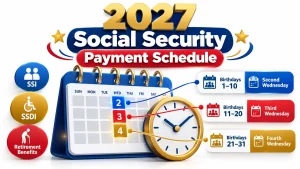
For many beneficiaries, payments are based on the birthday associated with the worker’s record:
1–10 → second Wednesday
11–20 → third Wednesday
21–31 → fourth Wednesday
Special payment categories can follow different schedules.
See our complete 2027 Social Security Payment Schedule for every date.
Five Important Spousal Benefit Rules to Remember
1. The maximum is generally 50%
The full spouse benefit is generally up to half the worker’s PIA.
2. Claiming early reduces the benefit
For an FRA of 67, claiming at 62 can reduce the amount to about 32.5% of the worker’s PIA.
3. Waiting past FRA does not increase ordinary spouse benefits
Spouse benefits do not earn delayed retirement credits like a worker’s own retirement benefit.
4. Your own retirement benefit matters
SSA generally pays your own benefit first and then adds a spouse amount only when applicable.
5. Divorce does not necessarily end eligibility
A qualifying ex-spouse may receive benefits after a marriage lasting at least 10 years.
Frequently Asked Questions
How much is a Social Security spouse benefit in 2027?
There is no single dollar amount. The maximum normal spouse benefit is generally 50% of the worker’s full retirement age benefit, subject to eligibility and claiming-age rules.
Can a wife get half of her husband’s Social Security?
Potentially.
At full retirement age, a qualifying spouse can receive up to 50% of the worker’s PIA if that is greater than the spouse’s applicable own retirement benefit.
The same rules can apply to husbands.
Can I get 50% at age 62?
Generally no if your FRA is 67.
At exactly 62, the spouse benefit can be reduced to approximately 32.5% of the worker’s PIA.
What age gives the full 50% spouse benefit?
For people born in 1960 or later, normal retirement FRA is 67.
A qualifying spouse who waits until FRA can receive up to 50%.
Does waiting until 70 increase spousal benefits?
No.
Ordinary spouse benefits do not receive delayed retirement credits after FRA.
What if my spouse waits until age 70?
Your ordinary spouse benefit is still generally based on up to 50% of the worker’s full-retirement-age benefit, not 50% of the worker’s higher age-70 payment.
Can I collect my own benefit and my spouse’s?
SSA generally pays your own retirement benefit first. If the spouse benefit is higher, it may add an amount so the combined payment reaches the higher applicable spouse amount.
Can I claim only spousal benefits and delay my own?
For most people reaching retirement now, deemed filing generally prevents this strategy.
How long do you have to be married?
Generally at least one year for current spouses, although exceptions exist.
Can divorced spouses get Social Security benefits?
Yes.
A divorced spouse may qualify when the marriage lasted at least 10 years and other SSA requirements are met.
Does my ex lose money if I claim on their record?
Generally no.
Divorced-spouse benefits do not reduce the worker’s own retirement payment.
Can an ex-spouse claim if the worker has not filed?
In some cases, yes, if both are at least 62 and the divorce has lasted at least two years, along with other requirements.
Are survivor benefits limited to 50%?
No.
Survivor benefits use different rules and should not be confused with ordinary spouse benefits.
Bottom Line
Social Security spousal benefits can be worth up to:
50% of the worker’s full retirement age benefit
but claiming age matters.
For someone whose FRA is 67, the approximate spouse benefit as a percentage of the worker’s PIA is:
Age 62 → 32.5%
Age 63 → 35%
Age 64 → 37.5%
Age 65 → 41.7%
Age 66 → 45.8%
Age 67 → 50%
Waiting beyond full retirement age does not increase ordinary spousal benefits.
The worker generally must file before a current spouse can receive benefits, while qualifying divorced spouses have some additional options.
And if you qualify for retirement benefits on your own record, Social Security normally pays those first and then adds a spouse amount only when the spouse calculation is higher.
For couples planning retirement in 2027, this makes claiming strategy especially important.
Related Reading on Elite Era Trends
Social Security Full Retirement Age in 2027
2027 Social Security Payment Schedule