Best AI Model for Coding in 2026: Gemini 4 Argon vs GPT-6 Astra vs Claude Opus 5.5
Best AI Model for Coding in 2026: Gemini 4 Argon vs GPT-6 Astra vs Claude Opus 5.5
If you are choosing an AI model for serious software engineering in 2026, the answer is no longer as simple as picking the model with the highest single benchmark score.
The three strongest frontier options for coding right now are:
- Google Gemini 4 Argon
- OpenAI GPT-6 Astra
- Anthropic Claude Opus 5.5
Each model wins a different part of the coding stack.
Claude Opus 5.5 is the strongest overall choice today for difficult agentic and terminal-driven coding when you need immediate production access.
Gemini 4 Argon is the most interesting value option for long-horizon repository work, giant outputs and low token cost—but it is still in phased rollout.
GPT-6 Astra is especially strong when coding is combined with computer use, browser interaction, tool use and OpenAI’s production ecosystem.
The benchmark picture supports that split.
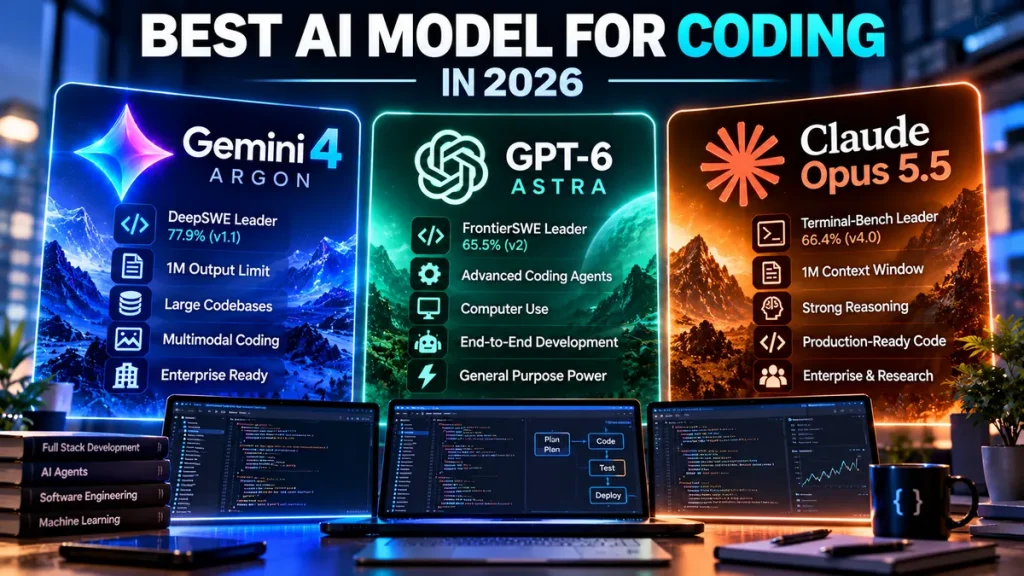
Google reports Argon leading DeepSWE v1.1 and Vibe Code Bench, while GPT-6 Astra leads FrontierSWE v2 and Claude Opus 5.5 leads Terminal-Bench 4.0 in Google’s published comparison.
Independent Artificial Analysis currently gives Claude Opus 5.5 Max the highest overall Intelligence Index score among the three at 58, compared with 53 for GPT-6 Astra Max and 53 for Gemini 4 Argon High.
Here is how to choose the best coding model for your actual workflow.
Best AI Coding Model in 2026: Quick Verdict
| Use case | Best choice | Why |
|---|---|---|
| Best overall coding model available now | Claude Opus 5.5 | Strongest independent top-end score, excellent Terminal-Bench results, mature agent deployment |
| Best for long-horizon repository changes | Gemini 4 Argon | Leads DeepSWE v1.1 and Vibe Code Bench in Google’s comparison |
| Best for terminal-heavy autonomous coding | Claude Opus 5.5 | 66.4% on Google’s Terminal-Bench 4.0 comparison |
| Best for FrontierSWE-style software engineering | GPT-6 Astra | 65.5% on FrontierSWE v2 |
| Best coding value on announced token pricing | Gemini 4 Argon | $2/M input and $10/M output introductory pricing |
| Best for computer-use coding workflows | GPT-6 Astra | Official computer-use support and mature OpenAI tool ecosystem |
| Best for extremely long generated code/output | Gemini 4 Argon | Google says up to 1M output tokens |
| Best for mature multi-cloud deployment | Claude Opus 5.5 | Available through Anthropic, AWS, Google Cloud and Microsoft |
The Three Coding Models Compared
| Feature | Gemini 4 Argon | GPT-6 Astra | Claude Opus 5.5 |
|---|---|---|---|
| Developer | Google DeepMind | OpenAI | Anthropic |
| Availability | Phased rollout | Available through supported OpenAI products/API | Active and broadly available |
| Input price / 1M | $2 intro | $10 | $4 |
| Output price / 1M | $10 intro | $50 | $20 |
| Context window | Long-context performance demonstrated up to 1M; Google launch post emphasizes output limit | 1.05M | 1M |
| Max standard output | 1M | 128K | 128K |
| Reasoning control | Advanced reasoning | Low, medium, high, xhigh, max | Adaptive; effort control |
| Best coding signal | DeepSWE / long-horizon work | FrontierSWE / computer use | Terminal agents / top independent intelligence |
Coding Benchmarks: No Model Wins Everything
The strongest evidence comes from comparing multiple coding benchmarks rather than one headline number.
Google DeepMind’s official Gemini 4 Argon benchmark table includes all three models on several coding tests.
| Coding benchmark | Gemini 4 Argon | GPT-6 Astra | Claude Opus 5.5 | Leader |
|---|---|---|---|---|
| DeepSWE v1.1 | 77.9% | 74.1% | 74.2% | Argon |
| FrontierSWE v2 | 55.0% | 65.5% | 62.3% | Astra |
| Vibe Code Bench | 91.9% | 89.6% | 90.3% | Argon |
| Terminal-Bench 4.0 | 57.4% | 58.2% | 66.4% | Opus 5.5 |
| PostTrainBench | 45.3% | 44.3% | 49.3% | Opus 5.5 |
Source: Google DeepMind — Gemini 4 Argon performance table.
The key takeaway is straightforward:
Different coding benchmarks measure different kinds of engineering work.
A model can dominate repository-scale code transformation while another performs better when operating a terminal, running tests and iterating with tools.
Gemini 4 Argon: Best for Long-Horizon Repository Work?
Gemini 4 Argon’s strongest coding result is DeepSWE v1.1.
Google reports:
Gemini 4 Argon: 77.9%
Claude Opus 5.5: 74.2%
GPT-6 Astra: 74.1%
Argon’s lead is not enormous, but it is meaningful because DeepSWE focuses on long-horizon, real-world software-engineering work.
That makes Argon particularly interesting for tasks such as:
- large repository refactoring;
- multi-file feature implementation;
- codebase migrations;
- dependency upgrades;
- long debugging sessions;
- large-scale test generation; and
- repository-wide architecture changes.
Google also reports Argon at 91.9% on Vibe Code Bench, narrowly ahead of Opus 5.5 and Astra.
For more detail, see our Gemini 4 Argon benchmarks guide.
Claude Opus 5.5: Best for Terminal-Driven Coding Agents?
Claude Opus 5.5’s clearest coding advantage is Terminal-Bench 4.0.
Google’s comparison reports:
Claude Opus 5.5: 66.4%
GPT-6 Astra: 58.2%
Gemini 4 Argon: 57.4%
That gives Opus a:
8.2-point lead over Astra
and:
9.0-point lead over Argon
Terminal-Bench is especially relevant for coding agents that must do more than generate code.
A strong terminal agent may need to:
- inspect files;
- edit code;
- install dependencies;
- run tests;
- read errors;
- use shell tools;
- debug failures; and
- repeat until the task succeeds.
Anthropic specifically describes Opus 5.5 as a model for long-running agentic coding and knowledge work.
Anthropic also gives it a 1M-token context window and always-on adaptive reasoning.
Official model documentation: Anthropic — Claude Opus 5.5.
GPT-6 Astra: Best on FrontierSWE
GPT-6 Astra’s strongest result in Google’s coding comparison is FrontierSWE v2.
Google reports:
GPT-6 Astra: 65.5%
Claude Opus 5.5: 62.3%
Gemini 4 Argon: 55.0%
Astra leads Argon by:
10.5 percentage points
and Opus by:
3.2 points
That suggests Astra remains extremely strong for frontier software-engineering tasks even though it does not lead every coding benchmark.
OpenAI describes Astra as its most capable model for demanding work including:
- coding;
- complex reasoning;
- computer use;
- research; and
- document creation.
Official model documentation: OpenAI — GPT-6 Astra.
Independent Coding Results: Claude Leads at Maximum Effort
Provider benchmark tables are useful, but independent testing helps reduce dependence on vendor-selected evaluations.
Artificial Analysis currently compares all three models.
At the highest commonly cited tested settings, it reports:
| Independent metric | Gemini 4 Argon High | GPT-6 Astra Max | Claude Opus 5.5 Max |
|---|---|---|---|
| Intelligence Index | 53 | 53 | 58 |
| Terminal-Bench 4.0 | 57% | 59% | 60% |
| SciCode | 62% | 56% | 67% |
| AutomationBench-AA | 78% | 68% | 70% |
Independent comparison: Artificial Analysis Model Comparison.
These results support Claude Opus 5.5 as the strongest general high-effort model of the three on the independent composite.
But Argon’s 78% AutomationBench-AA result shows why aggregate rankings do not tell the whole story.
Pricing: Gemini 4 Argon Wins at Launch
For coding agents, price matters because a single task can involve many iterative model calls.
Gemini 4 Argon introductory pricing
$2 per million input tokens
$10 per million output tokens
Claude Opus 5.5
$4 per million input tokens
$20 per million output tokens
GPT-6 Astra
$10 per million input tokens
$50 per million output tokens
| Model | Input / 1M | Output / 1M |
|---|---|---|
| Gemini 4 Argon intro | $2 | $10 |
| Claude Opus 5.5 | $4 | $20 |
| GPT-6 Astra | $10 | $50 |
Google says Argon’s rates later rise to $4 input and $20 output per million tokens, matching Opus 5.5’s standard base rates.
For a full cost calculator, see our Gemini 4 Argon pricing guide.
Coding Cost Example
Suppose a coding agent uses:
500,000 input tokens
and:
100,000 output tokens
during a complex repository task.
Gemini 4 Argon introductory rate
Input:
0.5 × $2 = $1
Output:
0.1 × $10 = $1
Total:
$2
Claude Opus 5.5
Input:
0.5 × $4 = $2
Output:
0.1 × $20 = $2
Total:
$4
GPT-6 Astra standard headline rates
Input:
0.5 × $10 = $5
Output:
0.1 × $50 = $5
Total:
$10
However, OpenAI says prompts above 272K input tokens receive higher long-context pricing for the entire request, so a real 500K-input Astra task would need to use those current long-context rates rather than this simple headline-price illustration.
Context Window: Astra and Claude Publish Clear 1M Specs
Large coding tasks often require access to many files, logs, tests and documentation.
OpenAI officially lists GPT-6 Astra with:
1,050,000-token context window
Anthropic lists Claude Opus 5.5 with:
1,000,000-token context window
Google has demonstrated Argon on long-context GraphWalks tasks from 256K to 1M tokens, but its launch materials emphasize a different specification:
1 million maximum output tokens
rather than presenting the input-context specification in exactly the same format as OpenAI and Anthropic.
This distinction matters for SEO and technical accuracy.
Output Limit: Argon Changes the Coding Equation
For most programming tasks, 128K output tokens is already enormous.
But Google says Gemini 4 Argon can generate:
up to 1 million output tokens
OpenAI lists Astra at:
128K maximum output tokens
Anthropic lists Opus 5.5 at:
128K standard maximum output
with a 300K Batch API beta option.
Argon’s 1M output ceiling could be valuable for extreme tasks such as:
- massive automated migrations;
- generating many files in one long trajectory;
- repository-wide documentation;
- large synthetic test suites;
- long autonomous planning and implementation sessions.
It does not mean developers should routinely generate a million tokens.
Longer output also increases cost and review burden.
Which Model Is Best for Large Codebases?
Gemini 4 Argon may be the most interesting candidate for large-repository transformation once broadly available.
Reasons include:
- 77.9% DeepSWE v1.1;
- 91.9% Vibe Code Bench;
- strong 256K-to-1M long-context GraphWalks performance;
- 1M maximum output; and
- low announced token pricing.
However, Argon remains in a phased rollout.
For a team that needs production access today, Claude Opus 5.5 or GPT-6 Astra is more practical.
See our Gemini 4 Argon access guide for the current rollout status.
Which Model Is Best for Autonomous Coding Agents?
Claude Opus 5.5 currently has the strongest case.
Anthropic explicitly designed the model for long-running agentic coding.
Its Terminal-Bench performance is the strongest of the three in Google’s comparison, and its API is already available across multiple cloud platforms.
This combination matters because autonomous coding involves far more than code generation.
The model must repeatedly:
- plan;
- use tools;
- read files;
- run commands;
- interpret failures;
- recover from mistakes; and
- continue without losing the goal.
For those workflows, tool reliability and production availability matter as much as benchmark intelligence.
Which Model Is Best for Coding With Computer Use?
GPT-6 Astra has the clearest advantage when coding is combined with broader computer interaction.
OpenAI officially supports computer use alongside Astra.
That can matter for engineering workflows involving:
- browser-based dashboards;
- visual testing;
- web development;
- cloud-console interaction;
- GUI-based debugging;
- desktop applications.
Astra also sits inside OpenAI’s larger tool ecosystem for web search, file search and function calling.
For professional workflows, see our GPT-6 Astra for Work guide.
Which Model Is Best for Debugging?
Debugging quality depends heavily on the environment.
For terminal-based debugging where the model can run commands repeatedly, Claude Opus 5.5’s Terminal-Bench strength is compelling.
For debugging that requires computer or browser interaction, GPT-6 Astra’s computer-use tooling may be more useful.
For debugging across a very large repository with extremely long reasoning trajectories, Argon’s DeepSWE and long-context performance make it particularly interesting.
There is no strong evidence that one model universally dominates every debugging scenario.
Which Model Is Best for Code Review?
Code review benefits from:
- large context;
- careful reasoning;
- security awareness;
- understanding architecture; and
- ability to identify subtle regressions.
All three models are strong candidates.
Argon has strong long-context and cybersecurity signals.
Opus 5.5 has the highest independent overall Intelligence Index at max effort.
Astra combines strong reasoning with tool access and strong software-engineering benchmarks.
For high-stakes code review, a useful pattern may be to have one model generate the patch and another independently review it.
Which Model Is Best for Cybersecurity Coding?
Google emphasizes Argon heavily for cybersecurity defense.
On CWE-bench v1, Google reports:
Argon: 68%
GPT-6 Astra: 68%
Claude Opus 5.5: 67%
Those results are effectively very close.
Google’s differentiator is its controlled Fairwind deployment for advanced defensive cyber capabilities.
For more information, see our Google Fairwind Program explainer.
Which Model Is Best for ML Engineering?
Google’s PostTrainBench comparison shows:
Claude Opus 5.5: 49.3%
Gemini 4 Argon: 45.3%
GPT-6 Astra: 44.3%
That gives Opus the lead on this specific ML-engineering evaluation.
This category matters for developers building:
- training pipelines;
- fine-tuning workflows;
- evaluation systems;
- model infrastructure;
- data-processing code.
Best Model for Different Coding Jobs
| Coding job | Best model to test first |
|---|---|
| Autonomous terminal agent | Claude Opus 5.5 |
| Large repository migration | Gemini 4 Argon |
| Computer/browser coding workflow | GPT-6 Astra |
| Lowest launch token cost | Gemini 4 Argon |
| ML engineering | Claude Opus 5.5 |
| FrontierSWE-style coding | GPT-6 Astra |
| DeepSWE-style coding | Gemini 4 Argon |
| High-effort independent intelligence | Claude Opus 5.5 |
| Extremely long generated output | Gemini 4 Argon |
Should You Use One Model for Everything?
Probably not if coding quality and cost both matter.
A multi-model engineering stack can be more efficient.
For example:
Cheap/fast model → classify task
then:
Argon → large repository analysis
Opus → difficult terminal implementation
Astra → computer/browser workflow
then:
second frontier model → independent code review
This can reduce cost while using each model where it is strongest.
Best AI Coding Model for Individuals
For an individual developer, API benchmarks are only part of the decision.
You should also consider:
- which subscription you already pay for;
- IDE integration;
- usage limits;
- latency;
- privacy requirements;
- tool access;
- how often you hit rate limits.
Argon is not yet broadly available to normal Gemini users.
Claude Opus 5.5 is available now.
GPT-6 Astra is available through supported OpenAI products, subject to plan and usage limits.
For Astra limits, see our GPT-6 Astra usage-limits guide.
Frequently Asked Questions
What is the best AI model for coding in 2026?
There is no universal winner. Claude Opus 5.5 currently has the strongest case for difficult terminal-based agentic coding and the highest independent top-end intelligence score. Gemini 4 Argon leads several long-horizon coding benchmarks and has lower announced token pricing, while GPT-6 Astra leads FrontierSWE v2 and offers strong computer-use tooling.
Is Gemini 4 Argon better than Claude Opus 5.5 for coding?
Argon leads DeepSWE v1.1 and Vibe Code Bench in Google’s comparison, while Claude Opus 5.5 leads Terminal-Bench 4.0, FrontierSWE over Argon, and PostTrainBench. The better choice depends on whether your workload is repository-scale transformation or terminal-driven agentic execution.
Is GPT-6 Astra better than Claude Opus 5.5 for coding?
Astra leads Opus on FrontierSWE v2 in Google’s comparison, while Opus leads Astra significantly on Terminal-Bench 4.0. Opus also currently scores higher on Artificial Analysis’s maximum-effort Intelligence Index.
Which AI coding model is cheapest?
Gemini 4 Argon has the lowest announced introductory API rate at $2 per million input tokens and $10 per million output tokens. Claude Opus 5.5 costs $4/$20 and GPT-6 Astra costs $10/$50 at standard headline rates.
Which model has the largest context window?
OpenAI officially lists GPT-6 Astra at 1.05M tokens and Anthropic lists Claude Opus 5.5 at 1M. Google demonstrates Argon on long-context tests up to 1M tokens but emphasizes its separate 1M-token maximum output specification.
Which model can generate the most code in one response?
Gemini 4 Argon has the largest announced output limit at up to 1M tokens, compared with 128K standard maximum output for Astra and Opus 5.5.
Which is best for coding agents?
Claude Opus 5.5 currently has the strongest combination of Terminal-Bench performance, agentic design and immediate production availability.
Which is best for large codebases?
Gemini 4 Argon is particularly promising because of its DeepSWE performance, strong long-context evaluation results and huge output limit. However, broader developer access is still rolling out.
Which is best for computer use?
GPT-6 Astra has the clearest current advantage because OpenAI officially supports computer-use workflows alongside the model.
Which model is smartest overall?
On the current Artificial Analysis Intelligence Index at maximum tested settings, Claude Opus 5.5 Max scores 58, while GPT-6 Astra Max and Gemini 4 Argon High score 53. That is an aggregate score, not a coding-only guarantee.
Bottom Line
The best AI coding model in 2026 depends on what kind of software engineering you actually do.
Claude Opus 5.5 is the strongest overall coding-agent recommendation today.
It is already available, has a 1M context window, strong terminal-agent performance and the highest current top-end independent Intelligence Index score among the three.
Gemini 4 Argon is the most compelling challenger.
It leads DeepSWE v1.1 and Vibe Code Bench in Google’s comparison, costs far less during its introductory period, performs strongly on very long context and can generate up to 1M output tokens.
Its biggest weakness is practical:
most developers still cannot use it broadly yet.
GPT-6 Astra remains one of the strongest choices for software engineering combined with computer use, tools and OpenAI’s production ecosystem.
It leads FrontierSWE v2 in Google’s comparison and has a clearly documented 1.05M-token context window.
So the simplest recommendation is:
Best overall available coding agent: Claude Opus 5.5
Best value / long-horizon coding candidate: Gemini 4 Argon
Best coding + computer-use ecosystem: GPT-6 Astra
For professional development teams, the right answer may ultimately be to use more than one.
Benchmark the three models against your own repositories, tests and coding workflow, then measure:
- successful task completion;
- number of retries;
- bugs introduced;
- test pass rate;
- human review time;
- token cost; and
- time to merge.
Those metrics will tell you which model is truly best for your engineering team.