Gemini 4 Argon vs Claude Opus 5.5: Pricing, Coding, Benchmarks & Which Is Better?
Gemini 4 Argon vs Claude Opus 5.5: Pricing, Coding, Benchmarks & Which Is Better?
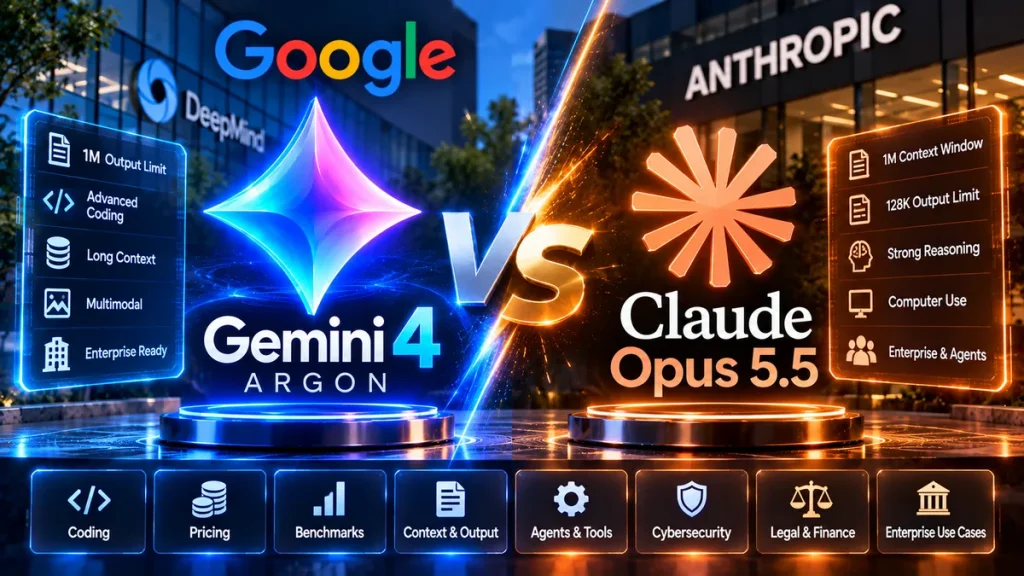
Gemini 4 Argon and Claude Opus 5.5 are two of the strongest frontier AI models released or announced in September 2026, but they make very different trade-offs.
Google built Gemini 4 Argon around long-horizon coding, enterprise knowledge work, finance, legal workflows, cybersecurity defense and extremely long model outputs.
Anthropic built Claude Opus 5.5 for long-running agentic coding and knowledge work, with a 1-million-token context window, adaptive reasoning, strong computer-use performance and broad production availability.
The practical difference today is important:
Claude Opus 5.5 is broadly available now, while Gemini 4 Argon is still in a phased rollout.
On price, Argon has the advantage at its announced introductory rates: $2 per million input tokens and $10 per million output tokens, compared with Opus 5.5 at $4 input and $20 output per million tokens.
On raw capability, the answer depends heavily on reasoning effort and workload. Independent Artificial Analysis currently scores Opus 5.5 higher than Argon at its maximum tested reasoning setting, while Argon wins several Google-published benchmarks in finance, legal work, long-context reasoning, automation and long-horizon coding.
So which is better?
Here is the full Gemini 4 Argon vs Claude Opus 5.5 comparison.
Gemini 4 Argon vs Claude Opus 5.5 at a Glance
| Feature | Gemini 4 Argon | Claude Opus 5.5 |
|---|---|---|
| Developer | Google DeepMind | Anthropic |
| Announced/released | September 30, 2026 | September 22, 2026 |
| Availability | Limited phased rollout | Active and broadly available |
| Input price | $2 / 1M introductory | $4 / 1M |
| Output price | $10 / 1M introductory | $20 / 1M |
| Cache read / cached input | 95% off input rate during intro | $0.20 / 1M cache reads |
| Context window | Google benchmarks 256K–1M long-context tasks; launch post does not separately list a formal input-context spec | 1M tokens |
| Max output | 1M tokens | 128K tokens standard; 300K Batch beta |
| Reasoning | Yes | Adaptive reasoning, always on |
| Default reasoning effort | High in many published evaluations | Medium |
| Input modalities | Multimodal | Text and images |
| API model | Broader API rollout pending | claude-opus-5-5 |
| Best immediate advantage | Price, long output, enterprise benchmarks | Availability, top-end intelligence, mature agent tooling |
Which Is Better: Gemini 4 Argon or Claude Opus 5.5?
There is no responsible universal winner.
If you need a frontier model you can deploy immediately across a mature API and cloud ecosystem, Claude Opus 5.5 is the stronger practical choice today.
If Google opens Argon broadly and its real-world behavior matches its current evaluations, Gemini 4 Argon may offer a stronger price-to-performance proposition for finance, legal research, enterprise automation, very long outputs and some long-horizon coding workloads.
Independent results also show why reasoning settings matter.
Artificial Analysis currently reports:
- Argon High: Intelligence Index 53
- Opus 5.5 Medium: 51
- Opus 5.5 High: 54
- Opus 5.5 Max: 58
At maximum tested effort, Opus 5.5 is clearly ahead on the independent composite.
But more reasoning also uses more tokens and increases cost per task.
Pricing: Gemini 4 Argon Is Cheaper at Launch
Google announced Argon’s introductory API pricing at:
$2 per million input tokens
$10 per million output tokens
Google also says cached input is discounted by 95% from the normal input-token rate during the introductory period.
After the introductory period, Google says Argon pricing becomes:
$4 per million input tokens
$20 per million output tokens
Anthropic prices Claude Opus 5.5 at:
$4 per million input tokens
$20 per million output tokens
Anthropic also lists:
- $0.20 per million cache-read tokens
- $5 per million for 5-minute cache writes
- $8 per million for 1-hour cache writes
- 50% Batch API discount on input and output
That means Argon’s introductory base token pricing is exactly half of Opus 5.5’s standard pricing.
Token-price comparison
| Price per 1M tokens | Gemini 4 Argon Intro | Argon Later | Claude Opus 5.5 |
|---|---|---|---|
| Input | $2 | $4 | $4 |
| Output | $10 | $20 | $20 |
| Cache read | Approx. $0.10 at 95% intro discount | Check Google pricing | $0.20 |
For a detailed Argon cost breakdown, see our Gemini 4 Argon pricing and API cost guide.
Cost Example: 1 Million Input + 100,000 Output Tokens
Consider a simplified workload using:
1,000,000 input tokens
and:
100,000 output tokens
Gemini 4 Argon introductory pricing
Input:
1 × $2 = $2
Output:
0.1 × $10 = $1
Total:
$3
Claude Opus 5.5
Input:
1 × $4 = $4
Output:
0.1 × $20 = $2
Total:
$6
At raw list prices, the simplified Argon introductory workload costs half as much.
However, this does not prove Argon is cheaper for every completed task.
Reasoning models can use different quantities of hidden reasoning and output tokens, and one model may complete a task in fewer attempts than another.
Independent Cost per Task: The Story Gets More Complicated
Artificial Analysis provides a useful example of why token price is not the full story.
At its current evaluation settings, Artificial Analysis reports:
| Model setting | Intelligence Index | Approx. cost per benchmark task |
|---|---|---|
| Gemini 4 Argon High | 53 | $1.99 |
| Claude Opus 5.5 Medium | 51 | $1.34 |
| Claude Opus 5.5 High | 54 | $1.82 |
| Claude Opus 5.5 Max | 58 | $5.98 |
This creates an important trade-off.
At medium effort, Opus 5.5 can cost less per evaluated task than Argon while scoring slightly lower overall.
At high effort, Opus 5.5 edges Argon on the Intelligence Index while remaining in a similar task-cost range.
At maximum effort, Opus reaches a significantly higher score but at much higher cost.
The best metric for production is therefore:
cost per successful task at the quality level you actually need.
Context Window: Claude Opus 5.5 Has the Cleaner Official Spec
Anthropic officially documents Claude Opus 5.5 with a:
1,000,000-token context window
and:
128,000-token standard maximum output
Anthropic also lists a 300,000-token maximum output in the Batch API beta.
Google’s public Argon launch post emphasizes a different specification:
up to 1 million output tokens
Google’s official benchmark suite also evaluates Argon on GraphWalks prompts ranging from 256K to 1M tokens, demonstrating very long-context capability.
However, Google’s launch post does not separately present a simple formal input-context-window figure in the same way Anthropic does for Opus 5.5.
Independent Artificial Analysis currently lists both models with approximately a 1M-token context window.
The safest distinction is:
Opus 5.5 has an officially documented 1M input context window, while Argon officially emphasizes a 1M maximum output and has been benchmarked by Google on 256K–1M long-context tasks.
Maximum Output: Gemini 4 Argon Has a Huge Advantage
Google says Gemini 4 Argon can generate:
up to 1,000,000 output tokens
Anthropic lists Claude Opus 5.5 at:
128,000 standard output tokens
The difference is approximately:
1,000,000 ÷ 128,000 ≈ 7.8×
Even compared with Opus 5.5’s 300K Batch API beta output limit, Argon’s announced ceiling remains much larger.
This could matter for:
- large codebase migrations;
- very long autonomous reasoning trajectories;
- multi-stage agent work;
- massive report generation;
- complex code transformations; and
- workflows where the model needs to preserve extensive intermediate reasoning or generated artifacts.
Which Is Better for Coding?
Coding is one of the most interesting parts of the comparison because different benchmarks favor different models.
DeepSWE v1.1: Argon leads
Google reports:
Gemini 4 Argon: 77.9%
Claude Opus 5.5: 74.2%
Argon’s lead is:
3.7 percentage points
DeepSWE measures long-horizon real-world software engineering.
Vibe Code Bench: Argon narrowly leads
Google reports:
Argon: 91.9%
Opus 5.5: 90.3%
The difference is only:
1.6 percentage points
FrontierSWE v2: Opus 5.5 leads
Google’s table shows:
Claude Opus 5.5: 62.3%
Gemini 4 Argon: 55.0%
Opus leads by:
7.3 percentage points
Terminal-Bench 4.0: Opus 5.5 clearly leads
Google’s comparison reports:
Claude Opus 5.5: 66.4%
Gemini 4 Argon: 57.4%
Difference:
9 percentage points
Anthropic independently highlights the same 66.4% Terminal-Bench 4.0 score at its highest effort setting.
Coding Verdict: It Depends on the Type of Engineering
The coding results point to a useful distinction.
Argon appears especially strong for long-horizon code transformation, planning and large repository work.
Opus 5.5 appears especially strong on agentic terminal execution and tasks where an engineering agent must actively operate tools and command-line environments.
That means a team doing a large code migration may prefer a different model from a team building an autonomous terminal-based coding agent.
For the full Argon benchmark breakdown, see our Gemini 4 Argon benchmarks guide.
Which Is Better for Finance and Enterprise Knowledge Work?
Google’s published results strongly favor Argon on several domain-specific enterprise benchmarks.
Vals Index
Gemini 4 Argon: 68.9%
Claude Opus 5.5: 67.0%
The difference is small but favors Argon.
Vals Finance Agent v2
Gemini 4 Argon: 65.4%
Claude Opus 5.5: 58.6%
Argon leads by:
6.8 percentage points
This benchmark measures multi-step financial research.
AutomationBench
Google’s table reports:
Gemini 4 Argon: 51.3%
Claude Opus 5.5: 42.5%
Argon leads by:
8.8 percentage points
However, Anthropic notes that its published AutomationBench result can be affected by production safeguards and benchmark setup, so small differences across sources should not be treated as directly interchangeable.
Independent Knowledge-Work Results Favor Opus at High Effort
The independent picture is more favorable to Claude.
Artificial Analysis currently reports Opus 5.5 Max ahead of Argon High on:
- AA-Briefcase v1.1;
- GDPval-AA v2.1;
- Humanity’s Last Exam;
- GDP.pdf;
- CritPt; and
- AA-LCR long-context reasoning.
For example:
| Independent benchmark | Argon High | Opus 5.5 Max |
|---|---|---|
| Intelligence Index | 53 | 58 |
| AA-Briefcase v1.1 | 1494 | 1822 |
| GDPval-AA v2.1 | 1611 | 1846 |
| Humanity’s Last Exam | 57% | 61% |
| AA-LCR v1.1 | 80% | 85% |
| AutomationBench-AA | 78% | 70% |
This is a good example of why one provider’s benchmark suite should never determine the whole verdict.
Which Is Better for Legal Work?
Google reports a striking advantage for Argon on Harvey’s Legal Agent Benchmark:
Gemini 4 Argon: 19.6%
Claude Opus 5.5: 3.8%
That is a large relative difference.
But the absolute score matters.
A 19.6% pass rate does not mean Argon can independently handle most legal-agent tasks.
The responsible conclusion is:
Argon shows a significant advantage on this specific benchmark, but neither result supports removing qualified human legal review.
Which Is Better for Science?
The scientific picture is mixed.
Google reports Argon ahead on:
LABBench 2
Argon: 88.8%
Opus 5.5: 73.1%
RiemannBench
Argon: 76.0%
Opus 5.5: 69.6%
But Opus wins the more execution-oriented Terminal-Bench Science 0.1:
Opus 5.5: 63.3%
Argon: 57.6%
Independent Artificial Analysis also gives Opus 5.5 Max a higher SciCode score than Argon High:
67% vs 62%
This suggests a familiar pattern:
Argon is extremely strong in scientific reasoning benchmarks, while Opus can be stronger on some agentic execution and coding-heavy science workflows.
Which Is Better for Long Context?
Google’s GraphWalks evaluation strongly favors Argon on the longest prompts.
For the 256K-to-1M-token subset:
Gemini 4 Argon: 84.2%
Claude Opus 5.5: 66.8%
Argon’s lead is:
17.4 percentage points
That is one of the largest gaps in Google’s benchmark table.
However, independent Artificial Analysis reports a narrower advantage in the other direction on its own long-context evaluation:
Opus 5.5 Max: 85%
Argon High: 80%
Different long-context benchmarks stress different skills.
Teams working with very large repositories or document collections should test their own retrieval, instruction retention and cross-document reasoning tasks.
Which Is Better for Computer Use?
Anthropic positions Opus 5.5 as its best Opus model for vision and computer use.
Anthropic reports an:
81.8% partial score on OSWorld 2.1
for Opus 5.5 in its published launch evaluations.
Google’s separate OSWorld-2.0 offline-subset benchmark lists Argon at:
69.2%
These are not identical benchmark setups, so the raw percentages should not be directly compared as though they came from one test.
Still, Opus 5.5 currently has the clearer public deployment story for computer-use agents because the model is available and Anthropic explicitly supports long-running agentic workflows.
Which Is Better for Cybersecurity?
Cybersecurity is one of Argon’s headline strengths.
On Google’s CWE-bench v1 comparison:
Gemini 4 Argon: 68%
Claude Opus 5.5: 67%
That is effectively very close.
Google also reports strong internal Argon results for vulnerability discovery and black-box penetration testing, while deploying its strongest cyber capabilities initially through the controlled Fairwind Program.
Anthropic, meanwhile, says Opus 5.5 includes strong coding-agent security controls, action screening and prompt-injection defenses.
For a deeper explanation of Google’s restricted cyber rollout, see our Google Fairwind Program guide.
Availability: Claude Opus 5.5 Wins Today
This category has a clear winner.
Claude Opus 5.5 is active and available now.
Anthropic lists support through:
- Claude API;
- Amazon Bedrock;
- Google Cloud;
- Microsoft Foundry; and
- Claude Platform on AWS.
Its Claude API model ID is:
claude-opus-5-5
Gemini 4 Argon remains in a phased rollout.
Google says Argon is initially being used by trusted cyber defenders through the Fairwind Program before broader availability begins with paid API customers and Google AI Ultra subscribers.
If you need to understand who can use Argon today, see our Gemini 4 Argon access and availability guide.
Which Is Better for Production Agents?
Today, Claude Opus 5.5 has the lower deployment risk simply because it is available through multiple supported production platforms.
Anthropic built Opus 5.5 specifically for long-running agentic coding and knowledge work and says the model can operate on complex projects over long periods.
Argon may become a compelling alternative once broader developer access opens, particularly where long outputs and lower token rates matter.
But until organizations can test Argon under normal production conditions, its strongest public evidence remains benchmark and early-tester data.
Gemini 4 Argon vs Claude Opus 5.5: Who Wins Each Category?
| Category | Winner | Reason |
|---|---|---|
| Availability today | Claude Opus 5.5 | Already active across multiple platforms |
| Intro token pricing | Gemini 4 Argon | $2/$10 vs $4/$20 |
| Long-term base pricing | Tie on announced base rates | Both $4/$20 after Argon intro period |
| Maximum output | Gemini 4 Argon | 1M vs 128K standard |
| Official context specification | Claude Opus 5.5 | 1M officially documented |
| Independent max intelligence | Claude Opus 5.5 | 58 vs 53 on Artificial Analysis |
| DeepSWE | Gemini 4 Argon | 77.9% vs 74.2% |
| Terminal-Bench 4.0 | Claude Opus 5.5 | 66.4% vs 57.4% |
| Finance benchmark | Gemini 4 Argon | 65.4% vs 58.6% |
| Google legal benchmark | Gemini 4 Argon | 19.6% vs 3.8% |
| Computer-use deployment | Claude Opus 5.5 | Mature, available agent stack |
| Long-output workflows | Gemini 4 Argon | 1M maximum output |
| Cybersecurity public benchmark | Very close | 68% vs 67% CWE-bench |
Choose Gemini 4 Argon If…
Argon deserves serious consideration when broader access opens if:
- you care strongly about token cost;
- your workload needs extremely long outputs;
- you work heavily with finance, legal or enterprise research;
- your coding workload resembles long-horizon repository transformation;
- Google’s cloud and enterprise ecosystem is central to your organization;
- you want to evaluate Google’s newest cybersecurity model.
Choose Claude Opus 5.5 If…
Opus 5.5 is the stronger practical choice today if:
- you need production access immediately;
- you want a clearly documented 1M-token context window;
- terminal-based coding and autonomous tool use matter heavily;
- you need mature agent deployment infrastructure;
- you want the strongest current independent score at high reasoning effort;
- you deploy through AWS, Google Cloud, Microsoft or Anthropic’s own API.
Frequently Asked Questions
Is Gemini 4 Argon better than Claude Opus 5.5?
Not universally. Argon leads several Google-published enterprise, finance, legal, long-context and coding benchmarks. Claude Opus 5.5 leads other coding and science tests and currently scores higher on Artificial Analysis at its maximum tested reasoning setting.
Which model is cheaper?
Gemini 4 Argon is cheaper during its introductory period at $2 per million input tokens and $10 per million output tokens. Claude Opus 5.5 costs $4 input and $20 output. Google says Argon later moves to the same $4/$20 base rates.
Which model has a larger context window?
Anthropic officially documents Claude Opus 5.5 with a 1M-token context window. Google has benchmarked Argon on 256K-to-1M long-context tasks, while independent Artificial Analysis lists Argon at approximately 1M context, but Google’s launch post emphasizes its 1M output limit rather than separately publishing a formal input-context specification.
Which model can generate longer responses?
Gemini 4 Argon. Google says it supports up to 1 million output tokens. Anthropic lists Opus 5.5 at 128K standard output, with a 300K Batch API beta option.
Which is better for coding?
It depends on the coding task. Argon leads DeepSWE and Vibe Code Bench in Google’s table, while Opus 5.5 leads FrontierSWE v2 and Terminal-Bench 4.0.
Which is better for finance?
Google’s Vals Finance Agent v2 comparison favors Argon at 65.4% versus 58.6% for Opus 5.5. Anthropic and independent evaluations also show Opus 5.5 is a strong professional knowledge-work model, so organizations should test their own financial workflows.
Which is smarter overall?
Independent Artificial Analysis currently gives Opus 5.5 Max an Intelligence Index score of 58 versus 53 for Argon High. At lower Opus effort settings, the gap narrows or reverses, illustrating the trade-off between intelligence, reasoning compute and cost.
Which is available now?
Claude Opus 5.5 is available now through Anthropic and multiple cloud platforms. Gemini 4 Argon remains in phased rollout.
What is Claude Opus 5.5’s API price?
Anthropic lists $4 per million input tokens and $20 per million output tokens, with cache-read pricing of $0.20 per million tokens and a 50% Batch API discount.
What is Gemini 4 Argon’s API price?
Google announced introductory pricing of $2 per million input tokens and $10 per million output tokens. After the introductory period, Google says pricing rises to $4 input and $20 output.
Bottom Line
Gemini 4 Argon and Claude Opus 5.5 are both frontier-level models, but they are optimized around different strengths.
Gemini 4 Argon’s strongest advantages are its introductory token price, 1M-token maximum output, finance and legal benchmark results, long-context performance in Google’s GraphWalks evaluation and strong long-horizon coding scores.
Claude Opus 5.5’s strongest advantages are immediate availability, a clearly documented 1M-token context window, strong terminal coding, mature agent deployment, broad cloud support and higher top-end independent intelligence scores.
If you need to deploy today, Opus 5.5 is the easier decision.
If you can wait for broader access and care heavily about price, long outputs or Google’s enterprise benchmark strengths, Argon is one of the most important models to test when access opens.
For serious production work, do not select either model based on a single benchmark.
Run the same real tasks through both models, measure:
- completion quality;
- failure rate;
- token usage;
- latency;
- human correction time; and
- cost per successful outcome.
That will tell you far more than any leaderboard.