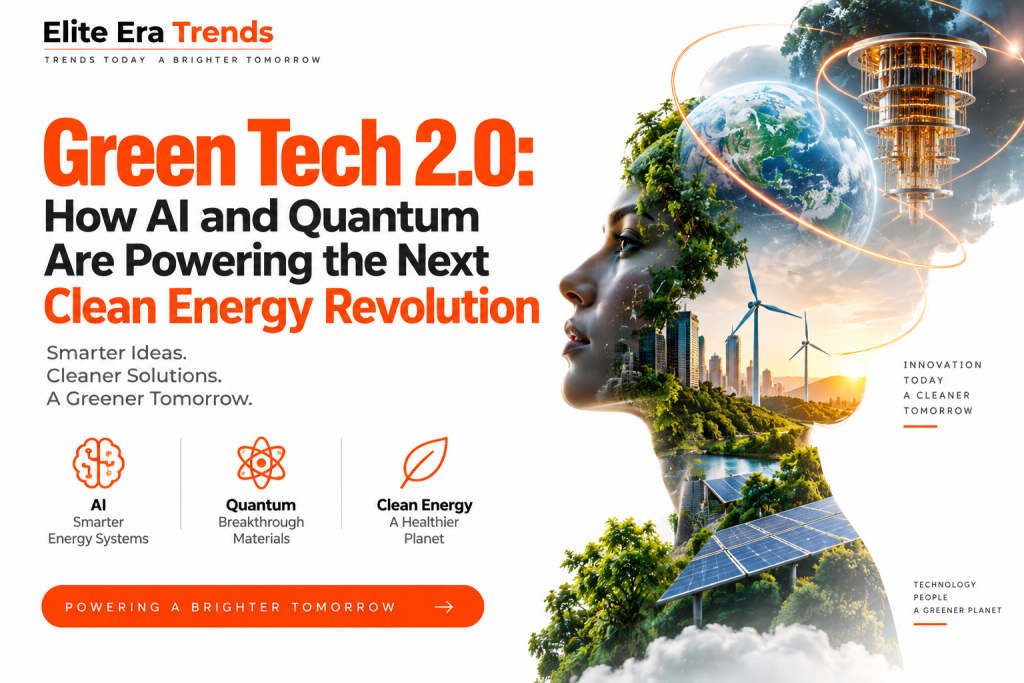
Green Tech 2.0: How AI and Quantum Are Powering the Next Clean Energy Revolution
For decades, the clean-energy revolution was largely about building better hardware: more efficient solar panels, larger wind turbines, electric vehicles and increasingly powerful batteries.
The next phase could look very different.
Artificial intelligence is beginning to help energy systems predict, optimize and adapt, while quantum technologies are being investigated as new ways to simulate molecules, discover materials and solve some computational problems that are difficult for today’s machines.
Welcome to Green Tech 2.0—an emerging era in which clean energy is becoming not only more renewable, but also more intelligent.
The transition is already significant. The International Energy Agency expects renewable generation to overtake coal-fired electricity generation in 2026, with renewables’ share of global electricity generation forecast to rise from 33% in 2025 to 37% by 2027.
But generating more clean electricity is only part of the challenge.
The world also needs smarter grids, better storage, improved forecasting, new materials and more efficient ways to use energy.
That is where AI and quantum technology could become increasingly important.
What Exactly Is Green Tech 2.0?
The first generation of green technology focused mainly on replacing high-carbon technologies with cleaner alternatives.
Think:
- solar instead of fossil-fuel electricity;
- electric vehicles instead of combustion engines;
- batteries instead of fuel tanks;
- heat pumps instead of conventional heating systems;
- and wind farms instead of coal-fired power stations.
Green Tech 2.0 adds intelligence and advanced computation to that infrastructure.
Instead of simply generating electricity from the sun, AI can help predict when solar output will rise or fall.
Instead of waiting for grid equipment to fail, predictive systems can identify potential problems earlier.
Instead of testing thousands of battery materials manually, researchers can use machine learning—and potentially quantum computing—to narrow down promising candidates before physical experiments begin.
The result could be an energy system that does more than become cleaner.
It could become predictive, adaptive and increasingly autonomous.
1. AI Is Turning the Electricity Grid Into a Smarter Network
Modern electricity grids are becoming far more complicated.
Millions of solar installations, wind turbines, batteries, electric vehicles and flexible devices are increasingly interacting with power networks that were originally designed around large centralized power stations.
Artificial intelligence is well suited to problems involving enormous quantities of changing data.
The International Energy Agency says AI is already being applied to electricity systems to improve forecasting, operations, maintenance and the integration of renewable electricity. Under its widespread-adoption scenario, the IEA estimates AI could potentially unlock as much as 175 gigawatts of additional transmission capacity from existing power lines.
The U.S. Department of Energy has similarly identified AI opportunities across grid planning, permitting, operations, reliability and resilience.
Imagine a grid that can anticipate problems
A future AI-supported grid could continually analyze:
- electricity demand;
- weather forecasts;
- renewable generation;
- battery availability;
- equipment conditions;
- transmission constraints;
- EV charging;
- and electricity prices.
It could then help grid operators determine how to move electricity efficiently while maintaining reliability.
In other words, the grid starts behaving less like static infrastructure and more like an intelligent network.
2. AI Can Make Wind and Solar More Predictable
One of renewable energy’s biggest challenges is obvious:
The weather changes.
Solar panels produce less electricity when clouds arrive.
Wind turbines generate differently as wind conditions change.
Knowing what will happen hours or days ahead can therefore be extremely valuable to electricity operators.
AI-powered forecasting is advancing rapidly.
Google DeepMind has developed AI weather systems capable of producing sophisticated forecasts, and in August 2026 it reported that its WeatherNext cyclone model achieved state-of-the-art results for predicting cyclone tracks, intensity and wind structure. DeepMind says weather forecasting research can also support applications such as renewable-energy planning.
AI has already been tested directly in wind-energy forecasting. An earlier DeepMind project used machine learning and weather forecasts to predict wind generation 36 hours ahead and optimize day-ahead electricity commitments.
Why better forecasting matters
The more accurately operators know how much wind or solar electricity will be available, the easier it becomes to balance supply with demand.
That can potentially mean:
less wasted renewable electricity + better grid planning + more reliable clean energy.
3. AI Could Help Us Get More Energy From Infrastructure We Already Have
Green technology is often discussed as a construction problem.
Build more solar.
Build more wind.
Build more transmission.
Build more batteries.
Those investments remain important, but AI offers another possibility: use existing assets more efficiently.
Energy companies are applying AI to areas including predictive maintenance, operational optimization, equipment monitoring and efficiency improvements. The IEA says AI could reduce costs, improve reliability, extend asset lifetimes and reduce downtime when effectively deployed.
That matters because constructing new energy infrastructure can take years.
Software improvements can sometimes extract additional performance from infrastructure that already exists.
This could make AI one of green technology’s most powerful invisible tools.
You might never see the algorithm—but you may benefit from the more efficient electricity network it helps operate.
4. AI Is Accelerating the Search for Better Batteries
The clean-energy transition depends heavily on energy storage.
Electric vehicles need batteries.
Homes with rooftop solar can benefit from batteries.
Electric grids increasingly need storage to help balance variable renewable electricity.
But improving batteries is fundamentally a materials-science problem.
Researchers must understand how materials behave at atomic and molecular scales while searching through enormous numbers of possible chemical combinations.
Machine learning is becoming increasingly important in that process.
A 2025 review in Nature Reviews Materials highlighted how atomistic modeling and machine learning can contribute to understanding and designing solid electrolytes for solid-state batteries, which are being investigated for properties including high energy density and improved safety.
IBM Research has also explored combining materials science, artificial intelligence, high-performance computing and quantum methods to accelerate battery-material discovery.
The old approach
Researchers might:
design → synthesize → test → fail → redesign.
The AI-assisted approach
Increasingly, computers can help:
model → predict → rank candidates → synthesize the most promising options → test.
That does not eliminate laboratory science.
It can make laboratory science more targeted.
5. Quantum Computing Could Take Materials Discovery Even Further
AI is already commercially useful in many industries.
Quantum computing is at a very different stage.
Today’s quantum computers remain limited, and large-scale fault-tolerant machines capable of reliably outperforming classical systems on major industrial problems are still under development.
But energy research is one area attracting serious attention.
In March 2026, the U.S. Department of Energy’s ARPA-E announced $37 million for ten projects under its Quantum Computing for Computational Chemistry program. The initiative is intended to investigate quantum algorithms for chemistry and materials science, including applications involving batteries, superconducting transmission lines, magnets and catalysts.
In June 2026, the Department of Energy also announced its Quantum Genesis initiative, which aims to develop and deploy a scientifically relevant fault-tolerant quantum computing capability for research and development by 2028. Whether that target will be achieved remains to be seen.
Why quantum computing could matter for clean technology
Nature behaves according to quantum mechanics at microscopic scales.
Simulating complicated molecules and materials on classical computers can become extremely computationally demanding.
Quantum computers are being developed partly because they may eventually model certain quantum systems more naturally.
If sufficiently capable machines arrive, researchers hope they could assist in designing:
- better battery chemistry;
- more efficient catalysts;
- superconducting materials;
- carbon-capture materials;
- hydrogen technologies;
- advanced photovoltaic materials;
- and industrial processes requiring less energy.
This is one of Green Tech 2.0’s biggest possibilities—but also one of its least mature.
6. AI and Quantum May Eventually Work Together
The most interesting future may not be AI versus quantum computing.
It may be AI plus quantum computing.
AI is excellent at identifying patterns, learning from enormous datasets and searching complicated spaces.
Quantum computing is being investigated for particular simulation and optimization problems.
Combining them could eventually create hybrid scientific workflows.
A 2025–2026 review in npj Computational Materials discusses the use of computational techniques, machine learning and quantum computing in the discovery of high-entropy materials for applications including batteries and supercapacitors.
A possible future research loop could look like this:
AI proposes materials → quantum simulation analyzes difficult molecular behavior → automated laboratories test candidates → experimental data feeds back into AI → the cycle repeats.
This remains an emerging research vision rather than a universally established industrial workflow.
But if the technologies mature, the traditional process of materials discovery could become dramatically more computational.
7. AI Could Help Bring Fusion Energy Closer
Fusion is another field where artificial intelligence may have an important role.
Fusion attempts to reproduce the process that powers stars by combining atomic nuclei and releasing energy.
One of the enormous engineering challenges is controlling extremely hot plasma.
In October 2025, Google DeepMind announced a research partnership with Commonwealth Fusion Systems focused on applying AI to fusion research, including problems connected with plasma behavior and control.
Commercial fusion electricity has not yet become an established source of grid power.
There are still substantial scientific, engineering and economic challenges ahead.
But AI offers researchers increasingly sophisticated tools for modeling and controlling extraordinarily complicated physical systems.
If practical fusion is eventually achieved, AI may be one of the technologies that helped researchers get there.
8. Quantum Batteries Could Create an Entirely New Category of Energy Storage
Few emerging technologies sound more futuristic than the quantum battery.
Unlike the lithium-ion battery inside your phone, quantum batteries are theoretical and experimental systems that attempt to exploit quantum effects when storing, transferring or releasing energy.
A January 2026 review in Nature Reviews Physics described quantum batteries as an emerging field at the intersection of quantum physics, thermodynamics and information theory.
Research is moving beyond purely theoretical discussions. A March 2026 paper in Light: Science & Applications reported experimental work demonstrating collective effects associated with enhanced electrical power in a quantum-battery system.
That does not mean quantum batteries are ready to replace lithium-ion batteries in cars or phones.
They are not.
Major questions involving scalability, efficiency, stability, manufacturing and useful real-world implementation remain.
But the research illustrates how radically different future energy-storage concepts could become.
9. AI Could Make Climate Resilience Smarter Too
Green technology is not only about reducing emissions.
Societies also need to adapt to climate-related risks.
Artificial intelligence can contribute through improved weather forecasting, disaster prediction, infrastructure planning and climate modeling.
Google DeepMind reported in 2026 that its WeatherNext cyclone system could deliver the equivalent of roughly an additional day of predictive accuracy for cyclone forecasting compared with the prior benchmark described in its research.
Better forecasts can help governments, energy companies and communities prepare for extreme events.
For power systems, this matters enormously.
A grid that understands a severe storm earlier has more time to prepare generation, personnel, batteries and other resources.
The future green grid therefore needs to be not just low-carbon.
It needs to be resilient.
10. There Is a Catch: AI Itself Needs Enormous Amounts of Energy
There is an important contradiction at the heart of Green Tech 2.0.
AI can help make energy systems more efficient.
But AI infrastructure consumes electricity too.
The International Energy Agency projects that electricity generation required to serve data centers could rise from approximately 460 TWh in 2024 to more than 1,000 TWh in 2030 under its base case.
The IEA expects renewables to meet nearly half of the additional data-center electricity demand through 2030, while natural gas and coal also contribute and nuclear plays a larger role later in the period.
That means AI is not automatically green.
Its environmental impact depends on:
- how efficiently computing systems operate;
- where data centers are located;
- what electricity supplies them;
- how hardware is manufactured;
- how much water cooling systems require;
- and whether AI’s efficiency benefits exceed its own resource footprint.
Green Tech 2.0 therefore cannot simply mean more computing.
It has to mean better computing used for problems where it creates meaningful value.
AI vs Quantum: What Is Real Today?
The distinction is important.
| Technology | Green-tech status |
|---|---|
| AI renewable forecasting | Already being deployed |
| AI grid optimization | Already being deployed and expanded |
| AI predictive maintenance | Commercially available |
| AI materials discovery | Active research and industrial use |
| AI weather forecasting | Rapidly advancing and operationally relevant |
| AI-assisted fusion research | Active research |
| Quantum materials simulation | Emerging research |
| Fault-tolerant quantum computing | Still under development |
| Quantum batteries | Experimental |
| Large-scale quantum-powered energy optimization | Future potential, not established reality |
This distinction matters because emerging technology is often surrounded by hype.
AI is already changing parts of the energy industry.
Quantum technology may eventually change it even more—but many of its most transformative applications remain research goals rather than mature commercial systems.
What Could the Green Energy System of the Future Look Like?
Imagine a city in the 2030s or 2040s.
AI weather systems predict tomorrow’s solar and wind generation.
Smart buildings adjust electricity consumption automatically.
Millions of EVs charge when renewable electricity is plentiful.
Grid-scale batteries absorb excess solar power during the day.
AI detects transformer problems before they cause outages.
Factories continuously optimize energy consumption.
New battery and catalyst materials have been discovered using computational science.
Quantum processors—if they mature sufficiently—help researchers simulate molecules that classical systems struggle to model.
All these systems communicate across a highly digital electricity network.
This is the larger idea behind Green Tech 2.0:
Clean energy becomes an intelligent ecosystem rather than simply a collection of renewable-energy machines.
The Biggest Opportunity Is Intelligence
Solar panels capture sunlight.
Wind turbines capture moving air.
Batteries store electricity.
But intelligence determines how efficiently all those technologies work together.
That is where AI could deliver its greatest impact.
Quantum computing could add another layer by giving scientists new computational methods for discovering the materials and chemical processes that future clean technologies require.
The combination could accelerate innovation across:
energy generation → storage → transmission → consumption → materials → climate resilience.
The transformation will not happen overnight.
AI has energy costs.
Quantum computing faces major technical obstacles.
Electricity grids still require enormous physical investment.
New materials still have to leave the laboratory and prove they can be manufactured safely and economically.
But the direction is becoming clearer.
The next clean-energy revolution may not be powered by one breakthrough technology.
It may emerge from renewable energy, artificial intelligence, advanced materials and quantum science working together.
That is Green Tech 2.0.
And if these technologies fulfill even part of their potential, the future of energy will not simply be cleaner.
It will be smarter, more adaptive and fundamentally more advanced.
— Elite Era Trends
Disclaimer: This article is for educational and informational purposes. References to emerging quantum, AI and clean-energy technologies do not imply guaranteed commercial viability or future performance. Many quantum-energy applications discussed remain experimental or under active research.