Navier–Stokes Explained: The Equation, $1 Million Problem and 2026 Solution Claim
Navier–Stokes Equation & Millennium Problem
The Navier–Stokes equations are among the most important equations in physics, engineering and mathematics.
They describe how fluids move—from air flowing around an aircraft wing to water moving through a pipe. NASA describes them as equations relating quantities such as velocity, pressure, density and temperature in a moving fluid.
They are also at the center of one of mathematics’ most famous unsolved problems.
That story took a dramatic turn on September 8, 2026, when OpenAI published what it describes as an AI-generated solution to the Navier–Stokes existence and smoothness Millennium Prize Problem, including an analytical argument and a formal proof in Lean.
But does that mean Navier–Stokes is officially solved?
Not yet.
As of September 9, the Clay Mathematics Institute still categorizes the Navier–Stokes equation among its unsolved Millennium Prize Problems. Any proposed proof must undergo extensive mathematical scrutiny before it can be considered an accepted solution.
Here is what the equations mean, why they are so important and what the latest breakthrough claim could mean.
What Are the Navier–Stokes Equations?
The Navier–Stokes equations are mathematical equations used to describe the motion of viscous fluids.
A viscous fluid is one that resists deformation or flow because of internal friction. Water has relatively low viscosity, while substances such as oil or honey have higher viscosity.
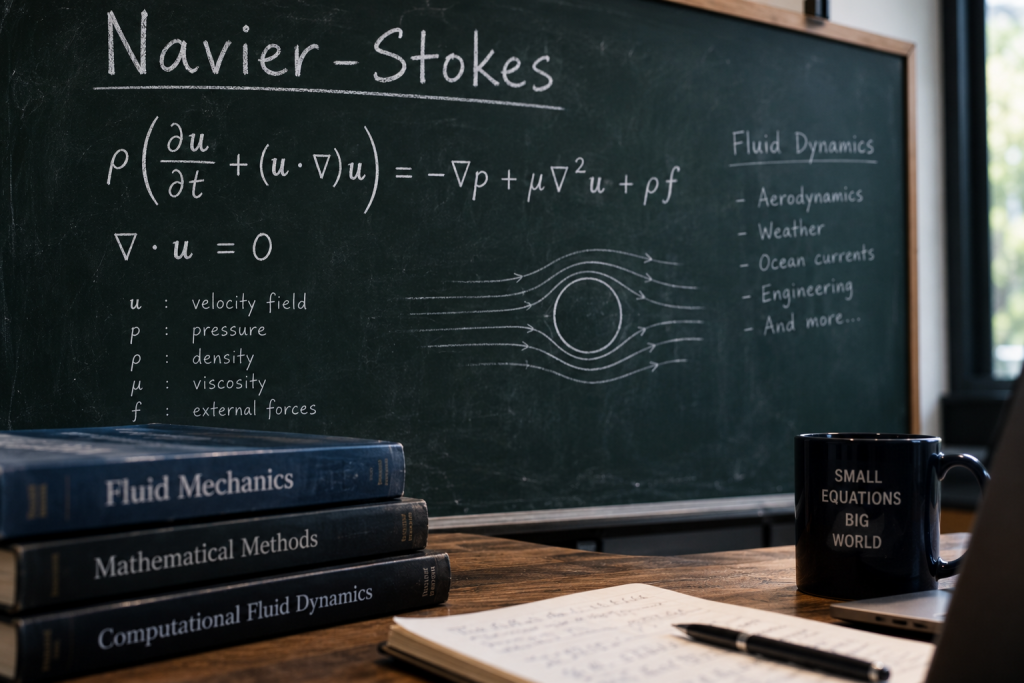
For a common case—an incompressible Newtonian fluid with constant viscosity—the momentum equation is often written as:
ρ(∂u/∂t + (u · ∇)u) = −∇p + μ∇²u + ρf
Together with the incompressibility condition:
∇ · u = 0
The Encyclopedia of Mathematics describes the Navier–Stokes equations as expressions of the conservation laws of momentum and mass for viscous fluids.
What Does Each Part of the Navier–Stokes Equation Mean?
The equation may look intimidating, but each part represents a physical effect.
| Symbol | Meaning |
|---|---|
| ρ | Fluid density |
| u | Fluid velocity |
| ∂u/∂t | Change in velocity over time |
| (u · ∇)u | Change caused by fluid moving through space |
| p | Pressure |
| −∇p | Force caused by pressure differences |
| μ | Dynamic viscosity |
| μ∇²u | Viscous diffusion |
| f | External forces such as gravity |
| ∇ · u = 0 | Incompressibility condition |
In simple terms, the equation balances acceleration, pressure, viscosity and external forces.
That balance tells us how the velocity of a fluid changes from one place and time to another.
Why Are the Navier–Stokes Equations Important?
Fluid motion appears almost everywhere in science and engineering.
Navier–Stokes equations are used in problems involving:
- airflow around aircraft,
- water moving through channels,
- jets and wakes,
- flow around vehicles and structures,
- pipelines,
- combustion,
- weather and atmospheric flow,
- marine engineering,
- and many computational fluid-dynamics simulations.
NASA notes that engineers commonly approximate these equations numerically using techniques such as finite-difference, finite-volume, finite-element and spectral methods—an area known as computational fluid dynamics, or CFD.
The Encyclopedia of Mathematics similarly lists flows through channels, around bodies, in jets and in wakes as fundamental Navier–Stokes applications.
Who Created the Navier–Stokes Equations?
The equations developed gradually during the 19th century.
French engineer and physicist Claude-Louis Navier derived an early form for viscous fluids in the 1820s. George Gabriel Stokes later developed a continuum-based derivation in the 1840s.
Historical sources place Navier’s work around 1822 and Stokes’ major derivation in 1845.
The equations therefore bear both names: Navier–Stokes.
What Is the Navier–Stokes Millennium Prize Problem?
The practical equations can be used every day by engineers.
The famous mathematical problem asks something much deeper.
For a smooth three-dimensional incompressible fluid, mathematicians want to know whether the Navier–Stokes equations always produce a smooth solution for all future time—or whether a solution can develop a singularity in finite time.
The Clay Mathematics Institute summarizes the issue as a fundamental question about whether solutions exist and remain well behaved.
The problem is one of seven Millennium Prize Problems announced by the Clay Mathematics Institute in 2000.
Each problem carries a $1 million prize.
What Does “Existence and Smoothness” Mean?
Suppose a fluid begins with a perfectly reasonable, smooth velocity field.
Mathematicians ask two related questions:
Existence: Does a solution continue to exist for all future time?
Smoothness: Does that solution remain finite and differentiable rather than developing infinite values or singularities?
The difficulty arises primarily in three dimensions.
Clay’s official formulation allows a solution of the problem either by proving that appropriately smooth three-dimensional flows always remain smooth or by constructing an acceptable example where smooth flow breaks down in finite time.
What Is a Navier–Stokes Singularity?
A singularity is a point where the mathematical solution stops behaving normally.
For example, some quantity related to the fluid velocity or its derivatives could become unbounded in finite time.
Clay’s official problem description states that if a finite-time blowup occurs in the Navier–Stokes setting, the velocity becomes unbounded near the blowup time.
A singularity does not simply mean that a real glass of water suddenly produces literally infinite speed.
It means the mathematical model develops behavior that its usual smooth formulation cannot continue through.
Whether this can happen from smooth three-dimensional initial conditions is the heart of the Millennium Problem.
Has Navier–Stokes Been Solved in 2026?
This question now requires an important distinction.
OpenAI says it has produced a solution
On September 8, 2026, OpenAI published a research announcement titled “An OpenAI model proposes a solution to the Navier–Stokes problem.”
The company says its internal AI system produced a proof showing that Navier–Stokes dynamics can develop a singularity in finite time. OpenAI also says it is sharing both a mathematical write-up and a formalized Lean proof.
Nature reported the announcement as a potentially historic mathematical breakthrough, while correctly presenting it as a claim that now requires evaluation by the mathematical community.
Clay still lists the problem as unsolved
As of September 9, 2026, the Clay Mathematics Institute website still lists Navier–Stokes under “Unsolved problems.”
Therefore, the most accurate statement right now is:
A major solution has been proposed, but the Navier–Stokes Millennium Prize Problem has not yet been officially recognized as solved by Clay.
Why Can’t the $1 Million Prize Be Awarded Immediately?
Clay has strict rules.
Before it will consider a proposed solution for a Millennium Prize, three major requirements must be satisfied:
- The solution must be published in a qualifying outlet.
- At least two years must pass after publication.
- The work must achieve general acceptance in the global mathematics community.
Clay also states that it does not accept direct manuscript submissions for prize evaluation.
That means even a correct proof announced today could not immediately receive the $1 million prize.
What Did OpenAI’s Proposed Solution Claim?
According to OpenAI’s announcement, the proposed proof takes the breakdown route rather than proving that every solution remains smooth.
The company says its system found a fluid configuration in which a vortex becomes increasingly concentrated and develops a finite-time singularity.
In other words, if the proof withstands mathematical scrutiny, it would show that smooth three-dimensional Navier–Stokes behavior does not necessarily remain smooth forever.
That would resolve one of the accepted alternatives in the Clay formulation.
However, independent mathematical verification is essential.
Why Is the Navier–Stokes Problem So Difficult?
The main challenge comes from the nonlinear term:
(u · ∇)u
This represents fluid motion carrying its own momentum.
That self-interaction can produce extremely complicated behavior.
At the same time:
- viscosity tends to smooth the flow,
- nonlinear motion can concentrate energy,
- vortices can stretch and interact,
- and behavior can occur across many spatial and time scales.
These competing effects are fundamental to turbulence.
Oxford engineering notes describe the equations as difficult because real fluid flows can contain a broad range of spatial and temporal scales.
Don’t Engineers Already Solve Navier–Stokes Equations?
Yes—but this is one of the most commonly misunderstood parts of the topic.
Engineers solve Navier–Stokes problems all the time.
Aircraft designers, automotive engineers and researchers use computers to obtain numerical approximations under specific initial conditions and boundary conditions.
NASA explains that analytical solutions are generally difficult, so high-speed computers use numerical techniques to approximate them.
The Millennium Prize problem is different.
It asks for a rigorous mathematical statement about all appropriate smooth three-dimensional initial conditions, not whether a computer can model a particular aircraft wing or pipe.
Do Any Navier–Stokes Solutions Already Exist?
Yes.
Many special situations have known exact or approximate solutions.
Mathematicians also know that certain types of weak solutions exist globally in three dimensions.
Clay’s official problem description notes that Jean Leray proved the existence of three-dimensional weak solutions with suitable properties. But the uniqueness and complete regularity of such solutions are not generally known.
That gap between having a weak solution and proving that a smooth, unique solution persists globally is a major part of the Millennium Problem.
What Is the Reynolds Number?
One important quantity in Navier–Stokes analysis is the Reynolds number.
It is usually written as:
Re = ρVL / μ
or equivalently:
Re = VL / ν
where:
- V is a characteristic velocity,
- L is a characteristic length,
- ρ is density,
- μ is dynamic viscosity,
- and ν is kinematic viscosity.
The Reynolds number compares inertial effects with viscous effects.
Low Reynolds numbers are generally associated with viscosity-dominated flow.
Higher Reynolds numbers can produce more complex behavior and are strongly associated with the transition toward turbulence.
Navier–Stokes vs Euler Equations
The Euler equations describe idealized fluid motion without viscosity.
Navier–Stokes equations extend that framework by including viscous effects.
NASA explicitly describes the Navier–Stokes equations as extensions of the Euler equations that account for viscosity.
A simplified comparison is:
| Euler equations | Navier–Stokes equations |
|---|---|
| Ignore viscosity | Include viscosity |
| Ideal fluid model | Viscous fluid model |
| Useful for some approximations | Widely used for real fluid flows |
| No viscous diffusion term | Contains viscous diffusion |
Why Would Solving Navier–Stokes Matter?
A rigorous resolution would be important primarily for mathematics, but the equations themselves underpin much of fluid mechanics.
A confirmed solution would deepen our understanding of:
- nonlinear partial differential equations,
- singularity formation,
- fluid turbulence,
- mathematical regularity,
- and the limits of classical fluid models.
Clay emphasizes that a proof matters not only because it tells us whether a statement is true, but because it provides mathematical understanding.
The 2026 AI-generated proof claim adds another dimension: whether advanced AI systems can independently produce mathematics at the level of historically difficult open problems.
Frequently Asked Questions
What is the Navier–Stokes equation?
The Navier–Stokes equations are differential equations describing the motion of viscous fluids. They express conservation of momentum and mass and relate factors including velocity, pressure and viscosity.
Is Navier–Stokes solved?
Not officially as of September 9, 2026. OpenAI has published a proposed finite-time singularity solution, but the Clay Mathematics Institute still lists the problem as unsolved.
Did OpenAI solve Navier–Stokes?
OpenAI says an internal AI system generated a mathematical proof showing finite-time singularity formation and released a Lean formalization. The claim is extremely recent and has not yet completed the independent acceptance process required for the Clay Millennium Prize.
How much is the Navier–Stokes prize?
The Clay Mathematics Institute allocated $1 million to each of its seven Millennium Prize Problems.
Why is Navier–Stokes hard to solve?
The equations are nonlinear and can create complicated interactions among velocity, pressure, viscosity and vortices across many spatial and temporal scales.
Are Navier–Stokes equations used in real life?
Yes. They form a foundation of fluid mechanics and computational fluid dynamics used to analyze airflow, channel flow, jets, wakes and flow around objects.
What does a Navier–Stokes singularity mean?
It means a mathematical solution becomes unbounded or loses the required smoothness in finite time. Clay’s official discussion states that finite-time breakdown would involve velocity becoming unbounded near the blowup time.
Who invented Navier–Stokes?
The equations are named after Claude-Louis Navier and George Gabriel Stokes, whose major contributions came during the 19th century.
The Navier–Stokes equations describe one of the most familiar things in nature—fluids moving—yet they have produced one of mathematics’ deepest questions.
For decades, nobody had proved whether every suitable smooth three-dimensional Navier–Stokes flow remains smooth forever or whether a singularity can develop.
On September 8, 2026, OpenAI published a proposed solution claiming that finite-time singularities can occur and released both an analytical write-up and formalized proof.
That makes this a potentially historic moment.
But the distinction is crucial: the Clay Mathematics Institute still lists Navier–Stokes as unsolved as of September 9, 2026, and its rules require years of publication history and broad mathematical acceptance before a Millennium Prize solution can be recognized.