Orionid Meteor Shower 2026: Peak Date, Best Time and How to Watch
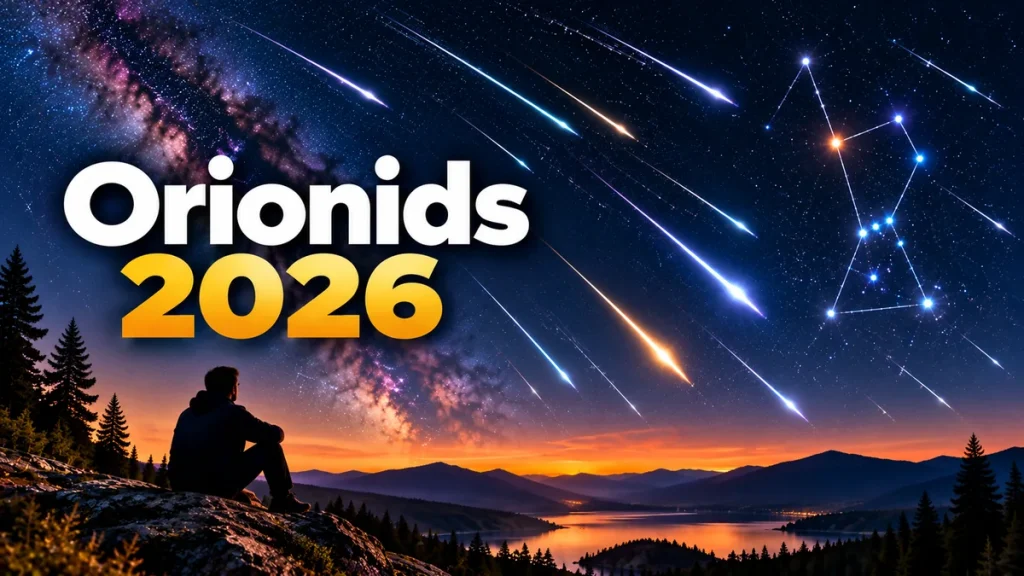
Orionid Meteor Shower 2026: Peak Date, Best Time and How to Watch
The Orionid meteor shower 2026 is already underway, and one of October’s biggest annual skywatching events will reach its peak later this month.
NASA lists the Orionids as active from October 2 through November 7, 2026, with the peak falling on the night of October 21 into October 22. Under ideal dark skies, observers may see roughly 10 to 20 meteors per hour. NASA Science
There is one complication in 2026.
A bright waxing gibbous Moon will be in the sky during much of the peak night, washing out some of the fainter meteors. NASA therefore recommends looking during the hours before dawn after the Moon has set, when the sky becomes darker. NASA Science
Even with that moonlight, the Orionids are worth watching.
They are among the fastest meteors visible during the year, striking Earth’s atmosphere at approximately 41 miles per second, or 66 kilometers per second. Some leave glowing trains behind them, and particularly bright meteors can appear as fireballs. NASA Science
The most fascinating part is where they come from.
Every Orionid you see is connected to debris left behind by one of the most famous objects in astronomy:
Halley’s Comet.
Here is when the 2026 Orionid meteor shower peaks, when to go outside, where to look, how the Moon will affect viewing and what you can realistically expect to see.
Orionid Meteor Shower 2026 at a Glance
| Question | 2026 Answer |
|---|---|
| Active dates | October 2–November 7 |
| Peak night | October 21–22, 2026 |
| Best general viewing | After midnight through pre-dawn |
| Best 2026 strategy | Watch after the Moon sets before dawn |
| Typical dark-sky rate | 10–20 meteors per hour |
| Meteor speed | 41 mph? No — 41 miles per second |
| Metric speed | 66 km/s |
| Parent object | Comet 1P/Halley |
| Radiant | Orion, near Betelgeuse |
| Visible from | Northern and Southern Hemispheres |
| Telescope required | No |
| Main 2026 challenge | Bright waxing gibbous Moon |
NASA provides the active dates, peak night, expected dark-sky rate, speed and Halley’s Comet origin. NASA Science
When Is the Orionid Meteor Shower in 2026?
The Orionid meteor shower is active from:
October 2 through November 7, 2026.
NASA identifies the peak night as:
October 21–22, 2026. NASA Science
That means activity builds gradually rather than appearing on a single night.
You may see occasional Orionid meteors before October 21 and after October 22, but the peak period is when Earth moves through one of the denser portions of Halley’s debris stream.
Timeanddate also identifies the night between October 21 and October 22 as the primary 2026 peak window. Time and Date
What Is the Best Time to See the Orionids?
The best general time to watch the Orionid meteor shower is after midnight through the hours before dawn.
That is when the Orion radiant climbs higher in the sky and an observer’s location on Earth is rotating more directly into the incoming stream of comet debris.
In 2026, timing matters even more because of moonlight.
NASA’s October skywatching guide says a bright waxing gibbous Moon will wash out some of the fainter meteors. It recommends trying during the few hours before dawn after the Moon has set. NASA Science
So the practical 2026 strategy is:
Wait until the Moon is low or has set, then continue watching until morning twilight begins.
Your exact moonset time depends on location.
What Time Will the Orionids Be Visible in the United States?
There is no single nationwide clock time because the position of the Moon, sunrise time and Orion’s altitude vary by location.
However, the meteor shower can generally be observed from late evening into dawn, with the strongest opportunities occurring later in the night.
For New York, Timeanddate’s 2026 Orionid sky map shows the radiant rising low in the east during late evening and climbing steadily higher through the early morning hours. By roughly 4–6 a.m., the radiant is high in the southeastern-to-southern sky. Time and Date
The same general pattern applies across much of the continental United States:
The later you stay out after midnight, the higher Orion becomes.
But because the Moon interferes in 2026, the best moment may be determined more by local moonset than by a single advertised peak hour.
How Many Meteors Will You See?
NASA lists the expected Orionid rate under dark conditions at approximately:
10 to 20 meteors per hour. NASA Science
Timeanddate gives a similar theoretical peak of up to around 20 meteors per hour. Time and Date
But this does not mean everyone will see 20 shooting stars every hour.
Actual observations depend on several factors, including sky darkness, clouds, moonlight, nearby artificial lighting, how high the radiant is above the horizon and how long you spend observing.
The bright Moon in 2026 will make many faint Orionids difficult to see.
So a city observer should not expect the theoretical maximum.
A darker location viewed during the moon-free pre-dawn window will offer much better odds.
Will the Moon Ruin the Orionid Meteor Shower in 2026?
Not completely, but it will reduce visibility.
The Orionid peak happens only several days before the October full moon, so the Moon will already be bright.
NASA specifically warns that the waxing gibbous Moon will wash out fainter meteors during the October 21–22 peak. NASA Science
Timeanddate similarly says viewing conditions are less favorable in 2026 because the shower occurs near the October 26 full moon. Time and Date
The brighter Orionids can still break through the moonlight.
This is particularly relevant because Orionids are known for fast, bright meteors and occasional persistent trains.
The key is to avoid having the Moon directly in your field of view.
Position yourself so a building, tree or other obstruction blocks the Moon while leaving a large portion of the darker sky visible.
What Causes the Orionid Meteor Shower?
The Orionids occur because Earth crosses a stream of dust and small particles left behind by Comet 1P/Halley.
NASA explains that when a comet travels through the inner solar system, material is released from its nucleus.
That debris gradually spreads along the comet’s orbit.
When Earth later crosses the debris trail, the tiny particles enter our atmosphere at enormous speed.
Frictional heating and compression of the air surrounding the particles produce the bright streaks we call meteors. NASA Science
So the streak you see is not a star falling through space.
It is usually a tiny fragment of comet material interacting with Earth’s atmosphere.
Are Orionids Really Pieces of Halley’s Comet?
Yes.
NASA identifies 1P/Halley as the parent comet of the Orionid meteor shower. NASA Science
Halley loses ice, dust and rocky material each time it passes through the inner solar system.
Those particles remain spread along its orbital path.
Earth encounters parts of that debris stream twice each year.
The May encounter produces the:
Eta Aquariid meteor shower.
The October encounter produces the:
Orionid meteor shower. NASA Science
This means you can see material associated with Halley’s Comet even though the comet itself is currently far away.
When Will Halley’s Comet Return?
Halley’s Comet was last visible from Earth in:
1986.
NASA says it travels around the Sun roughly once every 76 years and will return to the inner solar system in:
2061. NASA Science
So anyone watching the Orionids in 2026 is effectively seeing remnants from a comet that will not itself return to our skies for about another 35 years.
That connection is one of the reasons the Orionid meteor shower attracts so much interest.
Why Is It Called the Orionid Meteor Shower?
The name comes from the constellation:
Orion.
Meteor showers appear to originate from a particular point in the sky because of perspective.
That point is known as the:
radiant.
NASA places the Orionid radiant just north of the bright star Betelgeuse in Orion. NASA Science
If you trace several Orionid meteor paths backward, they appear to converge in that region.
But this does not mean the meteors are actually coming from Orion’s stars.
Those stars are vastly farther away.
The apparent convergence is a perspective effect created because Earth encounters a stream of particles traveling on roughly parallel paths.
Where Should You Look for the Orionids?
You do not need to stare directly at Orion.
In fact, meteors can appear anywhere across the sky.
Timeanddate notes that while Orionids appear to radiate from Orion, the streaks can occur across the entire night sky. Time and Date
Looking somewhat away from the radiant can actually produce longer-looking meteor trails.
If you are in the Northern Hemisphere, Orion rises generally in the east during the later evening and climbs higher as the night progresses.
Find a location with as much open sky as possible.
Lie back and let your eyes cover a broad area rather than concentrating on a single star or constellation.
How Fast Are Orionid Meteors?
Extremely fast.
NASA gives the Orionids a velocity of approximately:
41 miles per second
or:
66 kilometers per second. NASA Science
That is roughly:
148,000 miles per hour.
At those speeds, Orionids are among the faster major annual meteor showers.
Their speed can create another attractive feature:
persistent trains.
These glowing trails can remain visible briefly after the original meteor streak has disappeared.
What Is a Meteor Train?
A meteor train is a glowing trail that persists in the sky behind some meteors.
NASA notes that Orionids are particularly known for their brightness, speed and ability to leave glowing trains. NASA Science
The trail is produced by material and ionized gases associated with the meteor’s high-speed passage through the atmosphere.
Some trains disappear almost immediately.
Others can remain visible for several seconds or longer.
Very bright Orionids may also appear as fireballs.
What Is a Fireball?
A fireball is an unusually bright meteor.
It can appear substantially brighter than ordinary shooting stars and may attract attention even from people who were not deliberately watching the meteor shower.
Meteor showers do not guarantee fireballs.
But NASA notes that fast showers such as the Orionids can produce bright meteors and persistent trains. NASA Science
If moonlight hides many faint Orionids in 2026, these brighter events are the ones observers are most likely to notice.
Do You Need a Telescope to See the Orionid Meteor Shower?
No.
A telescope can actually make meteor watching more difficult.
Meteor showers are best observed with the:
naked eye.
A telescope shows only a tiny portion of the sky.
Meteors can appear almost anywhere.
You want the widest field of view possible.
A reclining chair, warm clothes and patience are more useful for Orionid watching than a telescope.
Are Binoculars Useful?
Not for watching the meteors themselves.
Binoculars also restrict your field of view.
However, binoculars can be useful while you are waiting if you want to examine Orion, the Pleiades or other bright deep-sky targets.
When actively watching for meteors, put the binoculars down and use your eyes.
How Dark Does the Sky Need to Be?
The darker the better.
City lights make the sky brighter and erase many faint meteors.
For the best results, travel away from major streetlights, illuminated buildings and urban sky glow.
NASA’s general meteor-viewing advice recommends finding an area away from city or street lights and allowing roughly 30 minutes for your eyes to adapt to darkness. NASA Science
This adaptation is important.
Your night vision becomes substantially more sensitive after spending time away from bright light.
Checking a bright phone screen can partly reset that process.
How Long Should You Watch?
At least 30 to 60 minutes is preferable.
Meteor activity is naturally irregular.
You might see several meteors close together and then nothing for a while.
Watching for only five minutes can therefore give a misleading impression.
Timeanddate recommends patience and notes that meteor viewing is often a waiting game. Time and Date
A longer observing session gives you a much better chance of seeing a bright Orionid.
Can You See Orionids From a City?
Yes, but you will see fewer.
Bright Orionids can still be visible from suburban or urban locations.
However, light pollution combined with the bright Moon will make 2026 particularly challenging for city observers.
If possible, find a nearby area with a darker eastern, southeastern or southern sky.
Even moving away from direct streetlights can improve your view.
Can the Orionids Be Seen From Both Hemispheres?
Yes.
NASA and Timeanddate both indicate that the Orionid meteor shower can be observed from the Northern and Southern Hemispheres. Time and Date
The exact orientation of Orion and the radiant differs with latitude.
But the shower is not restricted to one hemisphere.
That makes the Orionids a genuinely global astronomy event.
Are Orionids Shooting Stars?
They are commonly called shooting stars, but they are not stars.
A real star such as the Sun is an enormous sphere of hot plasma.
An Orionid meteor is typically created by a much smaller piece of comet debris entering Earth’s atmosphere.
The visible streak is called a:
meteor.
The particle before entering the atmosphere is called a:
meteoroid.
If part of an object survives its journey and reaches the ground, it is called a:
meteorite.
Most meteor-shower particles are tiny and burn up high in the atmosphere.
Can Orionid Meteors Hit the Ground?
Typical Orionid particles are generally too small to survive all the way to Earth’s surface.
NASA describes meteor showers as being created when comet particles collide with Earth’s atmosphere and disintegrate, producing the bright streaks we see. NASA Science
So watching the Orionids does not imply that dangerous space rocks are expected to rain down on observers.
The display occurs high above the ground.
How to Photograph the Orionid Meteor Shower
Meteor photography requires a different technique from photographing the Moon.
You want to capture a wide area of sky for a relatively long period.
NASA recommends using a tripod because meteor photography involves long exposures and handheld cameras cannot remain sufficiently steady. NASA Science
A wide-angle lens is usually preferable because it increases the amount of sky in the frame.
Use manual focus on the stars, keep the camera stable and take repeated exposures rather than waiting to press the shutter when you see a meteor.
By the time you react to a meteor visually, it is usually already gone.
Can a Smartphone Photograph the Orionids?
Possibly, especially newer phones with dedicated astrophotography or night modes.
However, meteor photography is difficult because each streak lasts only briefly.
A phone should be mounted on a tripod or stable support.
Avoid holding it by hand for long exposures.
Use the widest useful field of view and take repeated images during the viewing session.
The darker the sky, the better your chances.
Orionids vs Perseids: Which Meteor Shower Is Bigger?
The Perseids generally produce higher meteor rates.
NASA’s Orionid guidance lists approximately:
10–20 meteors per hour
under dark skies. NASA Science
The Perseids can produce substantially more under favorable conditions.
But the Orionids have their own advantages.
They are very fast, can produce attractive glowing trains and are connected to Halley’s Comet.
So “bigger” does not necessarily mean more interesting.
Orionids vs Eta Aquariids
The Orionids and Eta Aquariids share the same parent comet:
Halley’s Comet. NASA Science
The Eta Aquariids occur in May.
The Orionids occur in October.
Earth encounters different portions of Halley’s debris trail at different points in its orbit.
This gives Halley’s Comet the unusual distinction of producing two well-known annual meteor showers.
Why Can We Still See Halley Debris When the Comet Is Far Away?
Because comet debris does not disappear when the comet leaves.
Dust and rocky particles released during Halley’s repeated passages remain distributed around its orbital path.
Earth crosses that stream each year.
NASA explains that comet material gradually spreads into a dusty trail around the orbit. When Earth crosses these trails, the particles interact with our atmosphere and become visible as meteors. NASA Science
Some of the material creating a meteor shower may have been released from its parent comet many orbits ago.
Is October 21 the Only Night Worth Watching?
No.
Meteor showers do not switch on and off instantly.
The Orionids are active from October 2 to November 7, and activity can remain relatively elevated for several days around the peak. Time and Date
If October 21–22 is cloudy where you live, try nearby mornings.
You may see fewer meteors than during the main peak, but bright Orionids remain possible.
In 2026, a nearby date with less troublesome moon placement may even produce a more enjoyable practical viewing session for some locations.
What If the Weather Is Cloudy?
Clouds are one thing astronomy cannot work around.
Meteors occur high above Earth’s atmosphere, but thick clouds block your view.
Check the local cloud forecast shortly before going outside.
If the official peak is cloudy, try the night before or after.
Because the Orionids remain active for weeks, one cloudy evening does not eliminate the entire event.
What Other Astronomy Events Happen in October 2026?
October is unusually busy for skywatchers.
NASA’s October guide highlights Saturn at opposition on October 4, the Orionid peak on October 21–22 and the Moon passing close to the Pleiades on October 27–28. NASA Science
The month also includes the October full moon—the Hunter’s Moon—on October 25–26.
That makes the Orionids a useful supporting article for your existing October astronomy content.
Link this article internally to your Full Moon October 2026: Hunter’s Moon Date, Time & Viewing Guide article so readers can continue through the same Science cluster.
Will the Hunter’s Moon Affect the Orionids?
Yes, indirectly.
The Hunter’s Moon reaches full phase only several days after the meteor-shower peak.
Therefore the Moon is already a bright waxing gibbous during October 21–22.
That moonlight brightens the background sky and makes the faintest meteors harder to detect.
This is exactly why NASA recommends viewing in the hours before dawn after moonset. NASA Science
The meteor shower itself is not weaker because of the Moon.
You simply see fewer meteors because the sky is brighter.
Frequently Asked Questions About the Orionid Meteor Shower 2026
When is the Orionid meteor shower in 2026?
The Orionids are active from October 2 through November 7, 2026, with the primary peak on the night of October 21–22. NASA Science
What time is the Orionid meteor shower peak?
There is no single viewing time that works everywhere. For most observers, the best period is after midnight through the pre-dawn hours. In 2026, NASA specifically recommends trying after moonset before dawn because bright moonlight will hide some faint meteors. NASA Science
How many Orionids will be visible?
NASA lists about 10 to 20 meteors per hour under dark skies. Actual rates can be substantially lower when moonlight, city lights or clouds interfere. NASA Science
Where should I look to see the Orionids?
The radiant lies near Orion and just north of Betelgeuse, but meteors may appear anywhere across the sky. NASA Science
Do I need to find Orion?
No. Knowing where Orion is can help identify the radiant, but you should scan a broad area of sky rather than stare directly at the constellation.
Does the Orionid meteor shower come from Halley’s Comet?
Yes. The particles producing the Orionids come from debris released by Comet 1P/Halley. NASA Science
When will Halley’s Comet return?
NASA says Halley’s Comet will return to the inner solar system in 2061. NASA Science
How fast are Orionid meteors?
Approximately 41 miles per second, or 66 kilometers per second. NASA Science
Can I see the Orionids without a telescope?
Yes. A telescope is not needed and is generally less useful because meteor watching requires a wide field of view.
Will the Moon interfere in 2026?
Yes. A bright waxing gibbous Moon will wash out some fainter Orionids. The best opportunity may come after moonset in the hours before dawn. NASA Science
Can I see the Orionids from the United States?
Yes. The Orionids are visible from both hemispheres, including throughout the United States when weather and sky conditions cooperate. Time and Date
Can I see the Orionids from a city?
Bright meteors are possible from cities, but light pollution will reduce the number you can see.
What is the best place to watch?
A dark, open location away from city and street lights with a wide view of the sky.
How long should I let my eyes adjust?
Around 20 to 30 minutes in darkness is a good target. Avoid bright phone screens during that period. NASA Science
Is the Orionid meteor shower dangerous?
No special danger is expected. The tiny particles responsible for ordinary meteor showers generally disintegrate high in Earth’s atmosphere.
Is an Orionid a shooting star?
“Shooter star” is the popular expression, but Orionids are meteors created by tiny pieces of comet debris rather than actual stars.
Orionid Meteor Shower 2026: Bottom Line
The Orionid meteor shower peaks on the night of October 21–22, 2026, giving skywatchers another chance to see debris left behind by the legendary Halley’s Comet burn brightly through Earth’s atmosphere.
NASA lists the Orionids as active from October 2 to November 7 and estimates about 10 to 20 meteors per hour under sufficiently dark skies. The meteors enter the atmosphere at around 41 miles per second, or 66 kilometers per second, making them some of the fastest annual meteors. NASA Science
The biggest challenge this year is the Moon.
A bright waxing gibbous Moon will wash out many faint streaks during the main peak. NASA’s recommendation is therefore especially useful:
Watch during the hours before dawn after the Moon has set. NASA Science
You do not need a telescope.
Find the darkest practical location, give your eyes 20–30 minutes to adjust, look across a wide section of sky and be patient.
And remember what you are actually seeing.
Halley’s Comet itself has not appeared in Earth’s skies since 1986 and will not return until 2061. But every October, Earth passes through material it left behind, allowing us to see traces of the famous comet decades before its next return. NASA Science
For readers planning more October skywatching, connect this article directly with your Hunter’s Moon 2026 viewing guide. The Hunter’s Moon follows only a few days after the Orionid peak, which also explains why moonlight will make the 2026 meteor shower more challenging than usual.