Full Moon October 2026: Hunter’s Moon Date, Time & Best Viewing Guide
Full Moon October 2026: Hunter’s Moon Date, Time & Best Viewing Guide
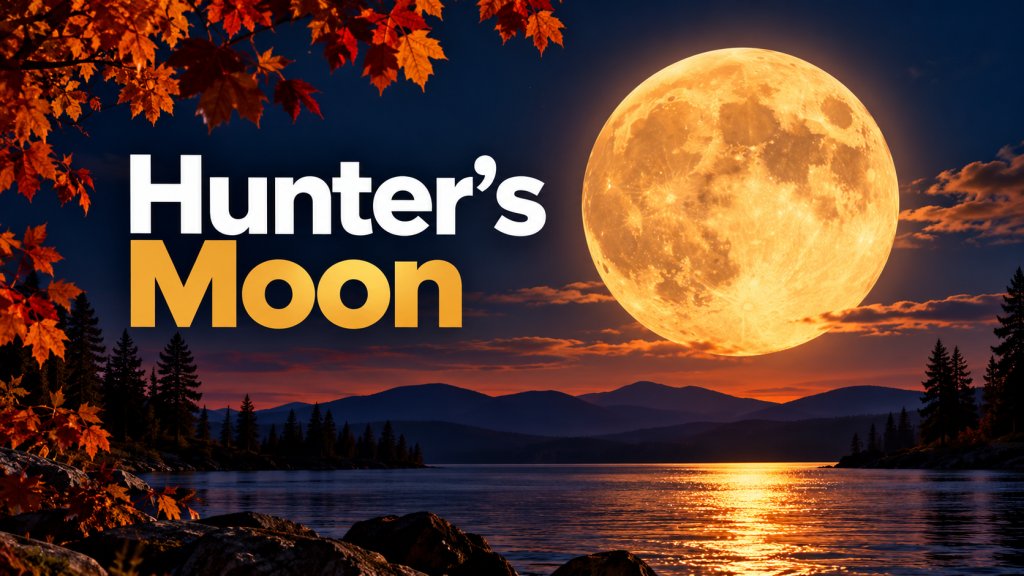
The full moon in October 2026, traditionally known as the Hunter’s Moon, reaches exact full phase on October 26 at 04:11 UTC.
For much of the United States, that means the Moon reaches peak illumination during the evening of Sunday, October 25 rather than after midnight on October 26.
In New York, exact full moon occurs at approximately 12:11 a.m. EDT on October 26. On the U.S. West Coast, the same astronomical instant occurs at about 9:11 p.m. PDT on October 25. Timeanddate lists the global full-moon instant at 04:11 UTC. Time and Date
The October full moon is especially easy to observe because you do not need:
- a telescope;
- binoculars;
- special glasses;
- or any astronomy experience.
If the sky is clear, simply look east around sunset as the Moon rises.
But several questions are already generating interest ahead of the event:
Is the October 2026 Hunter’s Moon a supermoon?
Why is it called the Hunter’s Moon?
Is it a Blood Moon?
What time should you look for it?
And why can the Moon appear enormous and orange when it first rises?
Here is the complete science and viewing guide.
Hunter’s Moon 2026 at a Glance
| Question | Answer |
|---|---|
| Full Moon | October 26, 2026 |
| Exact time | 04:11 UTC |
| New York | 12:11 a.m. EDT, Oct. 26 |
| Chicago/Central Time | 11:11 p.m. CDT, Oct. 25 |
| Mountain Time | 10:11 p.m. MDT, Oct. 25 |
| Los Angeles/Pacific Time | 9:11 p.m. PDT, Oct. 25 |
| Traditional name | Hunter’s Moon |
| Supermoon? | No, under NASA’s 2026 list |
| Blood Moon? | No |
| Lunar eclipse? | No |
| Blue Moon? | No |
| Telescope required? | No |
| Best general viewing | Around moonrise, evening of Oct. 25 |
Timeanddate identifies October 26 as the date of the October full moon, while NASA’s current supermoon schedule lists the next supermoons on November 24 and December 24—not October 26. Time and Date
When Is the Full Moon in October 2026?
The Moon reaches exact full phase at:
04:11 UTC on Monday, October 26, 2026. Time and Date
A full moon is an astronomical instant rather than an event that lasts for an entire day.
NASA explains that Moon phases are determined by the Moon’s position relative to Earth and the Sun. During full moon, the Moon is positioned on the opposite side of Earth from the Sun from our perspective, allowing us to see nearly the entire sunlit hemisphere. NASA Science
However, the Moon can look full for more than one night.
That means observers do not need to go outside at exactly 04:11 UTC to enjoy the Hunter’s Moon.
For many Americans, the most attractive view will actually happen around moonrise on Sunday evening, October 25.
What Time Is the Hunter’s Moon in the United States?
Because the exact full moon is a single astronomical instant, local clock times differ by time zone.
For the continental United States:
| U.S. Time Zone | Exact Full Moon |
|---|---|
| Eastern | 12:11 a.m. EDT, Oct. 26 |
| Central | 11:11 p.m. CDT, Oct. 25 |
| Mountain | 10:11 p.m. MDT, Oct. 25 |
| Pacific | 9:11 p.m. PDT, Oct. 25 |
| Alaska | About 8:11 p.m. AKDT, Oct. 25 |
| Hawaii | About 6:11 p.m. HST, Oct. 25 |
Space.com independently lists the New York timing as 12:11 a.m. EDT on October 26, while Timeanddate’s Los Angeles lunar calendar places full moon at approximately 9:11 p.m. local time on October 25. Space
This is why you may see different dates in search results.
October 26 is the UTC/Eastern-date answer.
For much of the United States farther west, exact fullness happens on October 25 local time.
What Is the Hunter’s Moon?
The Hunter’s Moon is the traditional name commonly given to the full moon that follows the Harvest Moon.
In 2026, September’s full moon served as the Harvest Moon, so the October full moon becomes the Hunter’s Moon.
Timeanddate notes that the name is connected with the traditional Northern Hemisphere hunting season, when communities historically prepared food for the coming winter. Time and Date
The name is cultural rather than scientific.
Astronomically, the Hunter’s Moon is simply a full moon.
Its orbital mechanics are governed by the same Sun-Earth-Moon geometry as every other full moon.
Why Is It Called the Hunter’s Moon?
The name reflects seasonal traditions.
After crops had been harvested, fields were more open and animals could be easier to see.
The bright autumn moonlight also provided illumination during evening hours.
This period became associated with hunting and preparing food for winter, leading to the name:
Hunter’s Moon. Time and Date
Different cultures have historically used different names for lunar months, so “Hunter’s Moon” should not be treated as the universal name used by every culture or Indigenous community.
It is simply the name most commonly used today for the October full moon in English-language astronomy calendars.
Is the October 2026 Hunter’s Moon a Supermoon?
No, according to NASA’s current 2026 supermoon listing.
NASA defines a supermoon as a full moon occurring near the Moon’s closest orbital approach to Earth, called perigee.
NASA currently lists the upcoming 2026 supermoons as:
- November 24, 2026
- December 24, 2026
The October 26 Hunter’s Moon is not on that list. NASA Science
This matters because some online articles use the term “supermoon” loosely.
NASA also emphasizes that supermoon is not an official astronomical term, and different popular definitions can produce slightly different lists. NASA Jet Propulsion Laboratory
For SEO and factual accuracy, the safest description is:
The October 2026 Hunter’s Moon is not included in NASA’s 2026 supermoon list.
What Exactly Is a Supermoon?
The Moon does not travel around Earth in a perfect circle.
Its orbit is slightly elliptical.
That means its distance changes throughout each orbit.
The nearest point is:
perigee
while the farthest point is:
apogee.
NASA says the Moon’s average perigee is approximately 363,300 kilometers (226,000 miles) from Earth, while average apogee is approximately 405,500 kilometers (251,000 miles). NASA Science
When a full moon happens particularly close to perigee, it is commonly called a supermoon.
NASA notes that a full supermoon can appear up to about 14% larger and 30% brighter than a full moon occurring near the farthest part of the Moon’s orbit. NASA Science
Those differences are real.
But they are not nearly as dramatic to the naked eye as some photographs make them appear.
Why Will the Hunter’s Moon Look Huge Near the Horizon?
Even an ordinary full moon can appear enormous when rising.
This is known as the:
Moon illusion.
NASA explains that photographs taken with the same camera settings show that the Moon is essentially the same apparent width when it is near the horizon as when it is high overhead.
The dramatic size difference we perceive is largely created by our brains. NASA Science
Foreground objects appear to contribute to the effect.
For example:
- buildings;
- mountains;
- trees;
- skylines;
can make the Moon appear unusually large.
That is one reason moonrise is often the most impressive time to watch a full moon.
Why Does the Hunter’s Moon Look Orange?
A rising full moon often looks:
- yellow;
- orange;
- amber;
- or occasionally reddish.
That is real atmospheric physics.
When the Moon is close to the horizon, its reflected sunlight travels through a longer path in Earth’s atmosphere.
Shorter blue wavelengths are scattered more strongly, leaving relatively more longer red and orange wavelengths reaching your eyes.
NASA explains that this is why the low Moon often appears warmer in color than the Moon overhead. NASA Science
Dust, smoke and air pollution can deepen the effect.
Is the Hunter’s Moon a Blood Moon?
No.
“Blood Moon” is commonly used today to describe the reddish Moon seen during a total lunar eclipse.
There is no lunar eclipse on October 25–26, 2026.
NASA’s official 2026 eclipse calendar lists four eclipses during the year:
- February 17 — annular solar eclipse
- March 3 — total lunar eclipse
- August 12 — total solar eclipse
- August 28 — partial lunar eclipse
There is no October eclipse. NASA Eclipse
So although the Hunter’s Moon may appear orange or reddish near the horizon, that color does not make it an astronomical Blood Moon.
Is the Hunter’s Moon a Blue Moon?
No.
A common modern definition of a monthly Blue Moon is:
the second full moon occurring within the same calendar month.
NASA explains that this type of Blue Moon occurs when two full moons fit into one calendar month. NASA Science
October 2026 has only one full moon:
October 26.
So the 2026 Hunter’s Moon is not a monthly Blue Moon.
What Is a Full Moon Scientifically?
The Moon does not generate its own visible light.
What we call moonlight is:
sunlight reflected from the lunar surface.
NASA explains that the Sun always illuminates half of the Moon.
As the Moon travels around Earth, we see different portions of that illuminated hemisphere.
Those changing appearances create the lunar phases. NASA Science
The major phases are:
- New Moon
- First Quarter
- Full Moon
- Third Quarter
Between them are the crescent and gibbous phases.
The complete cycle takes approximately:
29.5 days. NASA Science
That is why full moons occur roughly once each month.
Why Does the Exact Full Moon Last Only an Instant?
People often say:
“The full moon lasts all night.”
Visually, that is close enough.
Astronomically, however, exact full moon occurs at one particular instant when the Sun and Moon reach the required geometry relative to Earth.
Before that moment, the Moon is technically:
waxing gibbous.
After it:
waning gibbous.
The difference is far too subtle for most people to notice with their eyes.
That is why the Moon may look fully illuminated the night before and the night after its official full-moon time.
When Should You Watch the October Full Moon?
For most U.S. observers, one of the best opportunities will be:
Sunday evening, October 25, around local moonrise.
NASA notes that full moons generally rise near sunset. NASA Science
Watching near moonrise provides several visual advantages.
The Moon will:
- be low near the horizon;
- often appear yellow or orange;
- interact visually with buildings and landscapes;
- appear especially large because of the Moon illusion.
Exact moonrise varies by location.
So check your local moonrise time on October 25 rather than assuming the exact full-moon time is also the moment the Moon rises.
Where Should You Look?
Near full moon, begin looking toward the:
eastern horizon around sunset.
As the night progresses, the Moon moves higher across the sky.
By later in the night, it will be much higher and appear whiter than it did near the horizon.
You do not need a perfectly dark site to observe the Moon.
Unlike faint stars, galaxies or meteor showers, the full moon is extremely bright.
It can be observed from:
- cities;
- suburbs;
- rural areas.
A clear horizon matters more than escaping light pollution.
Do You Need a Telescope?
No.
The Hunter’s Moon is easily visible with the naked eye.
However, binoculars can reveal large lunar features, while even a modest telescope can show:
- craters;
- dark lunar maria;
- mountain regions;
- bright ray systems.
Ironically, exact full moon is not always the best phase for seeing crater relief.
When sunlight strikes the Moon more directly, shadows become shorter.
Around first and last quarter, long shadows near the lunar terminator often make crater walls and mountains look more dramatic.
Can You Photograph the Hunter’s Moon With a Phone?
Yes.
Modern phones can capture useful full-moon photos, especially models with optical telephoto cameras.
Try these basic steps:
- Clean the camera lens.
- Use the phone’s optical telephoto lens if available.
- Tap the Moon to focus.
- Reduce exposure until surface details become visible.
- Stabilize the phone against something solid or use a tripod.
- Avoid excessive digital zoom.
- Include a landmark or landscape during moonrise.
The most dramatic composition often comes from photographing the Moon near the horizon rather than high overhead.
Why Do Professional Moon Photos Look So Enormous?
Telephoto compression.
A photographer can stand far away from a building, mountain or monument and use a long focal-length lens.
This magnifies both the Moon and distant foreground object within a narrow field of view.
NASA explains that photographers can recreate the Moon-illusion effect by using long lenses with foreground objects in the frame. NASA Science
The Moon itself has not suddenly become several times larger.
The photograph’s perspective makes it look that way.
Will the Hunter’s Moon Affect the Orionid Meteor Shower?
Yes—primarily through moonlight.
The Orionid meteor shower peaks on the night of:
October 21–22, 2026
just a few days before the Hunter’s Moon.
NASA says the Orionids originate from debris left by Halley’s Comet and can streak across any part of the sky. NASA Science
Unfortunately, the Moon will already be a bright waxing gibbous during the Orionid peak.
The American Meteor Society expects significant moonlight interference in 2026, meaning many faint meteors will be harder to see. American Meteor Society
Brighter Orionids should still be visible from dark locations.
For your next Science article, this creates a natural supporting-page opportunity:
“Orionid Meteor Shower 2026: Peak Time, Best Viewing Hours & Halley’s Comet Connection.”
Other Astronomy Events in October 2026
The Hunter’s Moon is only one of several noteworthy sky events this month.
NASA’s October skywatching guide highlights:
October 4 — Saturn at opposition
Saturn is positioned opposite the Sun and is visible for much of the night.
October 21–22 — Orionid meteor shower peak
Earth passes through debris from Halley’s Comet.
October 27–28 — Moon near the Pleiades
The Moon passes close to the famous Pleiades star cluster, also called the Seven Sisters. NASA Science
That makes October 2026 an unusually useful month for building an astronomy-content cluster around your Hunter’s Moon article.
Hunter’s Moon vs Harvest Moon
The two names are related but not interchangeable.
The Harvest Moon is traditionally the full moon closest to the September equinox.
The Hunter’s Moon follows it.
In 2026:
September 26 → Harvest Moon
October 26 → Hunter’s Moon. Time and Date
Because the dates depend on the lunar cycle, the Harvest Moon can sometimes occur in October rather than September.
The Hunter’s Moon then shifts accordingly.
Does the Full Moon Affect Human Behavior?
Popular culture frequently associates full moons with:
- poor sleep;
- unusual behavior;
- increased hospital visits;
- crime;
- mood changes.
But strong claims should be treated cautiously.
Timeanddate’s October Moon guide notes that there is little hard evidence supporting broad claims that the full Moon measurably affects human physiology or behavior. Time and Date
That is different from effects such as tides.
The Moon’s gravitational influence on Earth’s oceans is well established.
Does a Full Moon Cause Higher Tides?
Full and new moons occur when the Sun, Earth and Moon are approximately aligned.
During these periods, solar and lunar gravitational effects combine to produce stronger tidal ranges known as:
spring tides.
A nearby perigee can enhance tides further.
The October Hunter’s Moon is not included in NASA’s upcoming supermoon list, so it should not be described as one of NASA’s designated 2026 supermoons. NASA Science
October 2026 Moon Phase Calendar
The main lunar phases during October are:
| Moon Phase | Date |
|---|---|
| Third Quarter | October 3 |
| New Moon | October 10 |
| First Quarter | October 18 |
| Full Moon / Hunter’s Moon | October 26 |
Timeanddate gives the exact October full moon as 04:11 UTC on October 26. Time and Date
Frequently Asked Questions
When is the full moon in October 2026?
The October full moon reaches exact full phase on October 26, 2026 at 04:11 UTC. Time and Date
What is the October 2026 full moon called?
It is commonly called the Hunter’s Moon. Time and Date
What time is the Hunter’s Moon in New York?
Approximately 12:11 a.m. EDT on October 26. Space
What time is the October full moon in California?
Approximately 9:11 p.m. PDT on October 25. Time and Date
Why is California’s full moon date October 25 instead of October 26?
The full moon occurs at one instant worldwide. Because Pacific Daylight Time is seven hours behind UTC, 04:11 UTC on October 26 converts to 9:11 p.m. PDT on October 25.
Is the October 2026 full moon a supermoon?
NASA’s 2026 supermoon page does not list the October Hunter’s Moon. Its listed upcoming supermoons are November 24 and December 24. NASA Science
Is the Hunter’s Moon a Blood Moon?
No. There is no lunar eclipse during the October 2026 Hunter’s Moon. NASA lists the year’s lunar eclipses on March 3 and August 28. NASA Eclipse
Is the Hunter’s Moon a Blue Moon?
No. October has only one full moon in 2026.
Why is it called Hunter’s Moon?
The traditional name is connected with the Northern Hemisphere hunting season following the harvest period. Time and Date
Why does the full moon look orange?
Moonlight passes through more atmosphere near the horizon, scattering shorter wavelengths and making the Moon appear more yellow, orange or red. NASA Science
Why does the Moon look bigger near the horizon?
The apparent increase is primarily the Moon illusion, a perceptual effect rather than a dramatic physical change in lunar size. NASA Science
Do I need a telescope to see the Hunter’s Moon?
No. It is easily visible with the naked eye.
Where should I look?
Look toward the eastern horizon around local sunset as the Moon rises.
What meteor shower happens near the Hunter’s Moon?
The Orionid meteor shower peaks on October 21–22, several days before the full moon. NASA Science
What comet causes the Orionids?
The Orionids come from debris left behind by 1P/Halley, or Halley’s Comet. American Meteor Society
When is the next supermoon after the Hunter’s Moon?
NASA lists a supermoon on November 24, 2026. NASA Science
Full Moon October 2026: Bottom Line
The October 2026 full moon reaches peak illumination at 04:11 UTC on October 26 and is traditionally known as the Hunter’s Moon. Time and Date
For U.S. observers, that translates approximately to:
12:11 a.m. EDT — October 26
11:11 p.m. CDT — October 25
10:11 p.m. MDT — October 25
9:11 p.m. PDT — October 25
The Hunter’s Moon:
- is not on NASA’s 2026 supermoon list;
- is not a lunar eclipse;
- is not a Blood Moon;
- and is not a Blue Moon. NASA Science
For the most visually dramatic experience, watch around moonrise on October 25.
That is when the Moon may appear especially large because of the Moon illusion and may take on a yellow or orange appearance because its light is traveling through more of Earth’s atmosphere. NASA Science
October is also a strong month for skywatching. Saturn reaches opposition early in the month, the Orionid meteor shower peaks October 21–22, and the Moon passes close to the Pleiades on October 27–28.