Claude Opus 5.5: Features, Pricing, Benchmarks & Complete 2026 Guide
Claude Opus 5.5: Features, Pricing, Benchmarks & Complete 2026 Guide
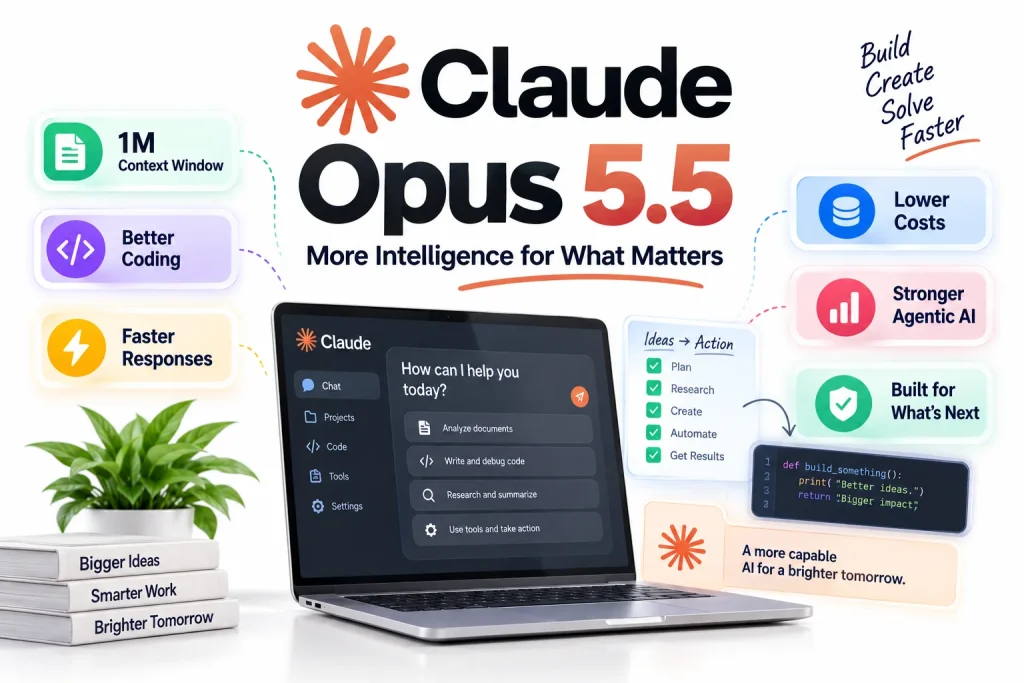
Claude Opus 5.5 is Anthropic’s newest Opus-class artificial intelligence model, built for advanced coding, long-running AI agents, complex research and professional knowledge work.
Anthropic released Claude Opus 5.5 on September 22, 2026, making it the first model in the company’s new Claude 5.5 family.
The update is particularly notable because Anthropic did not simply increase model capability.
It also reduced the cost.
Claude Opus 5.5 is priced at $4 per million input tokens and $20 per million output tokens, compared with $5 and $25 respectively for Claude Opus 5. Anthropic says its own testing found typical workloads cost about 40% less overall because Opus 5.5 also uses fewer tokens to complete many tasks.
The model also supports a 1 million-token context window, up to 128,000 output tokens, image input, adaptive thinking and extensive tool-based workflows.
Those capabilities make Claude Opus 5.5 particularly relevant to the growing shift from traditional chatbots toward AI agents for small business and enterprise automation.
This guide explains what Claude Opus 5.5 is, how much it costs, how its API works, what changed from Claude Opus 5 and who is most likely to benefit from using it.
What Is Claude Opus 5.5?
Claude Opus 5.5 is a frontier AI model developed by Anthropic.
Anthropic describes it as a model designed specifically for long-running agentic coding and knowledge work.
That means it is optimized for jobs that require the AI to maintain context, reason through several steps and potentially interact with tools over an extended period.
Examples include:
- Software development
- Codebase migrations
- Code reviews
- Business research
- Data analysis
- Document analysis
- Long-running AI agents
- Workflow automation
- Tool use
- Technical troubleshooting
- Professional knowledge work
- Multi-step research
Claude Opus 5.5 therefore represents more than a conventional question-and-answer chatbot.
It is designed for the increasingly important category of agentic AI.
An ordinary AI assistant might answer:
“Here is how you could analyze this codebase.”
An AI agent powered by a model such as Claude Opus 5.5 could potentially analyze the repository, inspect files, identify problems, make changes, run tests and continue working toward a defined objective.
For a broader explanation of this shift, see our complete guide to AI agents for small business.
Claude Opus 5.5 Release Date
Claude Opus 5.5 was released on September 22, 2026.
Anthropic currently lists the model as active and identifies it as the latest Opus model.
The Claude API model identifier is:
claude-opus-5-5
Anthropic says the model will not be retired before September 22, 2027.
Claude Opus 5.5 is the first member of Anthropic’s 5.5 model family.
Anthropic has also announced that Claude Sonnet 5.5 and Claude Haiku 5.5 are expected to follow.
Claude Opus 5.5 Specifications
Here are the most important Claude Opus 5.5 specifications.
| Feature | Claude Opus 5.5 |
|---|---|
| Release date | September 22, 2026 |
| Model ID | claude-opus-5-5 |
| Context window | 1 million tokens |
| Standard maximum output | 128,000 tokens |
| Batch API maximum output | Up to 300,000 tokens in beta |
| Input price | $4 per million tokens |
| Output price | $20 per million tokens |
| Cache read price | $0.20 per million tokens |
| 5-minute cache write | $5 per million tokens |
| 1-hour cache write | $8 per million tokens |
| Thinking | Adaptive, always on |
| Default effort | Medium |
| Input | Text and images |
| Output | Text |
| Reliable knowledge cutoff | June 2026 |
These specifications are based on Anthropic’s current Claude Platform documentation.
What’s New in Claude Opus 5.5?
The biggest improvements fall into several categories.
Lower Pricing
Claude Opus 5 cost:
- $5 per million input tokens
- $25 per million output tokens
Claude Opus 5.5 costs:
- $4 per million input tokens
- $20 per million output tokens
That represents a 20% reduction in the standard per-token API price.
Anthropic says the effective cost reduction can be larger because Claude Opus 5.5 often uses fewer tokens to accomplish the same work.
According to Anthropic’s own testing, typical workloads can cost approximately 40% less than with Claude Opus 5.
Faster Output
Anthropic says Claude Opus 5.5 generates output more than 30% faster than Claude Opus 5.
That can make a significant difference when an AI agent must perform dozens or hundreds of model interactions during a long-running task.
Cheaper Prompt Caching
Prompt caching is especially important for AI agents and coding systems because the same instructions or project context may be reused repeatedly.
Claude Opus 5.5 cache reads cost:
$0.20 per million tokens
Claude Opus 5 cache reads cost:
$0.50 per million tokens
That represents a 60% reduction in the cache-read price.
Stronger Agentic Coding
Anthropic is positioning Claude Opus 5.5 heavily around coding.
The model is designed to work through large software projects rather than only generate isolated code snippets.
Potential use cases include:
- Repository-wide analysis
- Large migrations
- Bug investigation
- Refactoring
- Automated testing
- Code review
- Dependency upgrades
- Documentation
- Long-running coding agents
More Natural Communication
Anthropic also says Opus 5.5 has been improved to communicate more clearly than Opus 5, including putting important information earlier in responses and producing writing that is easier to review during long sessions.
This matters because agentic work increasingly involves collaboration between humans and AI rather than simply generating a final answer.
Claude Opus 5.5 Pricing
Claude Opus 5.5 uses token-based API pricing.
Standard API Pricing
| Usage | Price per 1 Million Tokens |
|---|---|
| Input tokens | $4 |
| Output tokens | $20 |
| Cache reads | $0.20 |
| 5-minute cache writes | $5 |
| 1-hour cache writes | $8 |
Anthropic also provides a 50% discount for Batch API processing.
That reduces batch pricing to approximately:
- $2 per million input tokens
- $10 per million output tokens
Claude Opus 5.5 Cost Example
Suppose your application uses:
1,000,000 input tokens
and generates:
100,000 output tokens
The input cost would be:
1 × $4 = $4
The output cost would be:
0.1 × $20 = $2
Estimated total:
$6
This simplified example excludes prompt caching, tool costs, cloud-provider differences and other possible charges.
Claude Opus 5.5 vs Claude Opus 5 Pricing
The direct pricing difference is straightforward.
| Pricing | Claude Opus 5.5 | Claude Opus 5 |
|---|---|---|
| Input / 1M tokens | $4 | $5 |
| Output / 1M tokens | $20 | $25 |
| Cache reads / 1M | $0.20 | $0.50 |
Anthropic’s documentation confirms Claude Opus 5 was priced at $5 per million input tokens and $25 per million output tokens.
What Is Claude Opus 5.5 Fast Mode?
Anthropic also offers Fast Mode for Claude Opus 5.5.
Fast Mode is designed for tasks where latency matters more than minimizing cost.
Anthropic says it can provide up to approximately 2.5 times faster performance.
Fast Mode pricing is:
- $8 per million input tokens
- $40 per million output tokens
Anthropic currently describes Fast Mode as a research preview.
Potential Fast Mode applications include:
- Interactive coding
- Real-time development
- Time-sensitive analysis
- Interactive AI agents
- Developer assistants
Claude Opus 5.5 Context Window
Claude Opus 5.5 supports a 1 million-token context window.
A larger context window allows an AI model to process significantly more information during the same working session.
This can be useful for:
- Large software repositories
- Research collections
- Legal documents
- Business reports
- Technical manuals
- Large datasets represented as text
- Long conversation histories
- Multiple connected documents
A million-token context does not automatically guarantee perfect recall across every part of a large input.
However, it substantially expands the amount of information developers can provide to the model during a single workflow.
Claude Opus 5.5 Maximum Output
Claude Opus 5.5 supports up to 128,000 output tokens during standard use.
Anthropic also documents beta support for up to 300,000 output tokens through the Message Batches API.
Large output limits can be particularly useful when generating:
- Long technical reports
- Large code changes
- Structured transformations
- Documentation
- Multi-file outputs
- Extensive data analysis
Is Claude Opus 5.5 Good for Coding?
Coding is one of Claude Opus 5.5’s primary use cases.
Anthropic says the model performs particularly well on long, complicated software tasks such as repository-wide migrations and code audits.
For example, Anthropic reports that an early tester completed a 680,000-line code migration in less than a day using Opus 5.5. This is an Anthropic-provided early-access example rather than an independent guarantee of performance on all projects.
Anthropic also reports an example in which Opus 5.5 audited and repaired a 200,000-line codebase in under three hours, compared with more than 20 hours for Claude Opus 5 in the same reported test.
Actual performance can vary substantially depending on:
- Programming language
- Repository structure
- Tool configuration
- Prompt quality
- Agent framework
- Effort setting
- Testing environment
- Available context
Claude Opus 5.5 Benchmarks
Anthropic reports strong results across several coding and agentic evaluations.
FrontierCode
Anthropic reports Claude Opus 5.5 scoring 54.6% on FrontierCode v1.1 at its default medium effort level.
FrontierCode evaluates whether an AI coding agent’s changes would be accepted or merged.
CursorBench
Anthropic reports Claude Opus 5.5 scoring 52.5% on CursorBench 4.0 at medium effort.
CursorBench evaluates coding agents on ambiguous multi-file tasks based on real coding sessions.
Benchmark results should always be interpreted carefully.
Performance may change according to:
- Evaluation harness
- Tool access
- Reasoning effort
- Token budget
- Prompting
- Number of attempts
A benchmark winner is not automatically the best model for every real-world application.
Claude Opus 5.5 for AI Agents
One of the most important use cases for Claude Opus 5.5 is powering AI agents.
Traditional AI interaction often looks like this:
User → prompt → AI response
Agentic AI can look more like:
Goal → planning → tool use → action → verification → additional action → result
For example, instead of asking:
“Write a customer research report.”
an AI agent could potentially:
- Gather permitted information.
- Analyze the findings.
- Compare competitors.
- Create a report.
- Update an internal document.
- Prepare follow-up actions.
This trend is not limited to enterprise developers.
Businesses are increasingly experimenting with AI agents for small business to automate research, scheduling, administrative work, sales and customer support.
Claude Opus 5.5 for Customer Service
Claude Opus 5.5 can also be used as part of customer-service systems.
An AI support workflow might:
- Analyze a customer question
- Search an approved knowledge base
- Retrieve account information
- Draft a response
- Create a ticket
- Escalate unusual cases
- Summarize the interaction
However, customer-facing AI systems require careful control because inaccurate information can directly affect customers.
If this is the type of application you are building, see our complete guide to AI customer service agents for small business.
Claude Opus 5.5 for Voice Agents
Claude can also potentially serve as the reasoning layer behind broader voice-agent systems when combined with speech and telephony technologies.
A business voice agent might:
- Understand the caller’s request
- Retrieve information
- Decide which workflow to follow
- Schedule an appointment
- Route a call
- Create a lead
Businesses primarily interested in phone automation should read our guide to AI receptionist for small business.
Claude Opus 5.5 vs Consumer AI Agents
Claude Opus 5.5 is primarily a frontier model and developer platform capability.
That is different from consumer-facing agents such as Meta Muse.
A consumer agent presents a finished interface through which a person can delegate everyday tasks.
A model such as Claude Opus 5.5 can instead serve as the underlying intelligence powering applications and agent workflows.
For an example of the consumer-agent category, read What Is Meta Muse AI?.
If you want to see how an end-user personal agent works in practice, see our Meta Muse AI step-by-step guide.
These products illustrate the same broader trend:
AI is moving from generating information toward taking actions.
Does Claude Opus 5.5 Support Images?
Yes.
Anthropic’s current documentation lists Claude Opus 5.5 as accepting:
- Text input
- Image input
and producing:
- Text output
That makes it suitable for workflows involving:
- Screenshots
- Charts
- Diagrams
- Documents
- Interfaces
- Photographs
- Visual debugging
Does Claude Opus 5.5 Support PDFs?
Anthropic documents PDF processing support for Claude Opus 5.5.
Combined with the million-token context window, this can make the model particularly useful for large-document workflows.
Examples include:
- Contract analysis
- Research papers
- Business reports
- Technical documentation
- Regulatory documents
- Financial reports
Important high-stakes interpretations should still be independently verified.
Claude Opus 5.5 Adaptive Thinking
Claude Opus 5.5 uses adaptive thinking.
Unlike some earlier Claude configurations, thinking cannot simply be disabled.
Anthropic says developers should control thinking depth using the effort parameter instead.
The default effort setting is:
Medium
This allows applications to balance:
- Capability
- Cost
- Response time
- Task complexity
More difficult tasks can justify greater reasoning effort.
Simpler workloads may benefit from lower-cost configurations.
Claude Opus 5.5 API
Developers can call the model using:
claude-opus-5-5
Anthropic currently lists availability through:
- Claude API
- Amazon Bedrock
- Claude Platform on AWS
- Google Cloud
- Microsoft Foundry
This gives organizations several deployment options depending on their existing infrastructure.
Important Changes for Developers Upgrading From Claude Opus 5
Developers should not assume they can simply change the model ID and leave everything else unchanged.
Anthropic documents four important compatibility changes.
Thinking Cannot Be Disabled
Applications using previous thinking configuration options need to move to the effort setting.
Forced Tool Use Has Changed
Certain forced tool-choice configurations are no longer supported in the same way.
Thinking Blocks Are Bound to the Conversation
Developers maintaining agent conversations need to account for changes in how thinking blocks are preserved.
Older Computer-Use Tool Version Is Not Accepted
On the Claude API and Google Cloud, Anthropic says the earlier computer_20251124 tool is not accepted by Opus 5.5.
Production applications should therefore review Anthropic’s migration documentation before switching models.
Claude Opus 5.5 Knowledge Cutoff
Anthropic currently lists:
Reliable knowledge cutoff: June 2026
Training data cutoff: June 2026
That means information after June 2026 should not automatically be assumed to exist in the model’s built-in knowledge.
Applications requiring current information should provide search, retrieval or connected data sources.
Claude Opus 5.5 Availability
Claude Opus 5.5 is currently listed as active.
Developer access is available through Anthropic and supported cloud platforms.
Anthropic also announced increased usage limits for certain Claude subscription plans alongside the release.
Because subscription plans and usage limits can change, users should check the current Claude product interface before relying on a specific allowance.
Claude Opus 5.5 vs Claude Opus 5
Here is the simplest comparison.
| Feature | Claude Opus 5.5 | Claude Opus 5 |
|---|---|---|
| Input price | $4 / 1M | $5 / 1M |
| Output price | $20 / 1M | $25 / 1M |
| Cache read | $0.20 / 1M | $0.50 / 1M |
| Context window | 1M | 1M |
| Max standard output | 128K | 128K |
| Thinking | Always-on adaptive | Different configuration |
| Default effort | Medium | Different behavior |
| Relative speed | Anthropic says 30%+ faster | Baseline |
Opus 5.5 therefore keeps the large context capabilities of Opus 5 while reducing API pricing and improving efficiency.
Who Should Use Claude Opus 5.5?
Claude Opus 5.5 is most appropriate when a workload is complex enough to justify a premium model.
Strong use cases include:
Software Developers
Especially for:
- Large repositories
- Debugging
- Refactoring
- Migration work
- Testing
- Agentic coding
AI Agent Developers
Particularly when the agent must:
- Use tools
- Maintain long context
- Work through multiple steps
- Operate for extended periods
Researchers
Useful for:
- Large-document analysis
- Information synthesis
- Complex reasoning
- Research workflows
Businesses
Potential uses include:
- Workflow automation
- Internal knowledge systems
- Document processing
- Research
- Reporting
- Customer-service assistance
Professional Knowledge Workers
The model may be useful for complicated work involving large quantities of text, documents and connected information.
When Claude Opus 5.5 May Be Unnecessary
The most capable model is not always the most economical model.
Using Opus 5.5 for extremely simple tasks may create unnecessary costs.
Examples include:
- Basic classification
- Simple extraction
- Short summaries
- Basic rewriting
- Straightforward FAQ responses
Smaller Claude models or other lower-cost models may be more appropriate when the task does not require advanced reasoning.
The correct model is the one that meets the required accuracy, latency and cost targets—not automatically the largest one.
Claude Opus 5.5 Advantages
Claude Opus 5.5’s primary strengths include:
- 1 million-token context window
- 128K standard output
- Strong agentic coding focus
- Reduced pricing
- Cheaper cache reads
- Faster output than Opus 5
- Image input
- Extensive tool support
- Broad cloud availability
- Adaptive reasoning
Claude Opus 5.5 Limitations
Important limitations include:
- Premium pricing compared with smaller models
- AI outputs can still be incorrect
- Benchmark results do not guarantee real-world performance
- Adaptive thinking cannot be disabled
- Migration from Opus 5 includes compatibility changes
- Current information may require external retrieval
- Autonomous workflows still require oversight
AI agents capable of taking actions create greater potential consequences than AI systems that only generate text.
Human approval, access controls and monitoring remain important.
Frequently Asked Questions About Claude Opus 5.5
What is Claude Opus 5.5?
Claude Opus 5.5 is Anthropic’s latest Opus-class AI model, designed for long-running agentic coding, complex knowledge work and advanced AI workflows.
When was Claude Opus 5.5 released?
Claude Opus 5.5 was released on September 22, 2026.
How much does Claude Opus 5.5 cost?
Claude Opus 5.5 costs $4 per million input tokens and $20 per million output tokens through the standard Claude API.
Is Claude Opus 5.5 cheaper than Claude Opus 5?
Yes. Standard input and output pricing is 20% lower. Anthropic says typical workloads may cost around 40% less overall because Opus 5.5 also uses fewer tokens for many tasks.
What is the Claude Opus 5.5 context window?
Claude Opus 5.5 has a 1 million-token context window.
What is the maximum output for Claude Opus 5.5?
The standard maximum output is 128,000 tokens. Anthropic also documents beta support for up to 300,000 output tokens through the Batch API.
Is Claude Opus 5.5 good for coding?
Coding is one of the model’s main intended use cases. Anthropic specifically positions it for long-running agentic coding, code migrations, audits and complex software work.
What is the Claude Opus 5.5 API model ID?
The current Claude API model ID is:
claude-opus-5-5
Does Claude Opus 5.5 support images?
Yes. Claude Opus 5.5 accepts both text and images as input and produces text output.
Does Claude Opus 5.5 support PDFs?
Yes. Anthropic documents PDF support for the model.
Can Claude Opus 5.5 thinking be disabled?
No. Adaptive thinking is always enabled. Developers control reasoning depth using the effort setting.
What is Claude Opus 5.5 Fast Mode?
Fast Mode is a lower-latency option that Anthropic says can provide up to approximately 2.5 times faster generation. It costs more than standard processing.
Is Claude Opus 5.5 available on AWS?
Yes. Anthropic lists Claude Opus 5.5 as available through Amazon Bedrock and Claude Platform on AWS.
Is Claude Opus 5.5 available on Google Cloud?
Yes. Anthropic lists Google Cloud among the supported platforms.
Is Claude Opus 5.5 available on Microsoft Foundry?
Yes. Microsoft Foundry is also listed as a supported platform.
What is the Claude Opus 5.5 knowledge cutoff?
Anthropic lists a reliable knowledge cutoff of June 2026.
Should I upgrade from Claude Opus 5 to Opus 5.5?
Developers using Opus 5 may benefit from Opus 5.5’s lower pricing, faster output and improved agentic performance. However, Anthropic documents several compatibility changes, so production applications should review the migration requirements before switching.
The Bottom Line
Claude Opus 5.5 is a major 2026 release from Anthropic, especially for developers building AI agents and advanced coding workflows.
It combines:
- A 1 million-token context window
- Up to 128,000 standard output tokens
- $4 per million input tokens
- $20 per million output tokens
- $0.20 per million cache reads
- Adaptive thinking
- Image input
- Broad cloud availability
Anthropic says Opus 5.5 produces output more than 30% faster than Claude Opus 5 and reduces the cost of typical workloads by approximately 40%.
But the bigger story is not simply faster AI.
Models such as Claude Opus 5.5 are increasingly being optimized for systems that work through entire tasks, use tools and operate over longer periods.
That shift is already visible across both business and consumer AI.
To understand the broader trend, read our guide to AI agents for small business.
If your focus is customer support, continue with AI customer service agents for small business.
For phone automation, see AI receptionist for small business.
And for a consumer example of autonomous AI agents, see What Is Meta Muse AI? and our step-by-step guide to using Meta Muse AI.