How Is Social Security COLA Calculated? Inflation Formula, CPI-W & 2027 Estimate
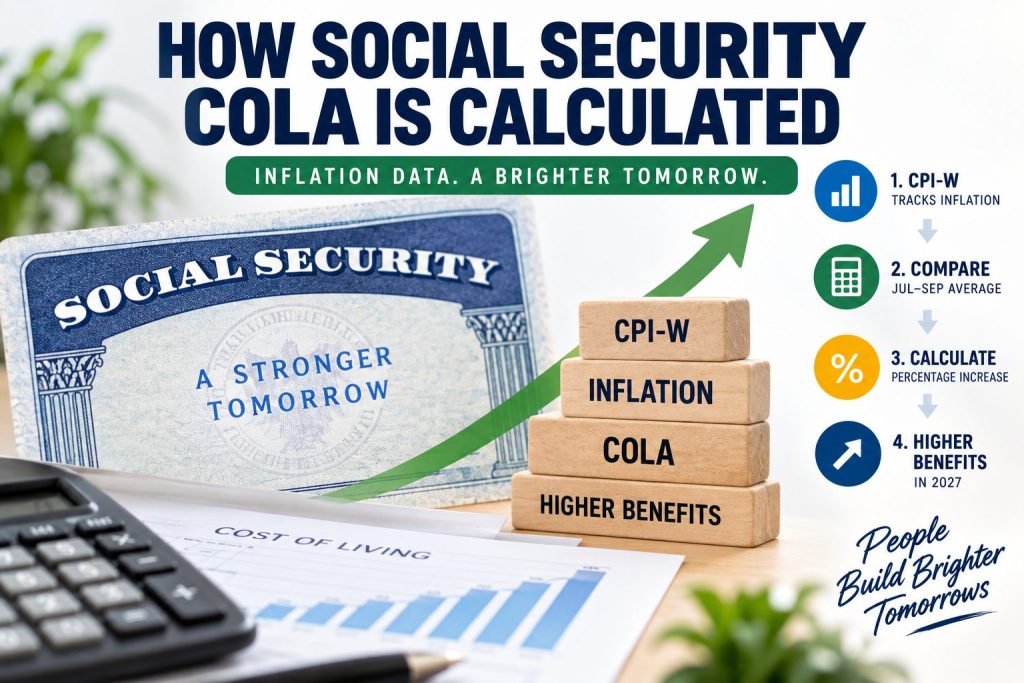
Social Security COLA calculation using CPI-W inflation data for 2027 benefits
Social Security’s annual cost-of-living adjustment, or COLA, is calculated using inflation data but not the headline inflation number most people see in the news.
The Social Security Administration uses the Consumer Price Index for Urban Wage Earners and Clerical Workers, or CPI-W, and compares the average index for July, August and September with the same third-quarter average used for the previous COLA.
For the 2027 Social Security COLA, two of the three inflation numbers are now available:
| Month | CPI-W |
|---|---|
| July 2026 | 327.104 |
| August 2026 | 328.481 |
| September 2026 | Not yet released |
The September CPI-W will provide the final piece of the calculation when the Bureau of Labor Statistics publishes September inflation data on October 14, 2026.
Current forecasts generally put the 2027 Social Security COLA in the 3.4% to 3.6% range, but no percentage is official yet.
How Does Social Security Calculate COLA?
The formula is surprisingly straightforward.
Social Security calculates the average CPI-W for July, August and September of the current year and compares it with the third-quarter average from the last year in which a COLA became effective.
The percentage increase is then rounded to the nearest one-tenth of 1%.
The official formula is:
COLA = [(Current Q3 CPI-W Average − Previous Q3 CPI-W Average) ÷ Previous Q3 CPI-W Average] × 100
The Social Security Administration confirms that CPI-W—not CPI-U, core CPI or the Federal Reserve’s preferred inflation measure—is the index required by law for the annual COLA calculation.
See the official Social Security COLA calculation method
The CPI-W Numbers Used for the 2027 COLA
The comparison period for the 2027 adjustment is the third quarter of 2025.
Those official CPI-W values were:
| Month | 2025 CPI-W |
|---|---|
| July | 316.349 |
| August | 317.306 |
| September | 318.139 |
| Q3 average | 317.265 |
Social Security used that 317.265 average when calculating the previous adjustment.
For 2026, BLS has now reported:
July CPI-W: 327.104
August CPI-W: 328.481
September remains unknown.
BLS reported that the August CPI-W was 3.5% higher than a year earlier and rose 0.4% from July before seasonal adjustment.
Read the latest BLS inflation report
What Would the 2027 COLA Be If Inflation Stopped Rising Now?
One useful way to understand the calculation is to assume the September CPI-W remains exactly equal to August’s 328.481.
The third-quarter average would then be:
(327.104 + 328.481 + 328.481) ÷ 3 = 328.022
Now compare that with the 2025 Q3 average of 317.265:
(328.022 − 317.265) ÷ 317.265 × 100 = approximately 3.39%
Under Social Security’s rounding rule, that would produce a:
3.4% Social Security COLA for 2027
That is only a mathematical scenario—not the official COLA—because the September CPI-W has not yet been released.
Could the 2027 COLA Be 3.5%?
Yes.
Because Social Security rounds to the nearest tenth of a percentage point, the final CPI-W does not need to increase dramatically for the result to move from 3.4% to 3.5%.
Based on the already published July and August readings, September CPI-W would need to be approximately 329.047 or higher for the calculation to reach the 3.5% rounding range.
That would require an increase of only about 0.17% from August’s CPI-W level.
So a 3.5% COLA remains entirely possible.
What Would It Take to Reach a 3.6% COLA?
For the formula to round to approximately 3.6%, September CPI-W would need to reach roughly:
329.999 or higher
That would represent an increase of about 0.46% from August.
This helps explain why current forecasts differ.
Some forecasters expect inflation to remain strong enough in September to push the COLA toward 3.5% or 3.6%, while others see a figure closer to 3.4%.
Recent estimates after the August inflation report have ranged from roughly 3.4% to 3.6%.
The September CPI-W—not the forecasts—will determine the final number.
Why August’s 3.4% Inflation Rate Does Not Equal the Social Security COLA
This is one of the most common sources of confusion.
BLS reported that the broad CPI-U increased 3.4% over the 12 months ending in August 2026.
That does not automatically mean the Social Security COLA will be 3.4%.
There are three important differences.
First, Social Security uses CPI-W, not the headline CPI-U.
Second, it uses an average of July, August and September, rather than a single month’s inflation rate.
Third, it compares that three-month average with the previous relevant third-quarter average rather than simply using the year-over-year inflation rate reported for September.
That is why headlines such as “inflation is 3.4%” cannot by themselves tell you the exact Social Security increase.
What Is CPI-W?
CPI-W stands for the Consumer Price Index for Urban Wage Earners and Clerical Workers.
It measures changes in the prices paid for everyday goods and services, including categories such as:
food,
housing,
energy,
transportation,
medical care,
clothing,
and other consumer expenses.
BLS says the CPI-W population represents approximately 30% of the U.S. population and is a subset of the broader CPI-U population.
Social Security law requires the CPI-W to be used for COLA calculations.
CPI-W vs CPI-U: What’s the Difference?
| Inflation measure | Main use |
|---|---|
| CPI-W | Social Security COLA |
| CPI-U | Headline U.S. consumer inflation |
| Core CPI | Inflation excluding food and energy |
| C-CPI-U | Chained consumer price measure |
The headline inflation number reported most frequently by the media is usually the CPI-U.
Social Security, however, specifically uses CPI-W.
This distinction matters because the two indexes can move at slightly different rates.
In August 2026, for example, BLS reported that CPI-U was up 3.4% year over year, while CPI-W was up 3.5%.
Why Did Inflation Rise in August 2026?
Energy was a major driver.
BLS reported that consumer prices rose 0.4% in August on a seasonally adjusted basis.
Gasoline prices increased 3.9% during the month, while the broader energy index rose 2.1%. Shelter increased 0.3%, while food rose 0.1%.
Gasoline alone accounted for more than one-third of the monthly increase in headline consumer prices.
Reuters also reported that inflation remained elevated in August as higher fuel prices pushed consumer costs upward.
For Social Security recipients, continued inflation during September could push the final COLA higher.
How Much Would a 3.4% COLA Increase Social Security Checks?
If the final COLA were 3.4%, the gross increase would depend on each person’s current benefit.
| Current monthly benefit | 3.4% increase | Estimated new benefit |
|---|---|---|
| $1,500 | $51 | $1,551 |
| $2,000 | $68 | $2,068 |
| $2,500 | $85 | $2,585 |
| $3,000 | $102 | $3,102 |
| $3,500 | $119 | $3,619 |
These are simple illustrations, not official benefit calculations.
A recipient’s actual payment can differ because of Social Security rounding rules, Medicare deductions, taxes, benefit type and other withholding.
For a broader look at retirement age, earnings limits, SSI and other upcoming changes, see our guide to 2027 Social Security benefit changes. 2027 Social Security Benefit Changes: COLA, Retirement Age and New Limits
How Much Was the Social Security COLA for 2026?
The official Social Security COLA for 2026 was 2.8%.
Social Security calculated that adjustment by comparing:
2024 Q3 CPI-W average: 308.729
with:
2025 Q3 CPI-W average: 317.265
The increase was approximately 2.8% after rounding.
That adjustment began with Social Security benefits payable in January 2026.
Approximately 75 million Social Security and SSI beneficiaries were covered by the 2026 adjustment.
Does Social Security Use Annual Inflation?
Not exactly.
Social Security does not calculate COLA by taking the inflation rate for the entire calendar year.
Only the CPI-W levels from the third quarter—July, August and September—are used in the comparison.
This means inflation earlier in the year can affect the level of prices entering the third quarter, but January-through-June CPI readings are not directly averaged into the COLA formula.
That distinction is important when interpreting early-year COLA forecasts.
What Happens If Inflation Falls?
A lower September CPI-W could reduce the final COLA compared with today’s forecasts.
However, Social Security does not reduce monthly benefits simply because prices fall during one month.
Under the statutory COLA formula, if the relevant third-quarter CPI-W average does not increase enough from the previous comparison period, there can be no COLA.
SSA explains that when there is no qualifying increase—or when the calculated increase rounds to zero—there is no COLA for that year.
When Will the 2027 Social Security COLA Be Known?
The critical date is:
October 14, 2026
BLS is scheduled to release the September 2026 Consumer Price Index report at 8:30 a.m. ET on that date.
Once the September CPI-W is available, all three third-quarter numbers will be known:
July 2026 — 327.104
August 2026 — 328.481
September 2026 — pending
The official COLA can then be calculated using the SSA formula.
When Would the 2027 COLA Affect Payments?
The COLA determined from 2026 inflation would apply to Social Security benefits beginning with the annual adjustment effective in December, with most beneficiaries seeing the higher amount in their January 2027 payment.
That follows the same structure used for the 2026 COLA, which became payable in January 2026.
Does Medicare Affect the COLA Calculation?
No.
Medicare premiums are not part of the COLA formula.
The COLA percentage is determined only from CPI-W.
However, many Medicare beneficiaries have their Part B premium deducted directly from their Social Security payments.
That means a higher Social Security benefit does not always translate into the same-sized increase in the amount deposited into a beneficiary’s bank account.
The gross COLA and the net payment should therefore be viewed separately.
Why Do Some People Want Social Security to Use CPI-E?
Some retirement advocates argue that CPI-W may not perfectly reflect the spending patterns of older Americans.
Retirees can devote a larger share of their budgets to areas such as health care, while CPI-W was designed around wage earners and clerical-worker households.
An alternative index known as CPI-E, which tracks spending patterns of older consumers, has periodically been proposed for Social Security COLAs.
But CPI-E is not the current legal formula.
Under current law, Social Security continues to use CPI-W. SSA’s actuarial office lists CPI-E-based COLA calculations among possible policy proposals rather than current law.
Social Security COLA Calculation FAQ
How is Social Security COLA calculated?
Social Security compares the average CPI-W for July, August and September with the corresponding third-quarter average used for the previous COLA. The percentage increase is rounded to the nearest tenth of 1%.
What CPI does Social Security use?
Social Security uses the Consumer Price Index for Urban Wage Earners and Clerical Workers, or CPI-W.
What is the latest 2027 Social Security COLA estimate?
Current forecasts after the August inflation report generally fall around 3.4% to 3.6%. The final percentage is not yet known.
Is the 2027 COLA officially 3.4%?
No.
A 3.4% result would occur if September inflation ends up in a range that keeps the quarterly calculation within the 3.4% rounding band. September CPI-W has not yet been released.
What were the July and August CPI-W numbers?
July 2026 CPI-W was 327.104, while August was 328.481.
When will September CPI-W be released?
The September CPI report is scheduled for October 14, 2026 at 8:30 a.m. ET.
What was the 2026 Social Security COLA?
The 2026 COLA was 2.8%.
Does Medicare determine Social Security COLA?
No. Medicare premiums can affect net Social Security checks, but they are not included in the CPI-W COLA formula.
Bottom Line
The Social Security COLA calculation is based on CPI-W inflation during July, August and September, not simply the headline inflation rate reported each month.
For the 2027 calculation, two crucial figures are already known:
July CPI-W: 327.104
August CPI-W: 328.481
The final number—September CPI-W—will be released on October 14, 2026.
If September remained at August’s level, the formula would produce approximately a 3.4% COLA.
A modest increase in September could push the result to 3.5%, while a stronger inflation reading could produce approximately 3.6%.
Until that final CPI-W reading arrives, every 2027 COLA percentage remains an estimate.